On Coolidge, Cleveland, Kipling, and Fish Stories

Courtesy of Fold3.com.

Cal, after the Presidency, indulging his love for fishing. Courtesy of Fold3.com.

“With worms you played more fairly with the trout. You offered him what he wanted most. You bet a worm and he wagered himself. If the trout lost, he usually had the worm, or most of it, not just a mouthful of deception to add bitterness to surrender. Fly-fishing, comparatively, was a cheap fraud in which the victim staked his all against an utterly inedible jigger that looked like something it wasn’t. The trout could not possibly gain anything; he could lose everything on nothing more estimable than vanity. The sole death-bed comfort he possibly could derive was the knowledge that he had been hooked by a purist. It is easy to understand why a politician might come to prefer flies” — Frederick Van de Water, In Defense of Worms and Other Angling Heresies (New York: Duell, Sloan and Pearce, 1949), pp.71-72.

“…[I]t perhaps adds to the spirit and emphasis of our dissent when we are told that fly-casting for trout is the only style of fishing worthy of cultivation, and that no other method ought to be undertaken by a true fisherman. This is one of the deplorable fishing affectations and pretenses which the sensible rank and file of the fraternity ought openly to expose and repudiate. Our irritation is greatly increased when we recall the fact that every one of these super-refined fly-casting dictators, when he fails to allure trout by his most scientific casts, will chase grasshoppers to the point of profuse perspiration, and turn over logs and stones with feverish anxiety in quest of worms and grubs, if haply he can with these save himself from empty-handedness. Neither his fine theories nor his exclusive faith in fly-casting so develops his self-denying heroism that he will turn his back upon fat and lazy trout that will not rise” — former President Grover Cleveland, “Some Fishing Pretenses and Affectations,” in Fishing and Hunting Sketches (New York: Outing Publishing, 1907), pp.122-123.
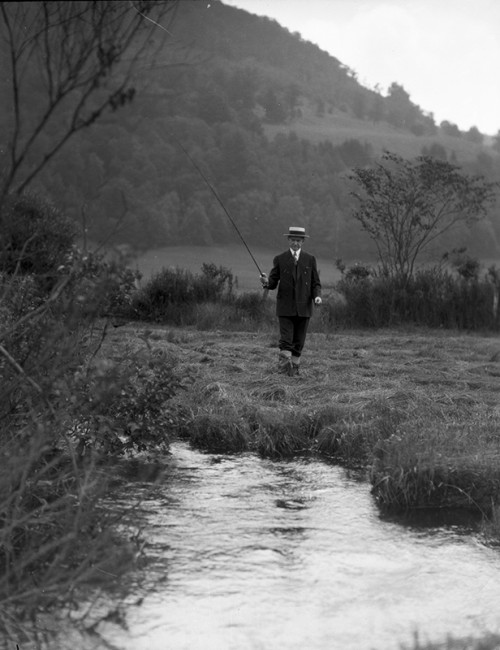
President Coolidge fishing one of his frequent spots.

President Coolidge fishing one of his frequented rivers. Courtesy of Yankee Magazine.

When it was discovered that the President used worms rather than flies when he went fishing in the Adirondacks, as he had done all his life, some “professional” fly-casters were appalled. It should be beneath the dignity of the President, they huffed. A few among the press even encouraged the sensationalism with stories recounting this supposed affront to the sport of fishing. Coolidge and his regular fishing partner, Secret Service man Edmund Starling (who introduced Cal to fly-fishing), knew better, as did most of those who practiced the noble sport. It was much ado about nothing for anyone aware of the joy and challenge found along countless streams, rivers and waterways. Bait fishing was the sport at its most fundamental, removed of all pretense or snobbery. It relied not on the sophistication of equipment or the scientific precision of the caster but on the simple gambit that occurs whenever human nature matches wits with fish. Through bait fishing, the challenger swimming at the other end of that line and rod was rewarded not with empty promises or mere guile and deception but with a return for its efforts, should it elude capture. This showed a natural respect for the fish as well as a human’s place in nature. Surrounded in the majesties of the outdoors, it only made common sense for men who lived simply, as Coolidge did, free of ostentation, vanity or the need to impress others, to fish consistently with that manner of life. It lived in step with nature not against it. Just as Frederick Van de Water and Grover Cleveland put it, the fly-caster may look down on bait fishing but when the best cast fails and the fish refuse to fall for the fly, all default to good bait. The simple forthrightness of this truth strips the veneer off a politician’s guarantees just as effectively as a fly-caster’s attitude of superiority over his method.
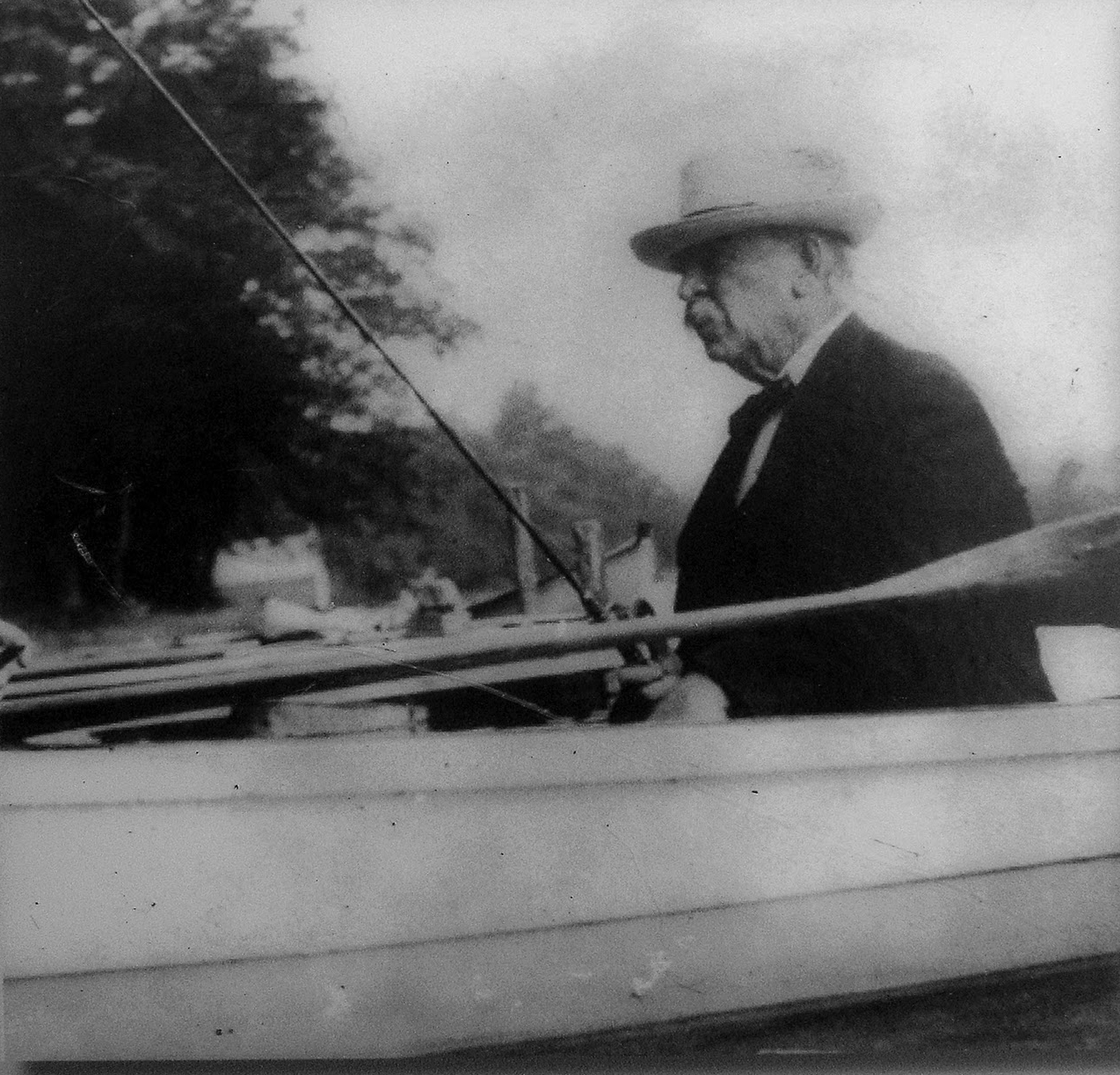
Former President Cleveland fishing one of his favorite spots.

Former President Cleveland fishing one of his favorite spots.

Mrs. Coolidge, in her Autobiography, recounts three favorite memories of her husband’s fishing experiences, the first of which revealed Mr. Coolidge’s previously untapped fascination with the art and sport. It started the summer of 1926 in the Adirondacks. She writes, “It was here that the President took up the serious business of fishing, and with the success which usually attends his efforts, for we served a fish course at luncheon every day.” Sometimes in search of pike or pickerel, he usually went fifteen miles away in the quest for trout. “Enthusiasm for the sport had so taken hold of him that at the close of the fishing season he was reluctant to give it up. He scanned the New York State fish and game laws and learned that while fishing was not permitted in the county in which we were living after the first of September, it was not prohibited in the adjoining county until Labor Day, a fact which was not known to the guide or to the caretaker of the camp, himself an ardent sportsman.” Here it was beneficial to know the gaming laws better than the experts did.

Her second favorite memory unfolded the next year as they stayed at the Game Lodge in the Black Hills of South Dakota. She narrates, “The President took a second summer course in fishing, which resulted in increasing skill. A kind neighbor gave him the exclusive privilege of fishing in a stream which ran through his farm, and many a delicious trout did he bring home for the family dinner. There was one experienced old fellow living in a certain hole, which he tried to attract with every sort of alluring bait, but the finny creature proved wary until in an unguarded moment, on the last day of fishing, curiosity got the best of him and he rose to investigate a salmon egg sandwiched between two worms, only to find himself impaled upon an ugly hook.”
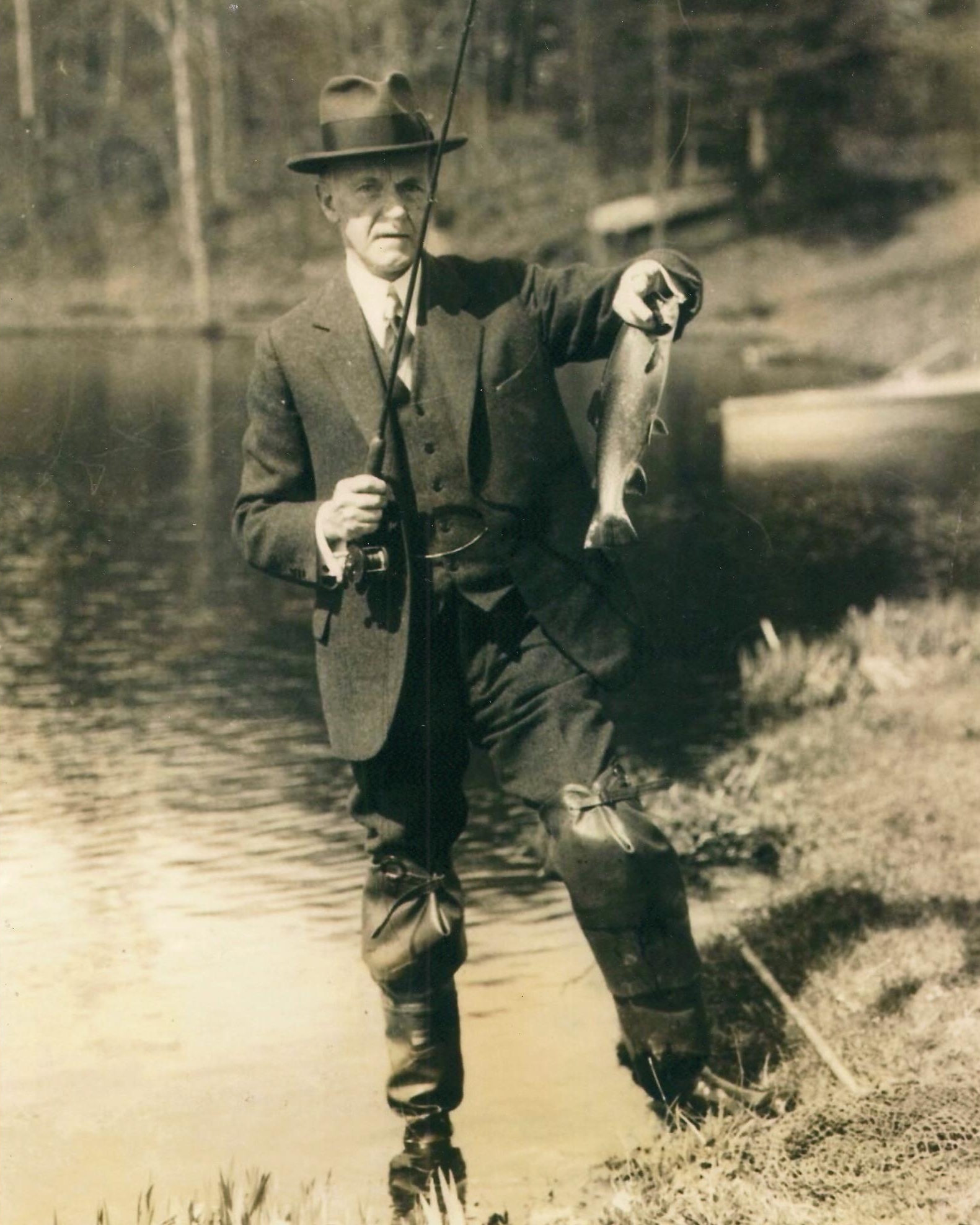
Coolidge held scrupulously to accurate fish stories. He made a point of displaying what he had caught, even documenting it for verification. Here he holds his latest catch up for visual confirmation.

Coolidge held scrupulously to accurate fish stories. He made a point of photographing what he had caught in order to have visual verification. Here he holds his latest catch up for confirmation.

Her third memory came in their last summer before leaving the Presidency, as they stayed on the Brule River in Wisconsin. Their cottage, located on a small island, was accessible from a roughly hewn wooden bridge that spanned the two shores. It was underneath that bridge where President Coolidge met his toughest challenge yet, among “several large trout who were rather tame and looked to us for their daily food consisting of crumbs from the table.” A particular trout, a “very greedy one” (in Grace’s words) was named by the President. He called him ” ‘Danny Deever’ — ‘for,’ said he, ‘I’ll hang him in the morning.’ ” Referencing Kipling’s popular 1890 poem, Coolidge relished not only the play on words but also the dramatic personification of his piscatorial nemesis, as any admirer of literature can appreciate. In the trout’s case, despite repeated efforts to lure him up with “pretty flies” (notice Coolidge was no purist theoretician, using flies and bait as circumstances warranted), Grace kept Danny fed so well that the “hangin’ in the mornin’ ” never took place.
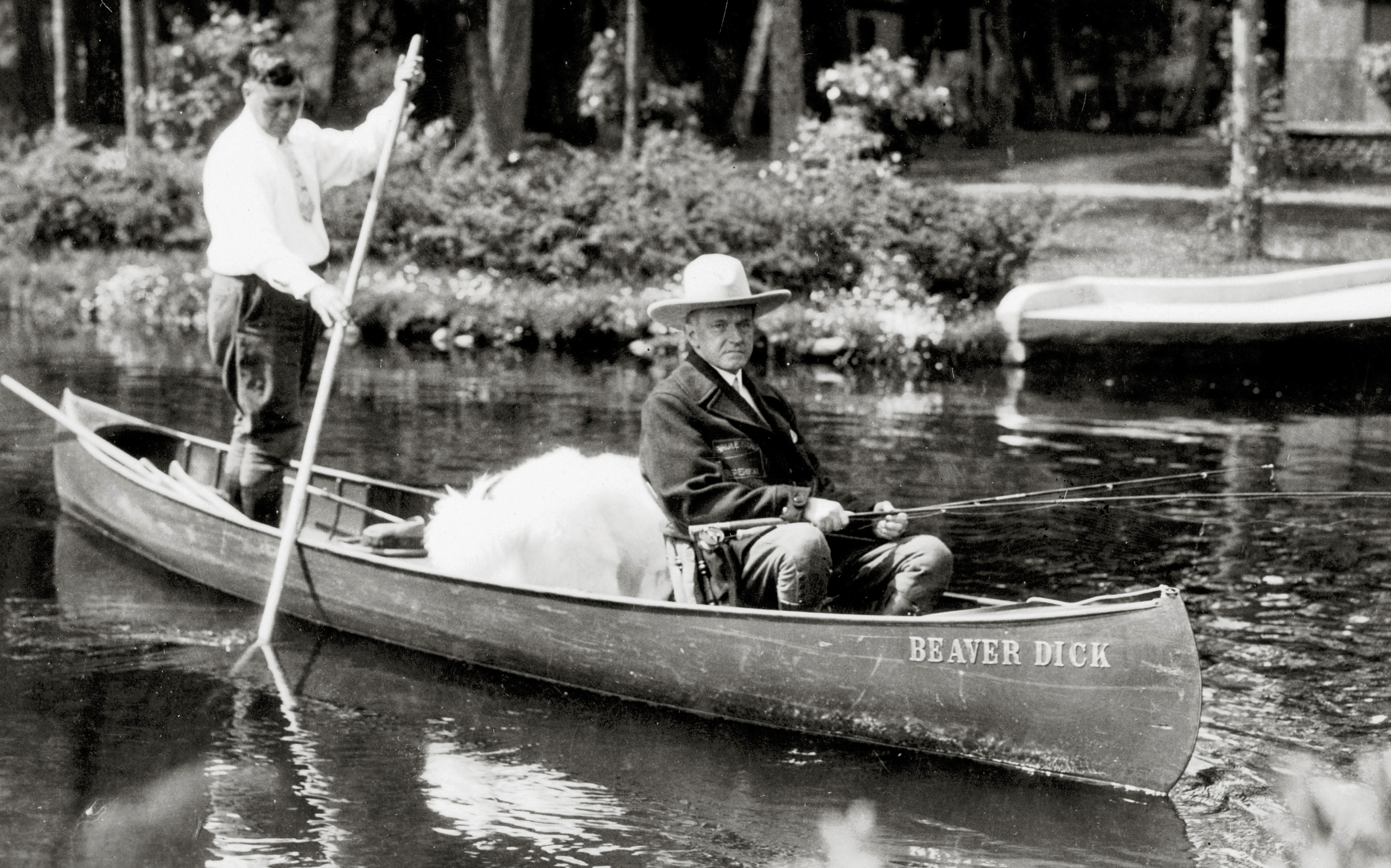
Coolidge, his dog Rob Roy, and his Brule River guide, John LaRock, 1928.

Coolidge, his dog Rob Roy, and his Brule River guide, John LaRock, 1928.

One wonders how many more fish stories might have been told had time and opportunity allowed Mr. Coolidge and his friend Starling to go on that great cross-country fishing expedition they had planned. One thing is sure: Cal would have brought the worms.
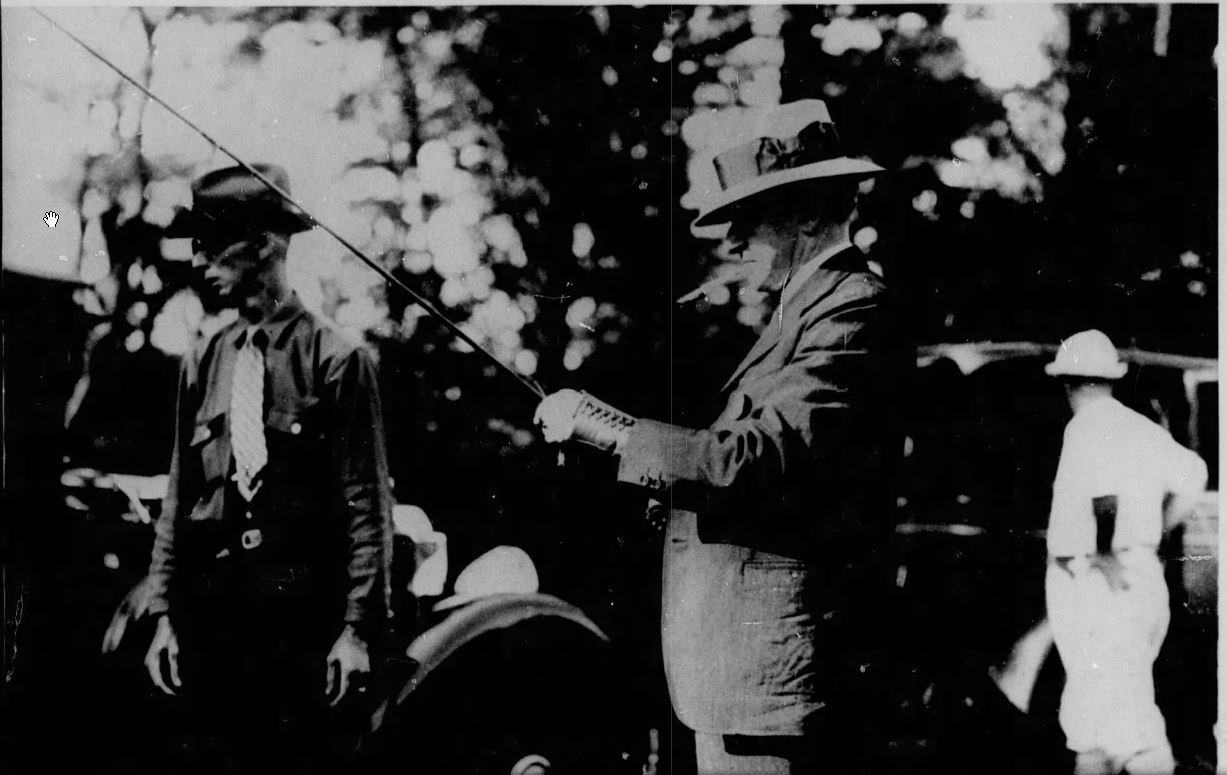
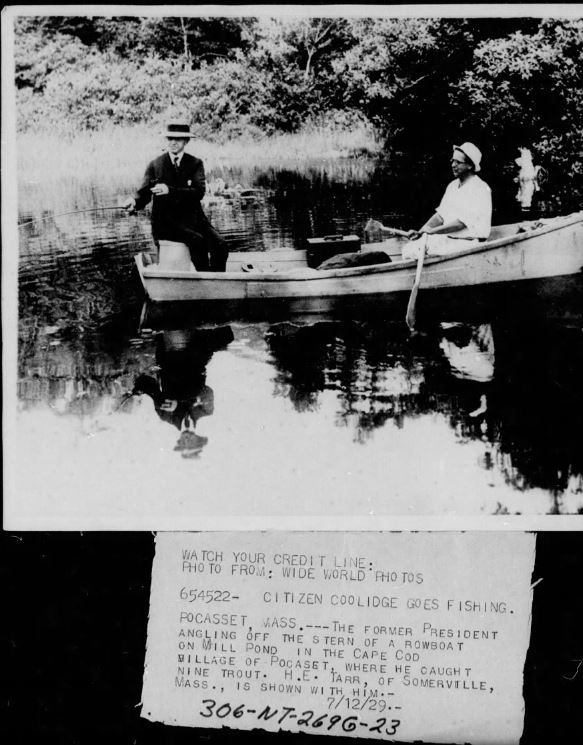
Coolidge preparing for trout, July 19, 1929.

Coolidge preparing for trout, July 12, 1929. Notice the wrist brace: He had sprained it earlier that year.

On Our Religious Foundations

President and Mrs. Coolidge look upon Plymouth Rock.

President and Mrs. Coolidge look upon Plymouth Rock.

Looking back to first the Protestant Reformation of the sixteenth century and then the Great Awakening during the eighteenth century, Calvin Coolidge pinpointed in 1923 what gave rise to the greatest political revolution in history, the creation of a constitutional Republic we know as the United States of America, “It was because religion gave the people a new importance and a new glory that they demanded a new freedom and a new government. We cannot in our generation reject the cause and retain the result.” It was not the ideological offspring of the Crusades — to do violence and conquer in the name of Christ, as the Old World had done for centuries. Rather, its lineage came from the call to return to New Testament Christianity, the love of neighbor and a reclamation of selfless service restored to its proper place of preeminence.

Coolidge would explain this sustaining impact of Christian principles in his Third Annual Message, December 8, 1925, “A spring will cease to flow if its source be dried up; a tree will wither if its roots be destroyed. In its main features the Declaration of Independence is a great spiritual document. It is a document not of material but of spiritual conceptions. Equality, liberty, popular sovereignty, the rights of men–these are not elements which we can see and touch. They are ideals. They have their source and roots in the religious convictions. They belong to the unseen world. Unless the faith of the American people in these religious convictions is to endure, the principles of the Declaration will perish. We can not continue to enjoy the result if we neglect and abandon the cause.”

As if to drive the point home, to define what he meant by Christ’s impression on American foundations, President Coolidge also once said, “Our government rests upon religion. It is from that source that we derive our reverence for truth and justice, for equality and liberty, and for the rights of mankind. Unless the people believe in these principles they cannot believe in our government. There are only two main theories of government in the world. One rests on righteousness, the other rests on force. One appeals to reason, the other appeals to the sword. One is exemplified in a republic, the other is represented by a despotism.”

Whatever despicable things our leaders may claim Americans are, we are not the children of the bloody Crusades. We are the sons and daughters of that which came later, the Great Awakening that stirred a conscience to God, revived a heart to walk humbly, and renewed a sense of our duty to do what is just one to another. Those who originally came here resolved for the first time in human experience, to build upon the firmest foundations ever known, the bedrock of Christian faith and reason, instead of the haphazard prejudices, arbitrary power, and vainglorious ambition they had known in the world they were physically and spiritually leaving behind. Those men and women of that day chose religious liberty at severe personal risk of all they had, even life itself, to stand before God with clear conscience not beholden to any man’s claim that he possessed mastery of their souls. In the end, they chose life, not death, and sought something more than a material advantage in new surroundings, they were seeking a better country, a heavenly one. This, not the avarice of Pope Urban’s Holy War, formed the foundation of America. That summons not a call to be ashamed and disgraced by our nation’s founding but to be honored and thankful.

On the Strength of Our Constitution: A Reminder That We Are All In This Together to Make America Succeed

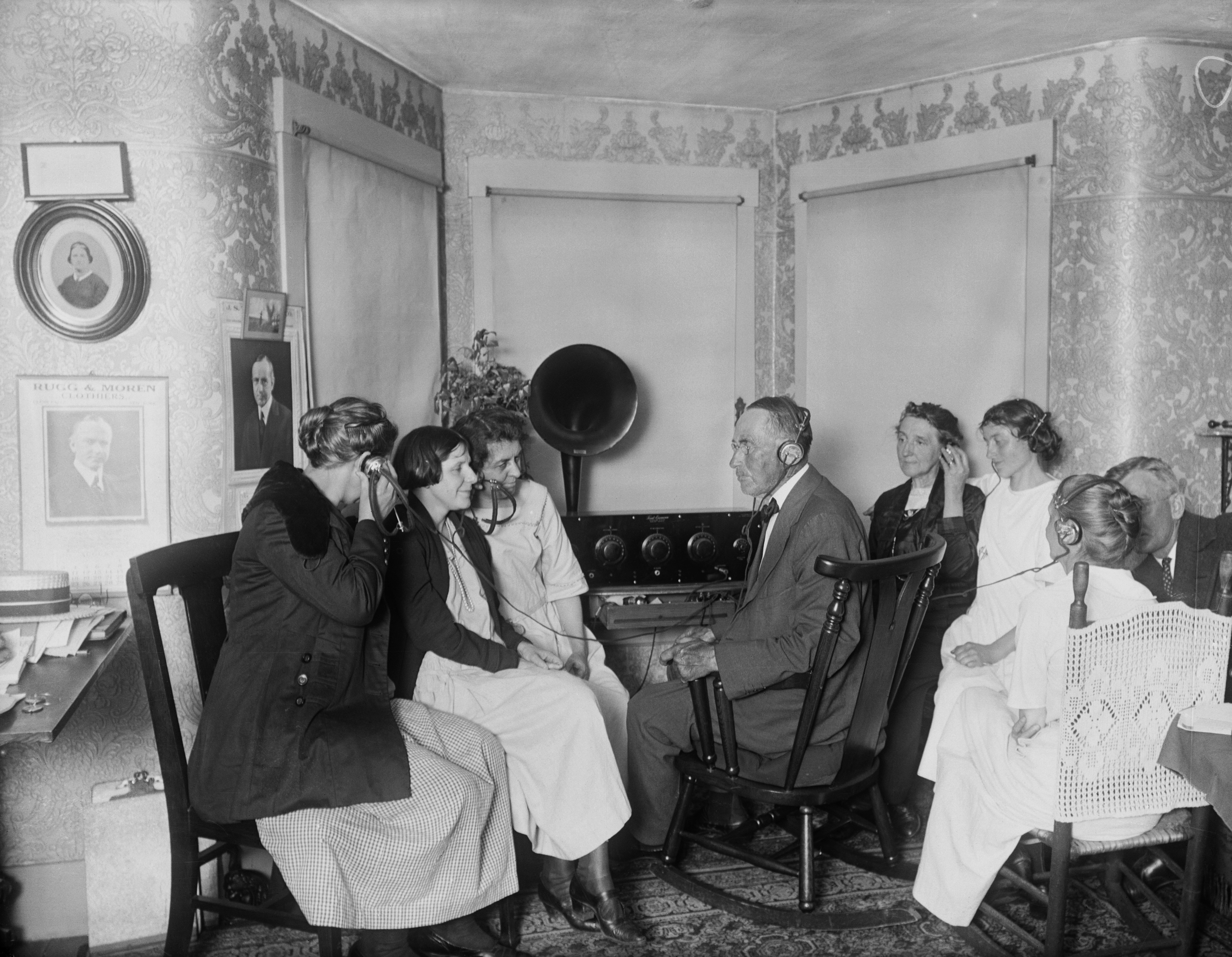
Colonel Coolidge with several Plymouth neighbors listening in as Calvin Coolidge delivers his acceptance speech around 8PM on August 14, 1924.

Colonel Coolidge, with several Plymouth neighbors, listening in as Calvin Coolidge delivers his acceptance speech around 8PM on August 14, 1924.

“While we are discussing some of the problems of the day, some of the changes we propose to meet temporary conditions, it is also well to remember that it is equally necessary to support our fundamental institutions. We believe in our method of constitutional government and the integrity of the legislative, judicial, and executive departments. We believe that our liberties and our rights are best preserved, not through political, but through judicial action. The Constitution is the sole source and guaranty of national freedom. We believe that the safest place to declare and interpret the Constitution which the people have made is in the Supreme Court of the United States.

“We believe the people of the Nation should continue to own the property and transact the business of the Nation. We harbor no delusions about securing perfection. We know that mankind is finite, and will continue to be under any system. But that system is best which gives the individual the largest freedom of action, and the largest opportunity for honorable accomplishment. Such a system does not tend to the concentration of wealth but to the diffusion of wealth. Under our institutions there is no limitation on the aspirations a mother may have for her children. That system I pray to continue. This country would not be a land of opportunity, America would not be America, if the people were shackled with government monopolies.

“Under our institutions success is the rule and failure is the exception. We have no better example of this than the enormous progress which is being made by the Negro race. To some of its individuals it may seem slow, toilsome, and unsatisfactory, but viewed as a whole it has been a demonstration of their patriotism and their worth. They are doing a great work in the land, and are entitled to the protection of the Constitution and the law. It is a satisfaction to observe that the crime of lynching, of which they have been so often the victims, has been greatly diminished, and I trust that any further continuation of this national shame may be prevented by law. As a plain matter of expediency the white man can not be protected unless the black man is protected, and as a plain matter of right law is law and justice is justice for everybody.

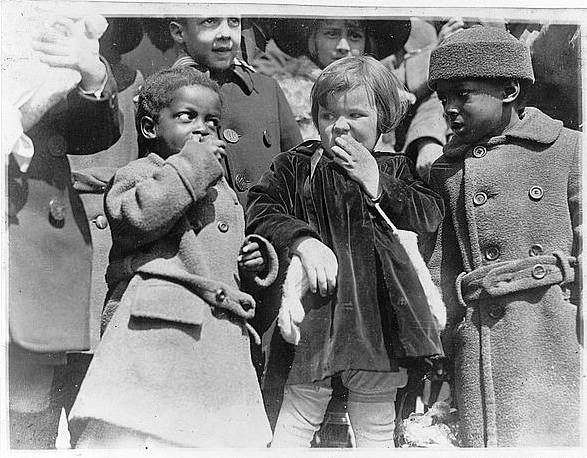
Children at the White House Easter Egg Rolling, or rather, Eating, as Mrs. Coolidge would later describe these annual gatherings in her Autobiography, p.75.

Children at the 1923 White House Easter Egg Rolling, or rather, Egg-Eating Contest, as Mrs. Coolidge would later describe these annual gatherings in her Autobiography, p.75.

President Coolidge at Cabin Bluff with the "spiritual" singers of Georgia Industrial College.

President Coolidge at Cabin Bluff with the “spiritual” singers of Georgia Industrial College, Winter 1928.

“…We are likely to hear a great deal of discussion about liberal thought and progressive action. It is well for the country to have liberality in thought and progress in action, but its greatest asset is common sense. In the commonplace things of life lies the strength of the Nation. It is not in brilliant conceptions and strokes of genius that we shall find the chief reliance of our country, but in the home, in the school, and in religion. America will continue to defend these shrines. Every evil force that seeks to desecrate or destroy them will find that a Higher Power has endowed the people with an inherent spirit of resistance. The people know the difference between pretense and reality. They want to be told the truth. They want to be trusted. They want a chance to work out their own material and spiritual salvation. The people want a government of common sense.

“These, Mr. Chairman, are some of the beliefs which I hold, some of the principles which I propose to support. Because I am convinced that they are true, because I am satisfied that they are sound, I submit them with abiding faith to the judgment of the American people” — President Calvin Coolidge, speech formally accepting the Republican nomination for President, up for election in his own right that fall, before more than 2,000 packed into Memorial Continental Hall in Washington, D.C., August 14, 1924.

The message was also carried via nationwide radio broadcast, reaching some estimated 25 million, many of whom enjoyed their first “listen in” to the President, led by WEAF out of New York and fourteen other stations across the country, including WCAP (Washington); WJAR (Providence); WMAS (South Dartmouth, MA); WNAC (Boston); WBDH (Worcester); WGY (Schenectady); WGR (Buffalo); KDKA (Pittsburgh); WTAM (Cleveland); WSAI (Cincinnati); WGN (Chicago); WMAQ (Chicago); KSD (St. Louis); and WDAF (Kansas City).

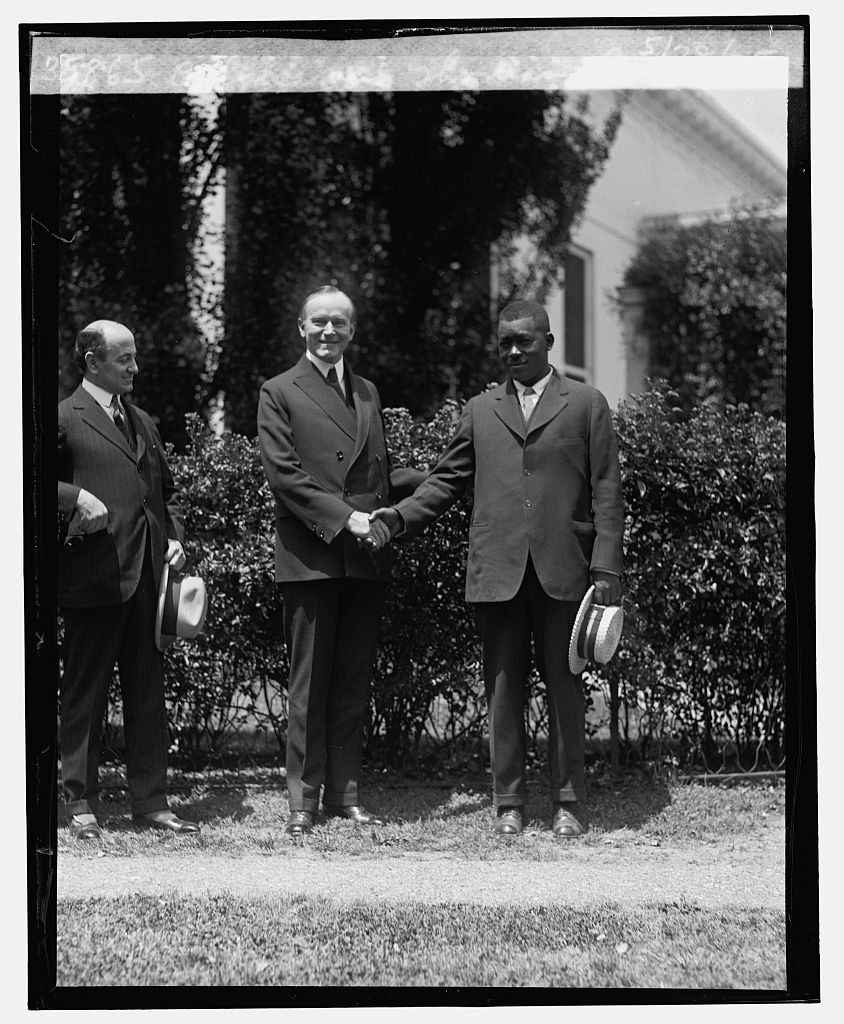
President Coolidge visits with Mr. Thomas Lee at the White House, May 28, 1925. Mr. Lee was recognized for his heroic efforts rescuing those endangered when a steam vessel capsized suddenly on the Mississippi River. Courtesy of the Library of Congress.

President Coolidge visits with Mr. Thomas Lee at the White House, May 28, 1925. Mr. Lee was recognized for his heroic efforts in saving 32 lives when a steam vessel capsized suddenly on the Mississippi River near Memphis. Courtesy of the Library of Congress.