On Civilizations

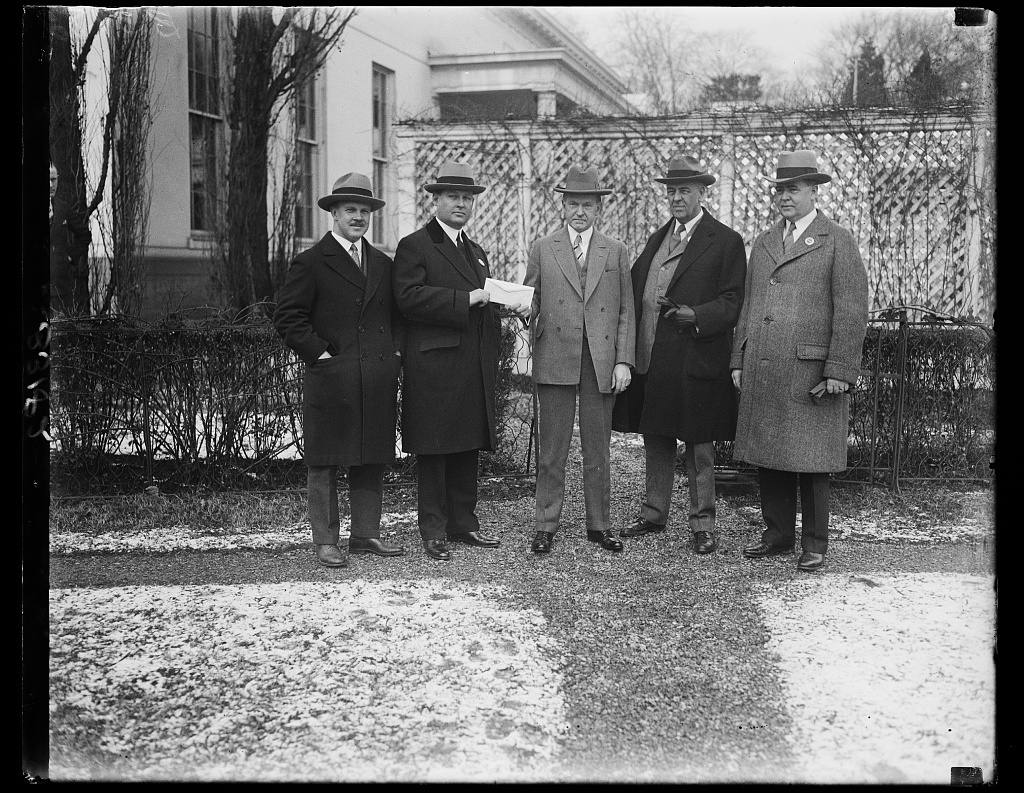
President Coolidge donating to the community chest for Washington, D. C., January 1, 1929. L to R: Elwood Street, Robert V. Fleming, Coolidge, Frederick A. Delano, and John Poole. Photo credit: Library of Congress.

“Who can say that there is any keener intellect now than that which made the civilization at the confluence of the Tigris and Euphrates, with its transportation, banking, commerce, and public laws five thousand years ago, or raised the pyramids, or wrote the Iliad, or wrought the wondrous forms of beauty in art and literature that have come down from ancient times? So near as we can read it, the history of the world has been alternate light and shadow, in which dark ages have followed golden ages. There have been eras which shine forth with great brilliancy through multitudinous records, and other eras notorious by the absence of recorded achievements. The old saying that there are but three generations from shirt-sleeves to shirt-sleeves, has had its counterpart in the history of nations. A people gather, grow strong under adversity, weaken under prosperity, and fall, first victims of weakness within and then victims of strength without. No one can deny this. Nor need it unduly alarm us. The American theory of society is founded in part on this condition…We need not feel that therefore there has been and will be no progress…The increase of knowledge, the development of science, have only given society new weapons with which it is possible for civilization to commit suicide. So far as we can see that happened time and again in the ancient world…Lands under the oppression of despotism crumbled, even if their allies won. Lands under the inspiration of freedom remained firm, enduring to the end. Neither shall we know by how wide a margin the cause of that civilization we represent, under the most tremendous shock that ever shook the world, yet survived. The great fact is that so far it has survived. It is ours to say whether it shall survive.” (‘The Power of the Moral Law’ by Calvin Coolidge, addressing the Community-Chest Dinner, Springfield, Massachusetts, October 11, 1921)

A Review of Troy Senik’s “A Man of Iron: The Turbulent Life and Improbable Presidency of Grover Cleveland”

At last, here is the book I wanted to read on Grover Cleveland. It was, unbeknownst to me, underway while I was working on ‘The Cleveland Reader,’ with the same desire to see ‘Grove,’ inexplicably marginalized as he has been over the last seventy years, restored to a deserved place of honor among Presidents. Any biography since Nevins’ masterpiece, A Study in Courage (and his collection of Cleveland’s Letters), labors in the protective shadows of the scholar’s initial efforts. However, Mr. Senik’s biography has done what all excellent biographers should do: elucidate the era in which the subject lives, both capable of sympathizing with his strengths and ably critiquing his weaknesses. He has demystified the Gilded Age for those who find Cleveland’s America a perplexing, even alien, world. It remains one of the most unstudied periods of U. S. history. The service rendered by Mr. Senik to guide readers through the tariff, pensions, civil service reform, election processes, and foreign policy equips even the novice with a confidence that post-Reconstruction America is not an intimidating, mapless wilderness but a country now known to us. His early mention of Cal Coolidge gave us hope that he would come back to Cal in the Afterword, itself a superb essay on why Cleveland has fallen in estimation and why he ranks higher than popular consciousness places him. Mr. Senik did not go back to connect Coolidge, however, at the end of his book and yet that is one small flaw in an otherwise superlative work. Cleveland was that anomaly of defiant honesty and self-sacrificing obligation that makes him an instant statesman, struggling to descend to common politician. It was against his nature. Nevertheless, this ‘man of iron’ can continue to inform our public discourse and enrich our political future, if we dare to partake of even an ounce of his courage and character.

Happy 151st Birthday, Mr. Coolidge!

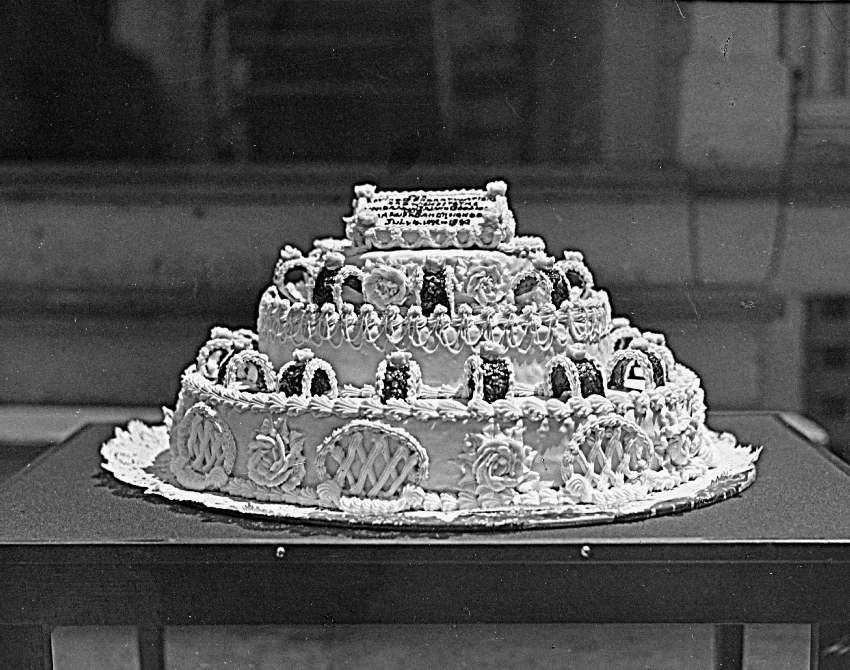
Six employees of the famous Dugan Brothers Bakery in New York arrive to present the larger of two elaborately designed birthday cakes delivered on July 3, 1929 to commemorate Calvin Coolidge’s birthday on the following day, July 4. The second cake with pink, green, and white candles, lovingly crafted and carefully shipped by Lee Ping Quan (the former cook aboard the USS Mayflower) and his restaurant staff out of New York City, joined a 24-pound Canadian salmon and hundreds of birthday wishes from all over the country. The former President, noting that the three reporters who came to call on the 5th of July looked hungry, cut them huge slices with a steak knife during their visit. Photo credit: Forbes Library.

Dugan Brothers Bakery, long renowned for its delectable pastries, breads, cakes, and other home-delivered offerings, also brought (in addition to the massive 2 foot+ diameter cake pictured here) large bouquets for Mrs. Coolidge and private secretary Miss Mae Hayes along with this wonderfully kind note:

“Honorable Calvin Coolidge, our dear friend and neighbor:

“Our high regard for you makes it a great honor and delight to bring you our loving congratulations and wishes and to present to you this humble gift in the name of our co-workers and the firm. It has been a great help, blessing, and satisfaction from time to time to muse on your lessons of moderation, frugality, and all else that is right for time and eternity. Your fine example has given greatly added weight to your precepts. We have always felt you were near to the lowly. This has relieved us from the embarrassment and timidity in this happy journey from Long Island. Having absolute confidence in you with affectionate regard, naturally takes you to our hearts with the beloved Washington and Lincoln. Our affection for you will continue past the dawn of the ‘perfect day.’

“In sincerity your friends, our co-workers, and ourselves.”

Happy 151st Birthday Mr. Coolidge!