On Keeping Perspective

6193346898_78dbff35d4_b working in Plymouth

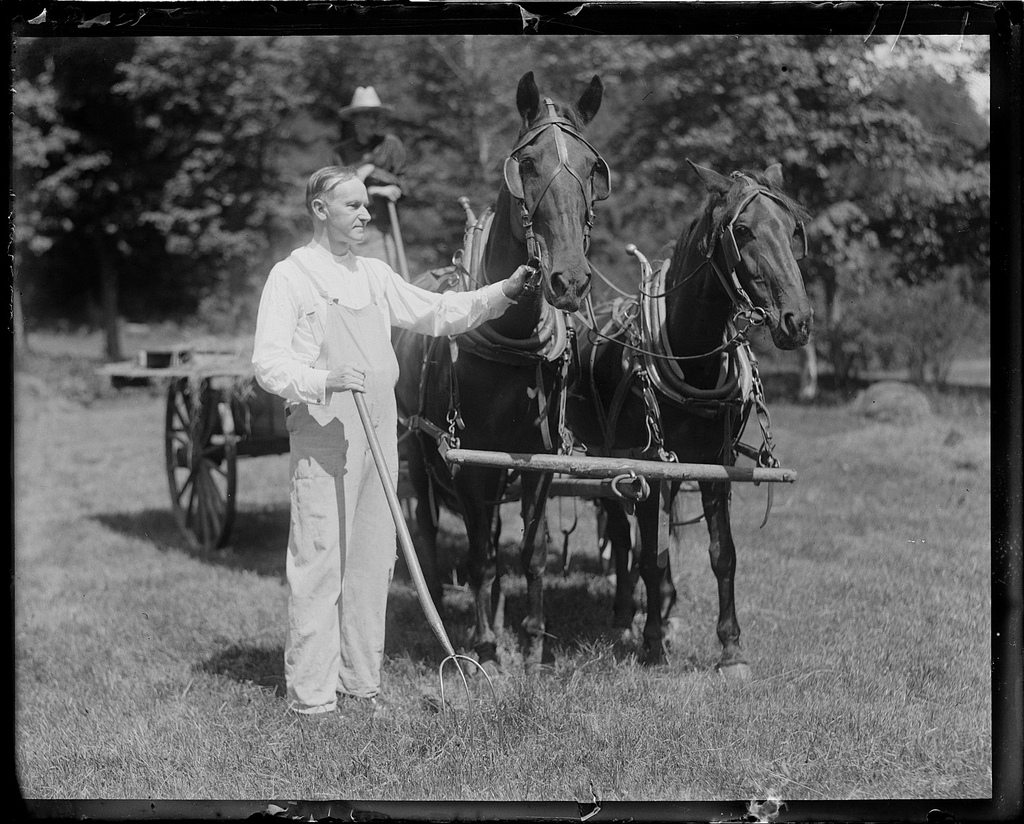
“I hope you all enjoyed your stay over in Vermont. I find it is helpful to me to go back once in a while to see that I am not forgetting how people earn their living, how they are required to live, and what happens when those who have harness breaks, or one of their shoes need some repairing, sit down and mend it. You can go out and do work on fences, do such odd jobs as are necessary to keep the house in repair, and in general do such things as are necessary for the ordinary American citizen to do. There is always a little danger that those who are entrusted with the great responsibilities of business and Government may come to forget about those things and disregard them and lose the point of view of the great bulk of citizens of the country who have to earn their living and are mainly responsible for keeping their houses, farms and shops in repair and maintaining them as a going concern. I find it very helpful to go back and revive my information about those things, lest I should be forgetful about it and get out of sympathy with those who have to carry on the work of the nation” — President Calvin Coolidge to the press, August 10, 1926 (The Talkative President, Eds. Quint and Ferrell, Amherst: University of Massachusetts Press, 1964, pp.46-7).

Happy Presidents Day!

6193348020_ca6a2a22b3_b Gov CC aint afraid of work on Arbor Day

On Missing his Father

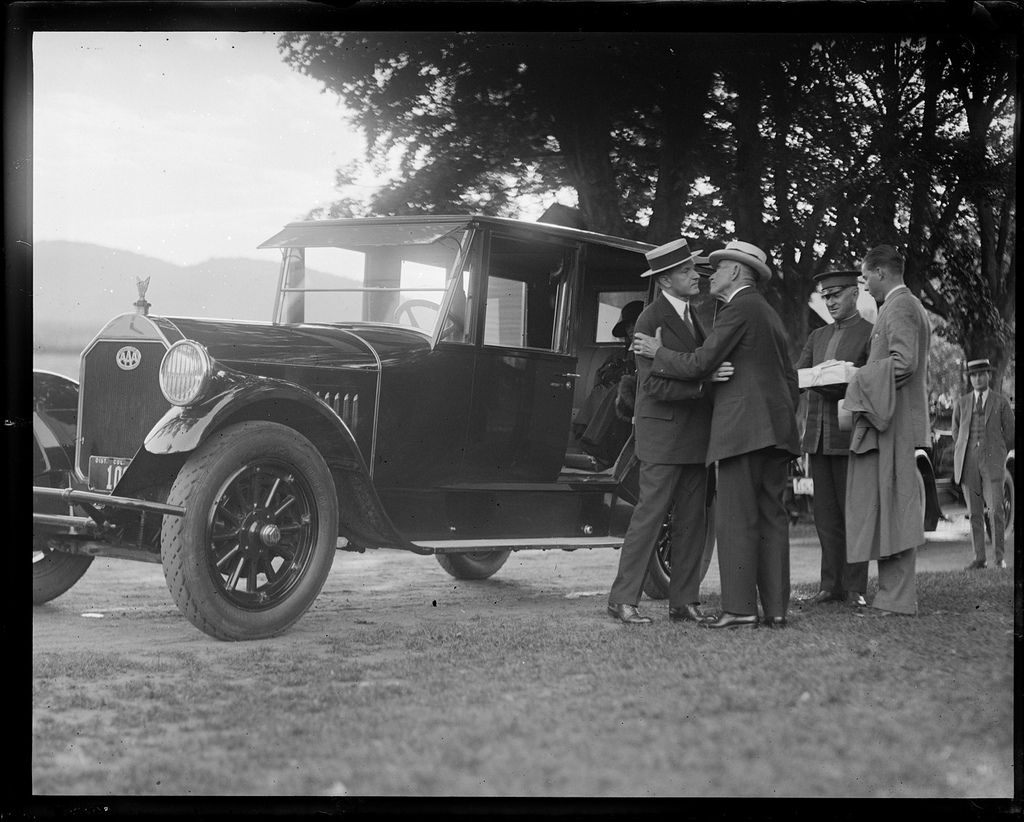
President Coolidge saying goodbye to his father, John. Courtesy of the Leslie Jones Collection.

President Coolidge saying goodbye to his father, John. Courtesy of the Leslie Jones Collection.

Reflecting deeply on the man whom he sought to make proud all of his life, the man who was closest to him from the beginning, the “Colonel” who took him along as a young boy in the performance of the older man’s official responsibilities throughout Plymouth and the surrounding area, the President writes a very touching passage in his Autobiography. The man who trained, disciplined and loved him – Calvin’s father – summoned an especially poignant tribute from the President, whose eloquence pervades his memoirs. Coolidge writes, “At his advanced age he had overtaxed his strength receiving the thousands of visitors who went to my old home at Plymouth. It was all a great satisfaction to him and he would not have had it otherwise. When I was there and visitors were kept from the house for a short period, he would be really distressed in the thought that they could not see all they wished and he would go out where they were himself and mingle among them. I knew for some weeks that he was passing his last days. I sent to bring him to Washington, but he clung to his old home. It was a sore trial not to be able to be with him, but I had to leave him where he most wished to be. When his doctors advised me that he could survive only a short time I started to visit him, but he sank to rest while I was on my way. For my personal contact with him during his last months I had to resort to the poor substitute of the telephone. When I reached home he was gone. It costs a great deal to be President.”1

In Memory of Danny Laverne Wright (February 8, 1955-January 18, 2015)

10872811_10205963980197421_2176076675940385600_o

1 The Autobiography of Calvin Coolidge, New York: Cosmopolitan Book Corporation, 1929, pp.192,194.

On Bigotry

CC portrait by Underwood 001

“Our country has many elements in its population, many different modes of thinking and living, all of which are striving in their own way to be loyal to the high ideals worthy of the crown of American citizenship. It is fundamental of our institutions that they seek to guarantee to all our inhabitants the right to live their own lives under the protection of the public law. This does not include any license to injure others materially, physically, morally, to incite revolution, or to violate the established customs which have long had the sanction of enlightened society.

But it does mean the full right to liberty and equality before the law without distinction of race or creed. This condition can not be granted to others, or enjoyed by ourselves, except by the application of the principle of broadest tolerance. Bigotry is only another name for slavery. It reduces to serfdom not only those against whom it is directed, but also those who seek to apply it. An enlarged freedom can only be secured by the application of the golden rule. No other utterance ever presented such a practical rule of life” — President Calvin Coolidge, Third Annual Message, December 8, 1925 (Supplement to The Messages and Papers of the Presidents, p.9537).


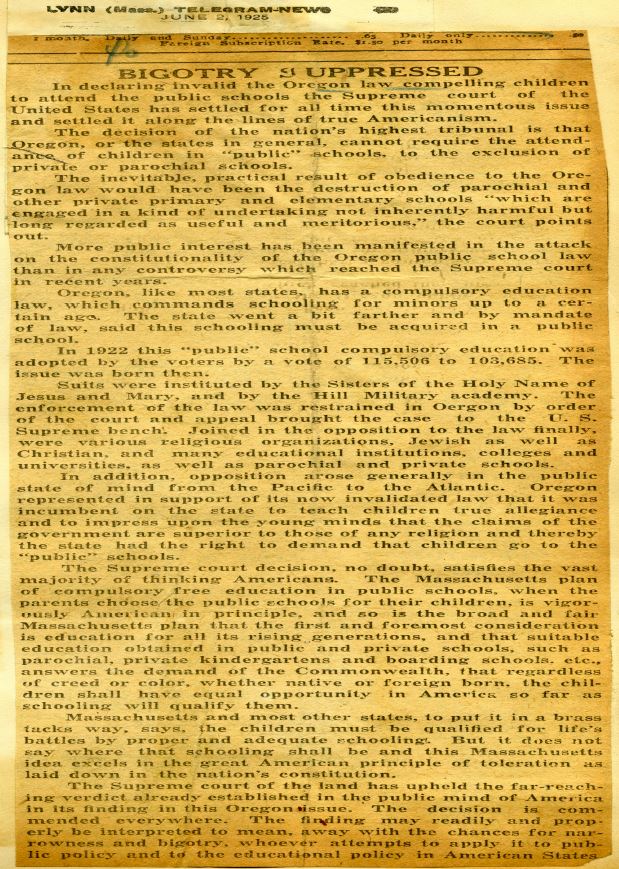
News piece appearing in the Lynn Telegraph-News from the same year as Coolidge's words here.

News piece appearing in the Lynn Telegraph-News from the same year as Coolidge’s words above. Courtesy of the Catholic University of America.