
Calvin Coolidge, November 1921
It is interesting to note that a number of states are considering a significant, and I would add, overdue change to the funding of education — giving the funds to parents. This raises the question of what would Coolidge think? We do not have to wonder very much, he told us.
When President Coolidge took up his predecessor’s call for a Cabinet-level Department of Education, he did not envision the pervasive reach of Washington into the daily operation, assignment of students, selection of curricula or the countless ways in which dollars from the Public Treasury purchase increasingly centralized control. In fact, he made it clear he opposed such a development. All these concerns were the responsibility of each state and local district unhampered to innovate, tailor its work to the needs of the students, parents and neighborhood, freed to not simply relate trivia but instill character and what made good citizenship. What he had in mind was not the current federal Department of Education, but rather a kind of information desk, where Americans all across the country could go to learn better methods, teaching techniques, and obtain help through the insight of others’ experiences in order to facilitate not the needs of Government but for Government to serve the needs of its employers, the American citizen and payer of taxes. This dovetailed with his belief in a Constitutional amendment to restrict child labor which, after approval by the Congress, fell short of the necessary two thirds of the states for ratification. Coolidge was not endorsing indolence among children, he pressed for both measures so that kids would not be forced to work the factories, mills and offices for their families, when they could instead be capitalizing on opportunities to educate themselves and thereby become better men and women, improved employers and employed, and more prepared for the work of tomorrow. While most of the country did not agree with either of his positions, however prescient his proposals were, most saw little harm coming from children learning a work ethic from early age, as his own boys did, Coolidge had a principled basis for his position.
He explained his views this way before the Convention of the National Education Association as it met in Washington, July 4, 1924,
“The encouragement and support of education is peculiarly the function of the several states. While the political units of the district, the township, and the county should not fail to make whatever contribution they are able, nevertheless, since the wealth and resources of the different communities vary, while the needs of the youth for education in the rich city and in the poor country are exactly the same, and the obligations of society toward them are exactly the same, it is proper that the state treasury should be called on to supply the needed deficiency. The state must contribute, set the standard, and provide supervision, if society is to discharge its full duty, not only to the youth of the country, but even to itself.
“The cause of education has long had the thoughtful solicitude of the National Government. While it is realized that it is a state affair rather than a national affair, nevertheless, it has provided by law, a Bureau of Education. It has not been thought wise to undertake to collect money from the various states into the National Treasury and distribute it again among the various states for the direct support of education. It seemed a better policy to leave their taxable resources to the states, and permit them to make their own assessments for the support of their own schools in their own way. But for a long time the cause of education has been regarded as so important and so preeminently an American cause, that the National Government has sought to encourage it, scientifically to investigate its needs, and furnish information and advice for its constant advancement. Pending before the Congress is the report of a committee which proposes to establish a Department of Education and Relief, to be presided over by a cabinet officer. Bearing in mind that this does not mean any interference with the local control, but is rather an attempt to recognize and dignify the importance of educational effort, such proposal has my hearty endorsement and support…
“While I believe that educators are under obligation to expend public funds economically, it seems obvious that the recent increase in expenses for this purpose is a most wise investment. It is impossible to conceive that there should be any increase in agricultural products in the production of manufactures, or any other increase in our material wealth, through ignorance. The reaction to using the resources of the country to develop the brains of the country through education has always been greatly to stimulate and increase the power of the people to produce.”
Outlining his thoughts before the Joint Session of Congress through his Annual Message the previous December, the President went further,
“Having in mind that education is peculiarly a local problem, and that it should always be pursued with the largest freedom of choice by students and parents, nevertheless, the Federal Government might well give the benefit of its counsel and encouragement more freely in this direction. If any one doubts the need of concerted action by the states of the nation for this purpose, it is only necessary to consider the appalling figures of illiteracy representing a condition which does not vary much in all parts of the Union. I do not favour the making of appropriations from the National Treasury to be expended directly on local education, but I do consider it a fundamental requirement of national activity which, accompanied by allied subjects of welfare, is worthy of a separate department and a place in the Cabinet. The humanitarian side of government should not be repressed, but should be cultivated.”
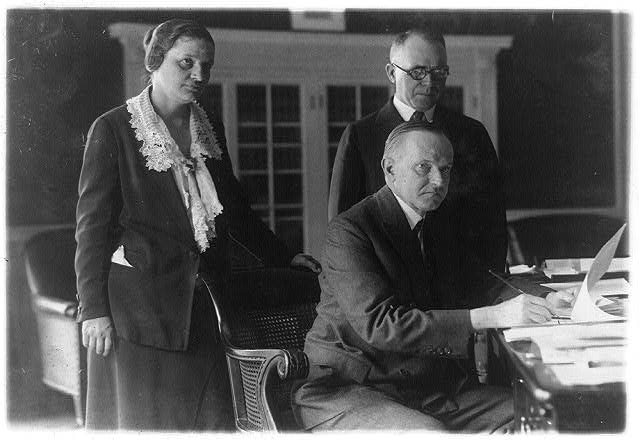
President Coolidge collaborating with Assistant Attorney General Mabel W. Willebrandt and Representative Israel M. Foster on child labor and education policy, June 7, 1924. Courtesy of the Library of Congress.




 The Importance of the Obvious