On the Criticism of Character in Commerce

Courtesy of the National Archives.

Courtesy of the National Archives.

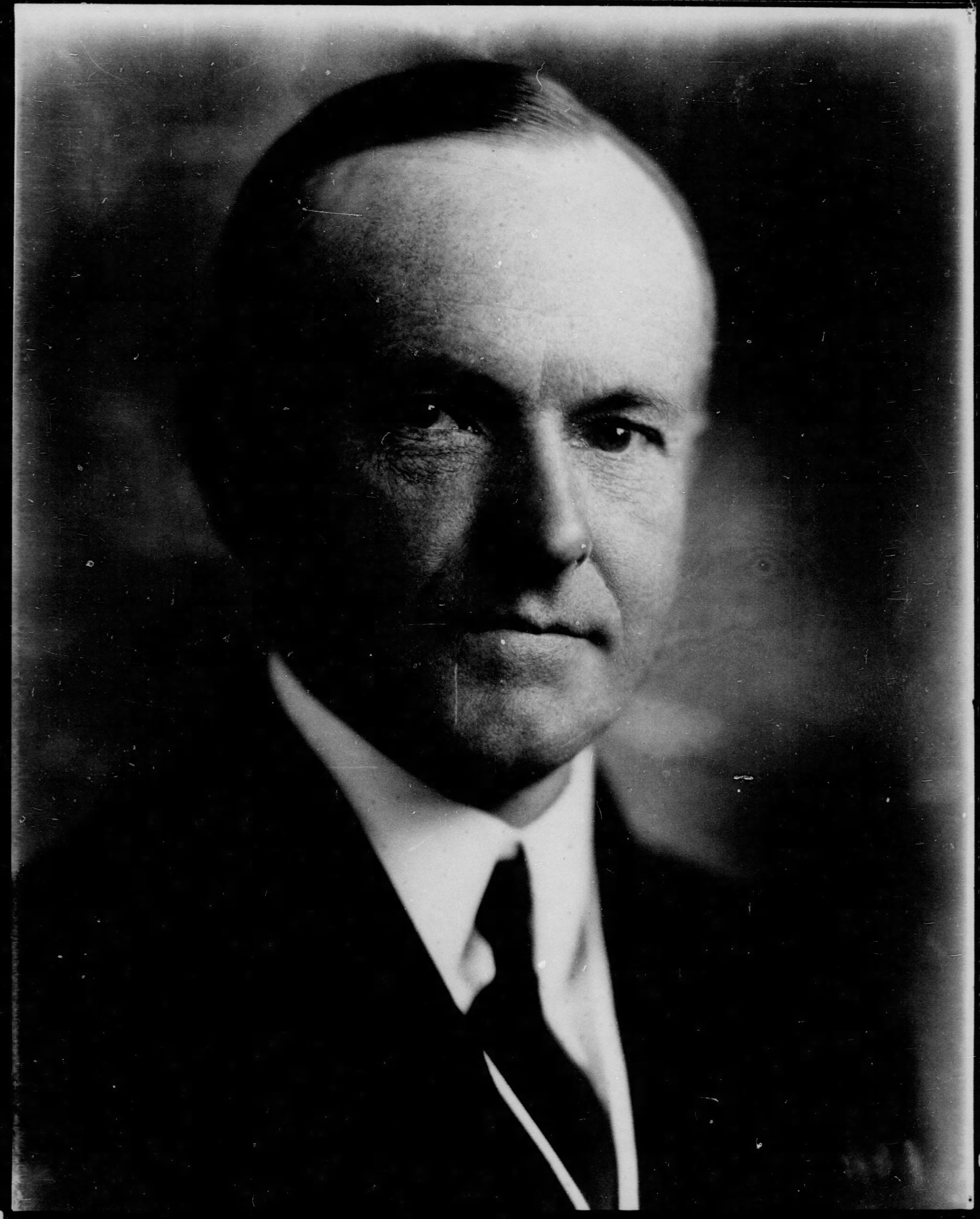
As Lieutenant Governor of Massachusetts, Calvin Coolidge addressed the Brockton Chamber of Commerce on this day ninety-nine years ago. In this message he articulates that the harsh criticism of our system and our institutions has always been the easy, simplistic course but when the “commercial age,” in which we now live these past hundred years, is properly assessed for value we discover it is all in pursuit of something far more important than material gain or physical possessions. It is in search for something more that develops character, the quality of the soul not merely the quantity of goods produced. Humanity is more than material. Inside there resides a spirit, an intellect, a yearning to dream, aspirations that cannot be quantified or satisfied by furnishing every physical need we could ever have. This is why centralized government always fails, by reducing mankind to only so many properties of matter that can be bestowed contentment and security in exchange for choice and independence, the spiritual craves for something more, a value intangible. Centralization dehumanizes man. Coolidge saw this and resisted it. He still speaks even now.

Coolidge said, “Man’s nature drives him ever onward. He is forever seeking development…Destructive criticism is always easy because, despite some campaign oratory, some of us are not yet perfect. But constructive criticism is not so easy. The faults of commercialism, like many other faults, lie in the use we make of it. Before we decide upon a wholesale condemnation of the most noteworthy spirit of modern times it would be well to examine carefully what that spirit has done to advance the welfare of mankind. Wherever we can read human history, the answer is always the same. Where commerce has flourished there civilization has increased. It has not sufficed that men should tend their flocks, and maintain themselves in comfort on their industry alone, however great. It is only when the exchange of products begins that development follows…

“It is only a figure of poetry that ‘wealth accumulates and men decay.’ Where wealth has accumulated, there the arts and sciences have flourished, there education has been diffused, and of contemplation liberty has been born. The progress of man has been measured by his commercial prosperity. I believe that these considerations are sufficient to justify our business enterprise and activity, but there are still deeper reasons…What then, of the prevalent criticism? Men have mistaken the means for the end. It is not enough for the individual or the nation to acquire riches. Money will not purchase character or good government. We are under the injunction to ‘replenish the earth and subdue it,’ not so much because of the help a new earth will be to us, as because by that process man is to find himself and thereby realize his highest destiny. Men must work for more than wages, factories must turn out more than merchandise, or there is naught but black despair ahead.

“If material rewards be the only measure of success, there is no hope of a peaceful solution of our social questions, for they will never be large enough to satisfy. But such is not the case. Men struggle for material success because that is the path, the process, to the development of character. We ought to demand economic justice, but most of all because it is justice. We must forever realize that material rewards are limited and in a sense they are only incidental, but the development of character is unlimited and the only essential. The measure of success is not the quantity of merchandise, but the quality of manhood which is produced.

“These, then, are the justifying conceptions of the spirit of our age; that commerce is the foundation of human progress and prosperity and the great artisan of human character. Let us dismiss the general indictment that has all too long hung over business enterprise. While we continue to condemn, unsparingly, selfishness and greed and all trafficking in the natural rights of man, let us not forget to respect thrift and industry and enterprise. Let us look to the service rather than to the reward. Then shall we see in our industrial army, from the most exalted captain to the humblest soldier in the ranks, a purpose worthy to minister to the highest needs of man and to fulfill the hope of a fairer day” (excerpts from “Have Faith in Massachusetts,” 1919, pp.15-20).

For the Coolidge Collector…

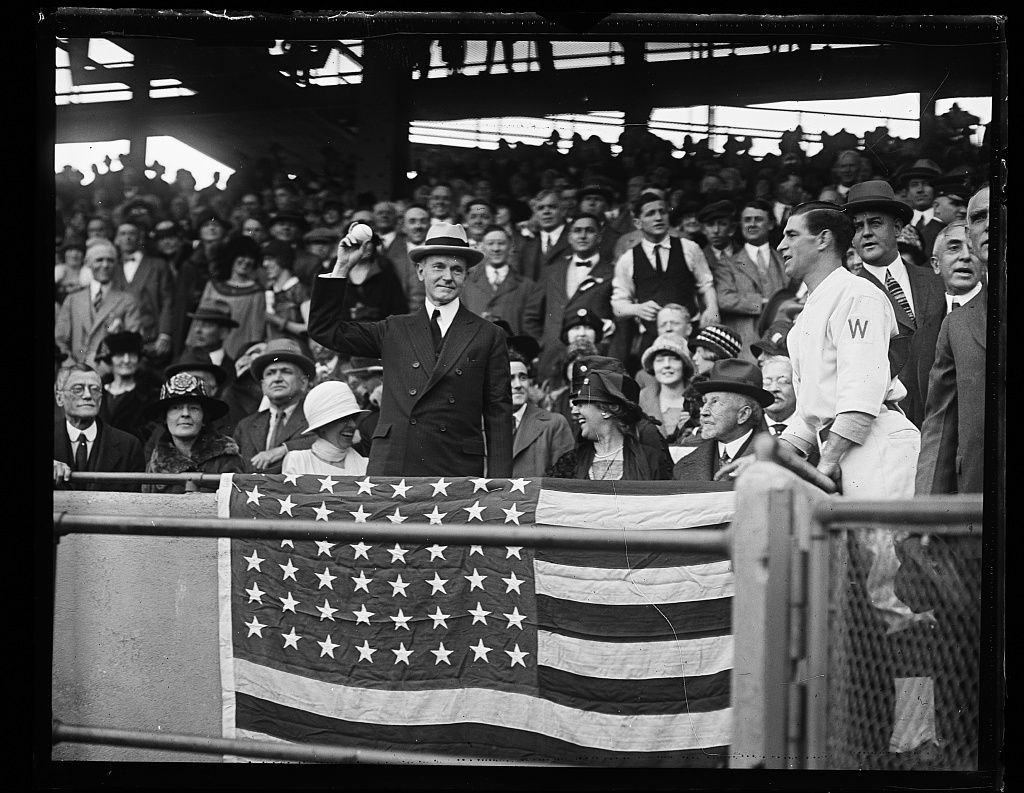
President Coolidge throwing out the first pitch, Griffith Stadium, as the Senators host the Giants, October 1924. Courtesy of the Library of Congress.

President Coolidge throwing out the first pitch, Griffith Stadium, as the Senators host the Giants, October 1924. Courtesy of the Library of Congress.

While not a collector of the Presidential Pez dispensers nor of past Presidential bobbleheads, the objects produced by the White House Historical Association — first in the shape of a very beautiful ornament earning a prominent place on any tree this Christmas, and now in partnership with the Washington Nationals, the Coolidge bobblehead, may require that I make a couple exceptions to that informal rule.

While Coolidge, no doubt with a twinkle in his eye and tongue firmly in cheek, was eager for the city of Washington to get back to an efficient use of people’s time following the pennant win in October of 1924, he praised the “knights of the bat and ball” who had secured a much deserved victory and baseball’s highest honor. Truly, the team had the entire nation behind it, play by play, to the last inning. “While baseball remains our national game our national tastes will be on a higher level and our national ideals on a firmer foundation.”

Coolidge Christmas Ornament 2015

Also, take a moment and get your Coolidge ornament in time for Christmas here.

On the Source of What Comprises Life

President Coolidge and the First Lady have their picture taken with members of the Advertising Association in 1924, two years before the speech cited below. Courtesy of the Library of Congress.

President Coolidge and the First Lady have their picture taken with members of the Advertising Association in 1924, two years before the speech cited below. Courtesy of the Library of Congress.

Addressing the American Association of Advertising Agencies meeting in Washington on October 27, 1926, President Coolidge took stock of the various components that made up life in the country. Society was rapidly modernizing, methods and culture were accelerating life at an incredible pace, and it was necessary not to lose sight of the values or the years of hard work that went behind each part of existence. Lest Americans take for granted the success of our free market system, the citizenship that makes Government work, or the cultural health of society, Coolidge recalls that none of these run themselves, none operate automatically, none go on indefinitely without a dedicated participation, continual maintenance, and strengthening of character. It was necessary then to look behind what made so much stellar success possible and perpetuate it far into the future. If the values informing and supporting this success did not remain grounded on firm, nurtured foundations the results visible in all our affluence, prosperity, and opportunity would dry up just as surely as the flowing mountain spring would were it cut off from its headwaters.

In more modern political terms, Coolidge was arguing that the social issues (grounded in the Judeo-Christian truth of the Ten Commandments and the Golden Rule) came first, not merely smart economic policy. Don’t discard the social issues, Coolidge asserts, thinking that we can reap the rewards with a system shorn of fundamental values and gutted of its moral meaning. The moral preceded and made possible the system that had advanced America in less than two centuries to heights not even millennia-old civilizations had reached. Those older empires had no less a grasp of shrewd trade or financial principles to dominate the world in their times. The Spanish Empire, Dutch Republic, and Great Britain had ruled commerce on a global scale in no too distance an age. America was different not because her people were genetically superior, intellectually better, or even morally purer. What made America different rested in her ideals. In fact, America had been entrusted with the same heritage of civilization which had been many generations in the building, to which many nations and peoples had contributed, sacrificed and toiled. It was in the moral convictions that life, liberty, and the pursuit of happiness are derived not from government authorities but from our Creator, and that governments are instituted among men not to despoil or possess the very life and property of subjects but to promote the general welfare of the whole people, not merely a part of it, that America had revolutionized and revitalized civilization. This was a dearly-learned truth and it was too precious to be jettisoned by a short-sighted, indifferent political expediency pawned off on a complacent citizenry.

Said another way, it is not enough to be for economic liberty while rationalizing away the deprivation of life to the most vulnerable. It is not enough to endorse tax reduction and balanced budgets without also decrying the immorality inflicted on the home and family by the divorce rate and redefinition of marriage, which both more profoundly impact prosperity than budgetary or monetary policy do. We cannot run from the cause, refusing to ever touch those dreaded “social issues” campaign after campaign, year after year, expecting job creation, expenditure reduction, and tax reform to furnish the exclusive focus for future political problem-solving. Our problems run far deeper than fine economic adjustments and while the array of social ills that we face is far smaller than in Coolidge’s day, he beckons us back to the importance of fundamentals. The spiritual must come first.

Coolidge expressed it this way, “Sometimes it seems as though our generation fails to give the proper estimate and importance to the values of life. Results appear to be secured so easily that we look upon them with indifference. We take too many things as a matter of course, when in fact they have been obtained for us only as the result of ages of effort and sacrifice. We look at our economic condition upon which we are absolutely dependent for the comforts and even the necessaries of life, and forgetting that it all rests on industry, thrift, and management, dismiss it lightly as a matter that does not concern us. Occasionally our attention is directed to our political institutions, which have been secured for us through the disinterested exertion of generations of patriotism, and, going along oblivious to the fact that they are the sole guarantees of our rights to life and liberty, we turn away with the comforting thought that we can let some party committee attend to getting out the vote and that probably the Government will run itself all right anyway. Then perhaps we are attracted by the buildings erected for education, or the temples dedicated to religious worship, and without stopping to realize that these are the main source of the culture of society and the moral and spiritual life of the people we pass them by as the concern very largely of schoolmasters and clergymen. We have become so accustomed to the character of our whole, vast, and intricate system of existence that we do not ordinarily realize its enormous importance.”

As he stated it in his Autobiography, “Unless men live right they die. Things are so ordered in this world that those who violate its law cannot escape the penalty. Nature is inexorable. If men do not follow the truth they cannot live” (p.53). Mr. Coolidge helps us remember that moral truth is the most practical reality we have. Without it, all else fails.