Governor Calvin Coolidge officially launches the 1920 campaign with his acceptance of the formal notification of his nomination as Vice Presidential candidate for the Republican Party at Smith College in Northampton. Given on July 27, 1920, Coolidge outlines the particulars of the GOP platform and embarks on what will eventually become nearly a ten-year endeavor to hold the Party to its electoral promises, political principles, and governing ideals. How prescient he would be is made clear with the hearing, especially as we head into the 2016 campaign. Enjoy this time capsule of political philosophy and stay tuned for more to come!
On A Heroic Day in A Heroic Land
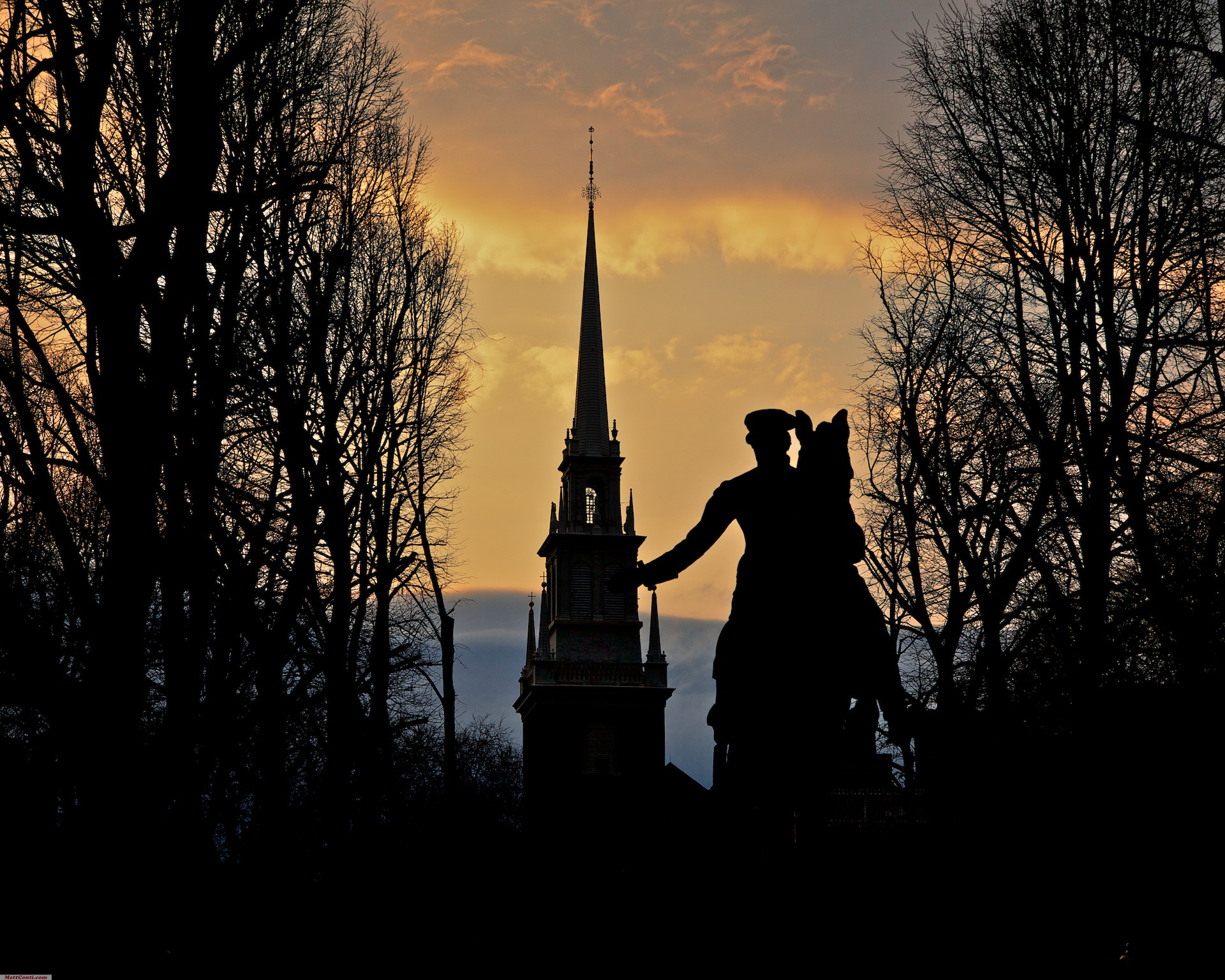
The steeple of the Old North Church with the statue of Paul Revere in silhouette. Photo courtesy of Matt Conti.
“It was from that steeple, one hundred and forty-eight years ago to-night, that the signal-lanterns gleamed, warning the watchers on the Charlestown shore that the British troops were on the move toward Lexington and Concord. There seems no doubt that these lights were displayed by the sexton, Robert Newman. Probably he was assisted in entering the church by Captain John Pulling, Jr. Back of this activity and directing it was Doctor Joseph Warren, who was within three months to give his life for his country at Bunker Hill. He had two messengers that he despatched on this night to warn Hancock and Adams, who were at Lexington, and arouse the countryside to resist the advance of the hostile forces. One of these was William Dawes, whom he sent out over Boston Neck, and the other was Paul Revere. It was Revere who arranged for the display of the signals which, as it turned out, were unnecessary, because he himself coming directly from Doctor Warren was stealthily rowed across the river, almost under the British war-ships, to Charlestown. He had been one of the moving spirits in a band of mechanics at the North End, organized to watch and report on all British actions. He knew what was acting, as he himself said, but had he been intercepted in crossing, as he feared, the lanterns would have conveyed the correct message to his confederate, Colonel Conant, who was waiting and received him on his landing. It is because his ride on this night was the consummation of a long period of watching and working, largely under his immediate oversight, that Paul Revere rises to the plane of true heroism. It was his plan and preparation, as well as his execution of it, that gave him the authority in that eventful hour to speak
‘A word that shall echo forevermore!’
“And yet it was because his word was received and acted upon that he rose to so grand a place in history. He became a hero only because the land was filled with heroism” — Calvin Coolidge, speaking in 1923 on the events of April 18, 1775, that would lead to the Battles of Concord and Lexington the following day, this day two hundred and forty years ago, that launched from the legendary Old North Church in Boston.
Coolidge reiterates that what made these events so pivotal was the preparations taken day after day by courageous and faith-filled men and women, to take in their own hands the risks worth taking to warn of danger and oppose despotic forces when they mobilized. What made the patriots like Revere, Dawes and Prescott successful was not only that they made themselves ready when the time came to act, they found unflagging support among a people which loved their country, a land of heroism. If liberty is to remain here and tyranny is to checked in its march, we cannot assume that all we need is one Paul Revere to ride in and save us. Capture or worse awaits such a tactic, one individual at a time. If we intend to stop the advance of evil, that love and courage must be kindled anew in as many of us as possible. We have to become again, as Coolidge observed, a land of heroes.
On the Veto Power
“If it were not for the rules of the House and the veto power of the President, within two years these activities [expensive legislation] would double the cost of the government…Different departments and bureaus are frequently supporting measures that would make them self-perpetuating bodies to which no appointments could be made that they did not originate. While I have always sought cooperation and advice, I have likewise resisted these efforts, sometimes by refusing to adopt recommendations and sometimes by the exercise of the veto power. One of the farm relief bills, and later a public health measure, had these clearly unconstitutional limitations on the power of appointment. In the defense of the rights and liberties of the people it is necessary for the President to resist all encroachments upon his lawful authority” — Calvin Coolidge, The Autobiography pp.230, 234.
Coolidge understood the importance of preserving the constitutional powers of the Presidency, that there were responsibilities and counterbalancing checks to be jealously guarded not to be handed over to the National Legislature. The Executive was not to weaken under his tenure, it would face two major Supreme Court challenges (the “Pocket Veto Case,” 279 U.S. 655 [1929] and Myers v. United States, 272 U.S. 52 [1926]), four legislative overrides, survive a fifth attempt by Congress to undo Coolidge’s veto, and be left unchallenged forty-one times. It is also noteworthy that most of these vetoes occurred during his second term, especially in the last two years of his administration. This is noteworthy because many Presidents expend political capital, exhaust momentum, and deplete energy so that by the close of their time, little resistance is made against the onslaught of public spending, patronage, and constant resort to the Treasury. While Coolidge did not let up from beginning to end, it could almost be said that he became more tenacious about waste and favoritism in the use of our funds. The claim some have made that Coolidge was too depressed and worn out to continue the work begun before his son’s death, do not adequately account for this important component of his unremitting activity to secure the President’s powers under the Constitution, restraining the ease with which Congress and the various bureaus and agencies use the money of others.
These informative charts give both historical perspective to the use of the President’s veto power, provided by Article I, Section 7 of the Constitution, but also take a closer examination of Coolidge’s particular use of that authority during nearly six years in office. Enjoy!
First, though, the list of his vetoes:
Now, a closer look at the tradition of Presidential veto use:
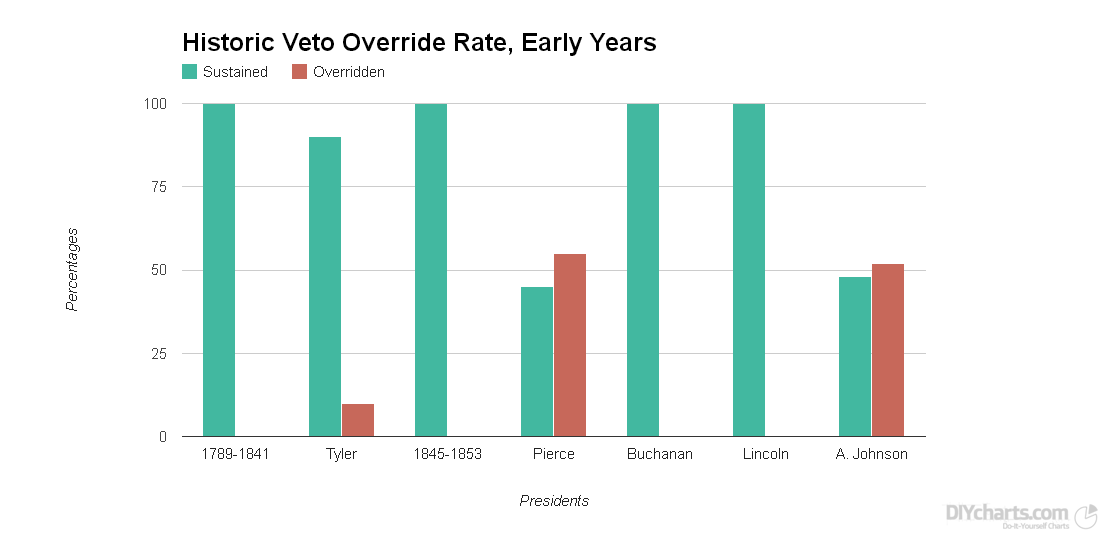
It is interesting to note that the Presidential veto was used sparingly in America’s early years, a mere 31 times in fifty-six years before the first Congressional override occurred on March 3, 1845, countering President John Tyler’s veto of special legislation for revenue cutters and steamers. Not until Pierce and again with Andrew Johnson would Presidents experience the Congressional countermand of veto power, both men undergoing the dubious and unique distinction of seeing more vetoes thrown out than sustained. While Ford came close, no other President has witnessed as consistent an opposition to the veto as Pierce and Johnson did.
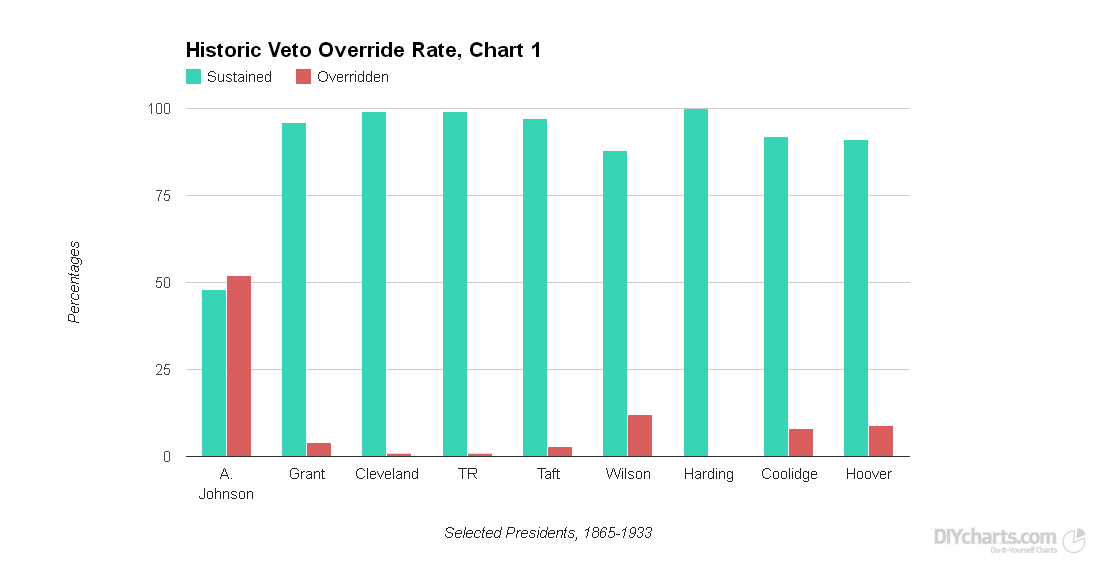
It is fascinating that Grant, so often dismissed as a weak President, set the tone for a healthy use of the veto power with 93 in eight years. It would be Cleveland, whose 584 vetoes in two nonconsecutive terms, that would raise the bar on the Presidential “no” to Congressional activity. Coolidge continued this strong tradition, issuing an average .75 vetoes every month in office in contrast to his last three predecessors, Harding (only six vetoes during twenty-eight months in office), Wilson (an average .45 vetoes a month for eight years, totaling forty-four), and Taft (39 in four years).
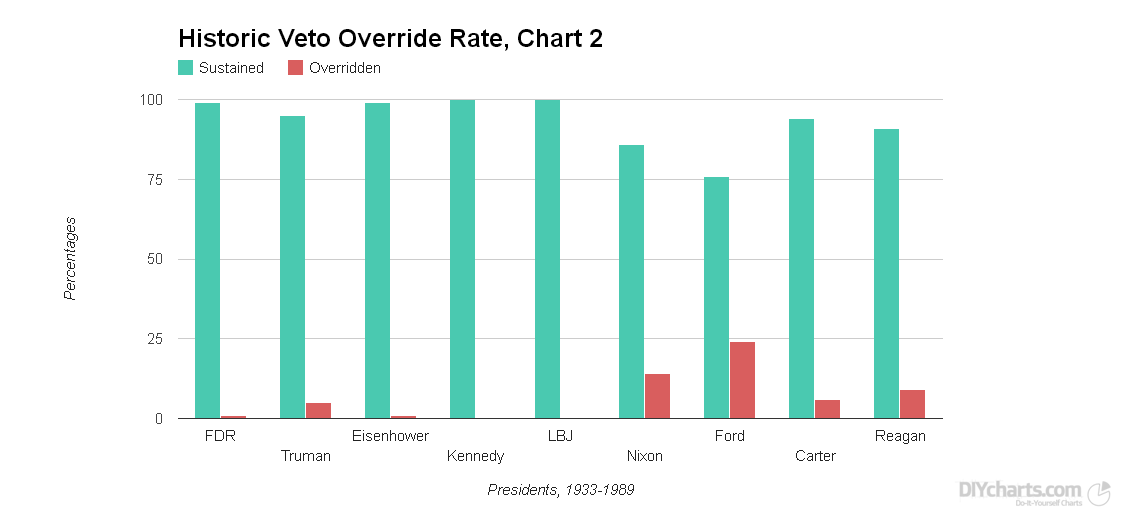
This chart, spanning a period more familiar to us, reveals the role that the makeup of the Congress has on the veto power just as it does the will of the President to wield it. It is worthy of note that in years where different Parties control each branch, the overrides increase, whether out of legitimate constitutional checks or mere partisan opposition. Since Nixon, overrides have become a regular part of every administration, whether warranted or not.
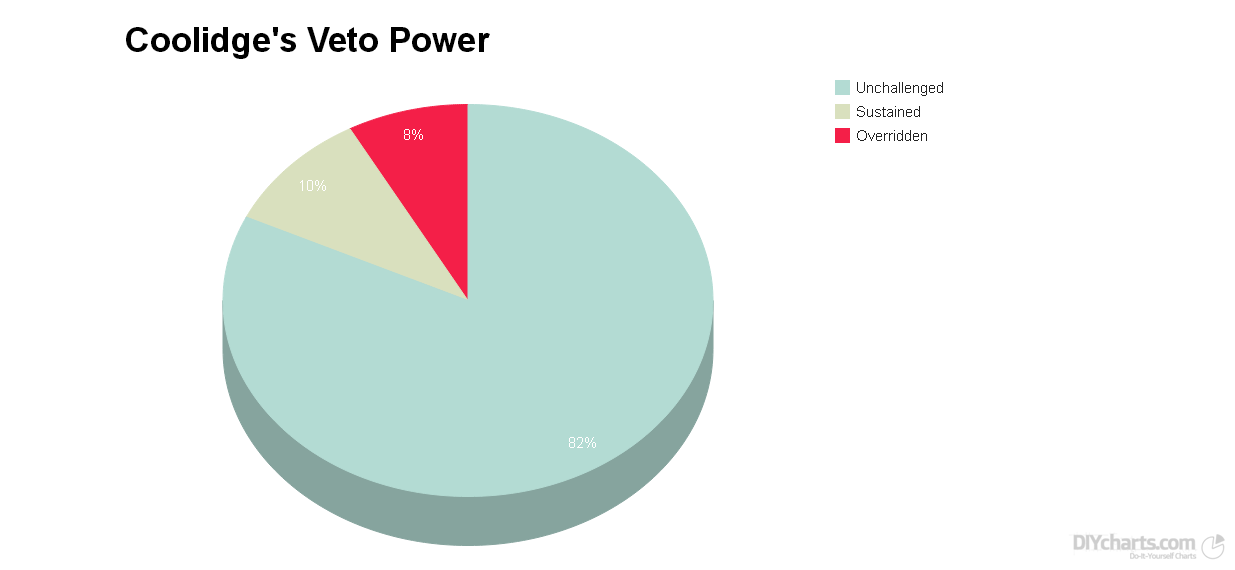
Here is a breakdown of the success rate behind Coolidge use of the veto. Only four were ever overridden by both Houses of Congress, A fifth one survived an attempted override and a sixth was upheld by the Supreme Court in the “Pocket Veto Case” (1929). An impressive 92% would stand over Congressional action. President Wilson would only ever see 88% success, with 12% of his vetoes overturned. Another 16% (eight vetoes) would come close to being undone by Congress between 1918-1921.
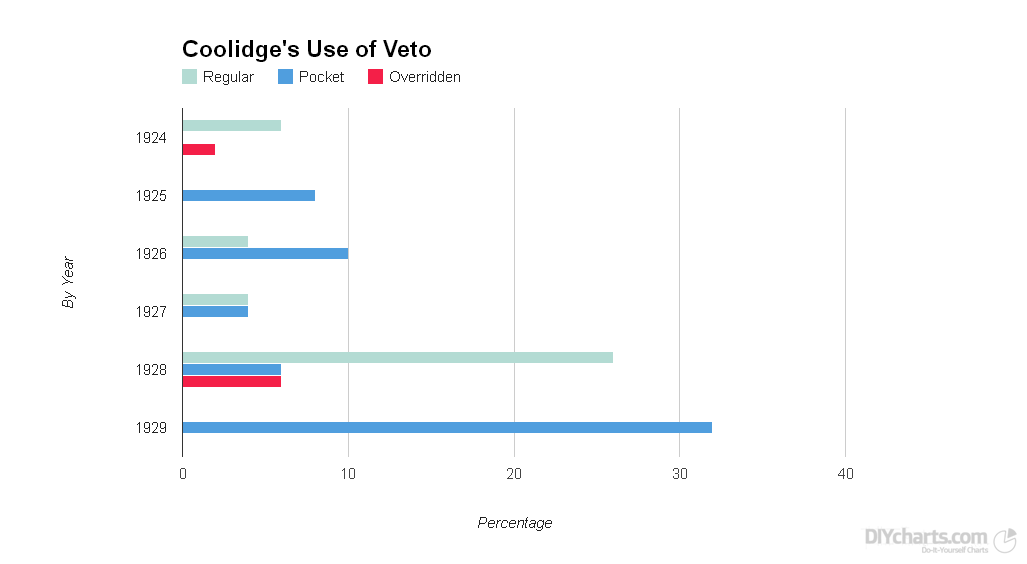
This chart not only illustrates the increase of President Coolidge’s veto use as his term advanced, he had particular skill in the use of the pocket veto – holding bills (less than ten days before the close of a Congressional session, as stipulated in the Constitution) of which he did not approve, until Congress adjourned, thereby preventing them from becoming law by simply “out-waiting” the House and Senate. In this way, the Congress could take no corrective action against his veto and it would force one or both chambers to rethink the bill and usually drop the matter altogether. May of 1928, however, was the high water mark of Congressional intransigence to Coolidge’s executive approach, when three of his vetoes were overridden in one day, May 24, 1928. Cal would have the last laugh, however, as he would brandish the pocket veto not once, three, or even ten but sixteen times while Congress, already adjourned and unable to respond, learned helplessly of it in the news. Those would form some of his last official acts in office before departing for home in Northampton on March 4, 1929.
 The Importance of the Obvious