In formats designed by this author, here begins a sampling, with more to follow, of Calvin Coolidge’s greatest excerpts from each of the five Memorial Day Addresses given as President between 1924 and 1928. These come from his speech on May 30, 1927.
On America’s Place in the World
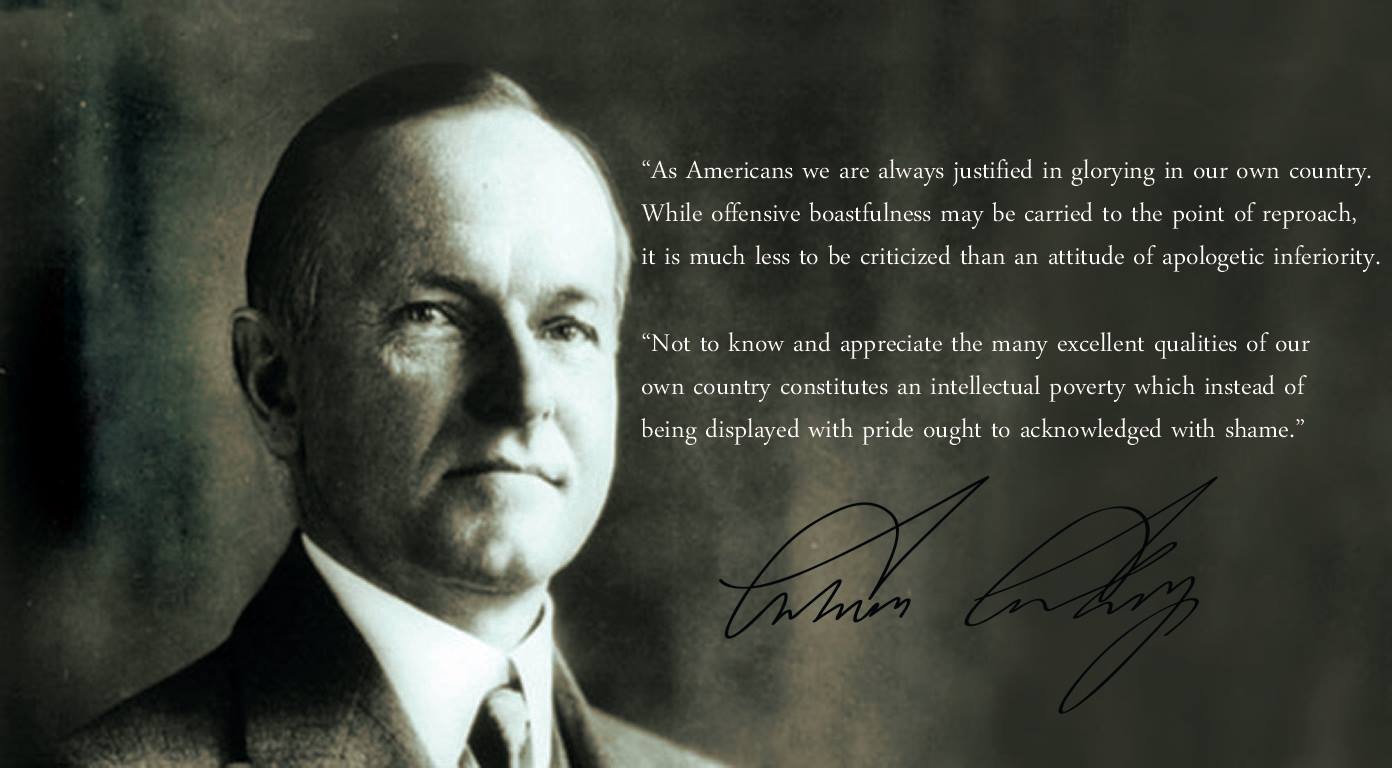
“As Americans we are always justified in glorying in our own country. While offensive boastfulness may be carried to the point of reproach, it is much less to be criticized than an attitude of apologetic inferiority. Not to know and appreciate the many excellent qualities of our own country constitutes an intellectual poverty which instead of being displayed with pride ought to be acknowledged with shame…
“While pride in our country ought to be the American attitude, it should not include any spirit of arrogance or contempt, toward other nations. All people have points of excellence and are justly entitled to the honorable consideration of other nations. While this land was still a wilderness there were other lands supporting a high state of civilization and enlightenment. On the foundation which that had already laid we have erected our own structure of society. Their ways may not always be our ways, and their thoughts may not always be our thoughts, but in accordance with their own methods they are attempting to maintain their position in the world and discharge their obligations to humanity. We shall best fulfill our mission by extending to them all the hand of helpfulness, consideration, and friendship. Our own greatness will be measured by the justice and forbearance which we manifest toward others…
“It is because of our belief in these principles that we wish to see all the world relieved from strife and conflict and brought under the humanizing influence of a reign of law. Our conduct will be dictated, not in accordance with the will of the strongest, but in accordance with the judgments of the righteous…
“The integrity of the Union rests on the Constitution. Unless that great instrument is to be the supreme law of the land, we could have no Union worthy of our consideration. In its original inception it was the product of prayerful consideration by the best endowed minds that were ever turned to political deliberation. Although it was drafted in convention, it represented the mature thought of the country. Into it went the genius of Adams and Jefferson, of Franklin and Madison, of Hamilton and Washington. It has been expounded by Webster and other statesmen in the Congress, and adjudicated by Marshall and other magistrates on the bench. With its three independent departments, the executive, legislative, and judicial, it established a republican form of government incomparable in the guaranties of order and liberty with which it has endowed the American people. As a charter of freedom and self-government it is unsurpassed by any political document which ever guided the destinies of a people.
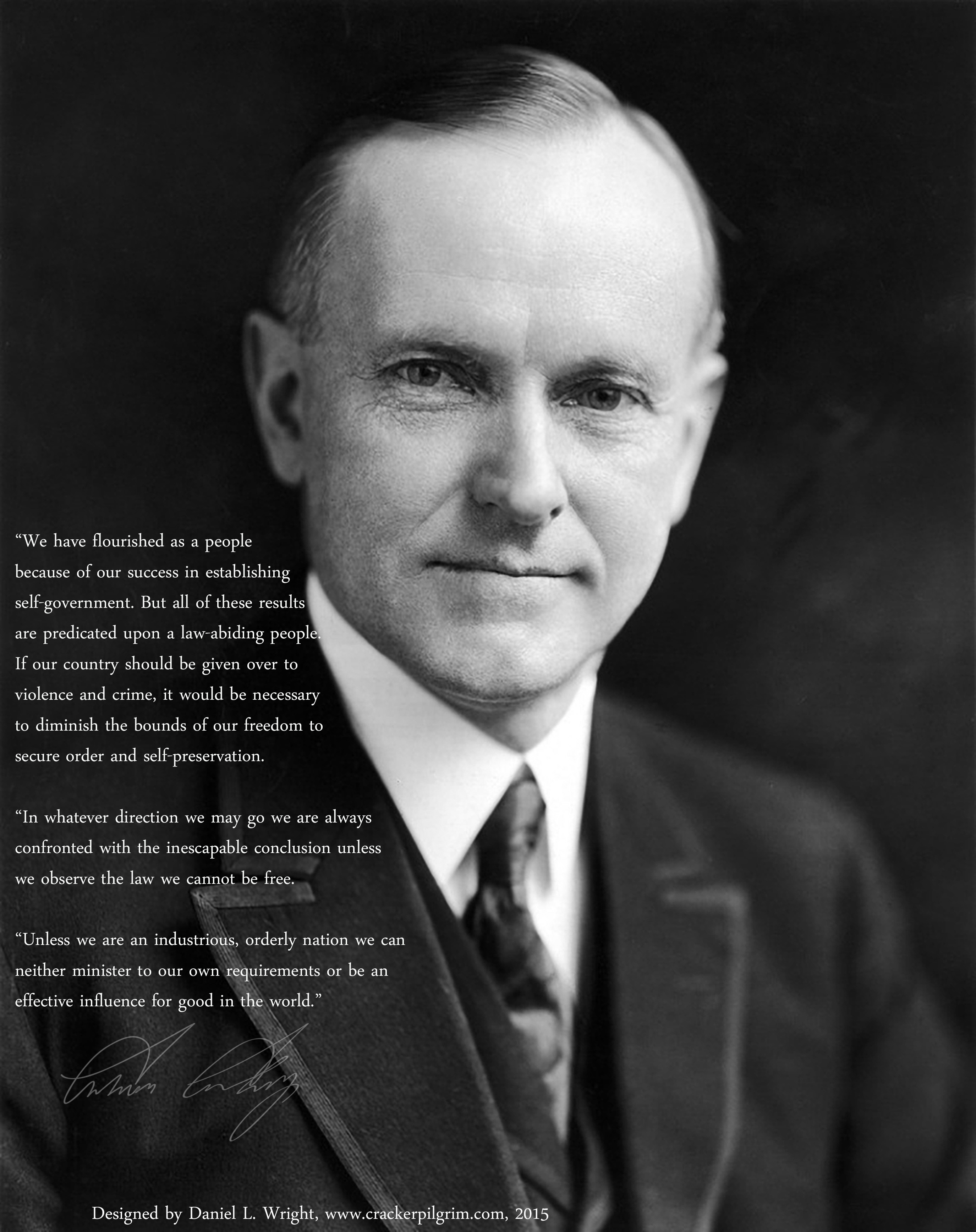
“We have made our place in the world through the Union and the Constitution. We have flourished as a people because of our success in establishing self-government. But all of these results are predicated upon a law-abiding people. If our own country should be given over to violence and crime, it would be necessary to diminish the bounds of our freedom to secure order and self-preservation. In whatever direction we may go we are always confronted with the inescapable conclusion that unless we observe the law we cannot be free. Unless we are an industrious, orderly nation we can neither minister to our own requirements or be an effective influence for good in the world. All of these things come from the heart of the people. So long as they have the will to do right and the determination to make sacrifices, our institutions will stand secure at home and respected abroad. It is to those who had that will, who showed that determination that we today do honor.
“We can not leave this hallowed ground, decorated as it is today with all the flowers which loving memory has brought, without realizing anew that it is the spirit of those who rest here which gave us our independence, our Constitution, our Union, and our freedom. They have bequeathed to us the rarest, richest heritage which was ever bestowed upon any people. Their memory speaks to us always, reminding us of what we have received from them and of our duty to dedicate ourselves to its preservation and perfection” — President Calvin Coolidge, Memorial Day Address at the National Cemetery in Arlington, Virginia, May 30, 1927.
On Mr. Hughes
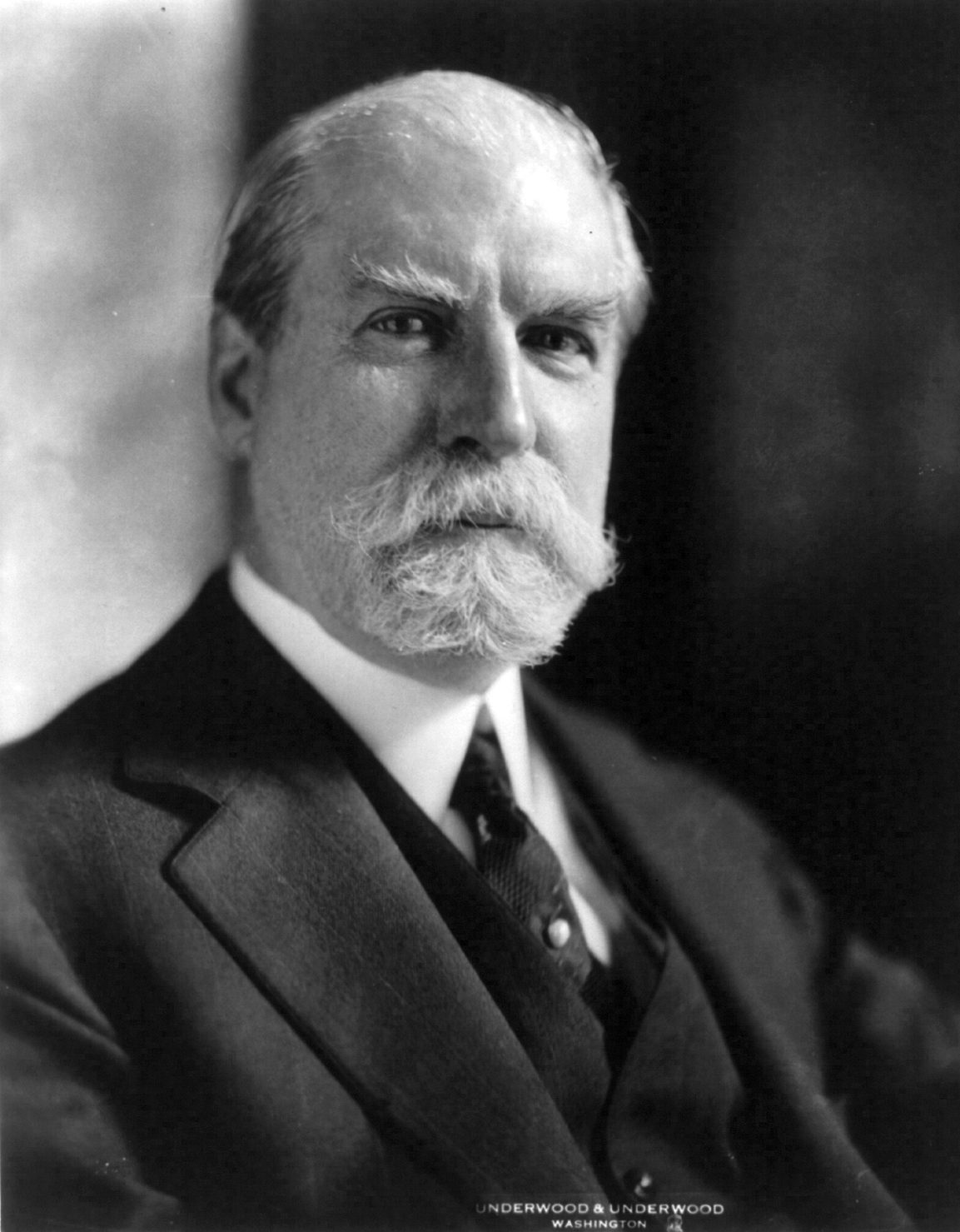
View this fascinating introduction featuring historians Bernadette A. Meyler and David Pietrusza on the 1916 Presidential Election and Mr. Charles Evans Hughes of New York, the brilliant statesman, Supreme Court justice, and, under Harding and Coolidge, superb Secretary of State. He would return to judicial work, first on the World Court at Coolidge’s nomination, but also go back to the Supreme Court as Chief Justice, becoming one of President Roosevelt’s foremost adversaries in the implementation of the New Deal. Mr. Hughes’ excellent mind and genuinely impeccable character sets him apart from so much of the “run-of-mill” politics not only in his era but even in ours, one hundred years later. The more one learns about Charles Evans Hughes, the higher his reputation rises. Both he and Coolidge would tragically lose a child and perhaps, as a consequence, held a particular sympathy for one another as bereaved fathers only can. Hughes, just as his name was being reconsidered for the 1920 Presidential nomination, lost his eldest daughter, Helen, to tuberculosis. Coolidge, just as his name had secured nomination in his own right in 1924, lost his youngest son, Calvin Jr., to blood poisoning. History might have taken a drastically different course had either death not occurred.
While Franklin D. Roosevelt’s Attorney General, Robert H. Jackson, himself a future Justice on the Supreme Court, conveyed an oft-held impression the dignified Mr. Hughes left with many people, when he said Hughes not only resembled Almighty God, he spoke like Him too. Or so goes the joke.
President Coolidge had his own laugh on Secretary Hughes or rather on his distinctive facial hair, during one of the older man’s temporary stays in the White House. Coolidge dispatched the White House barber up to the Secretary’s room, instructing him exactly what to say. Sheepishly knocking on the door, the poor man dutifully repeated what the President told him to say and then listened for permission to enter. The President had sent him up to ask whether Secretary Hughes was ready for his scheduled shave. No answer could be heard from inside the room. The man went away without reply. Cal, learning what had happened as a result of his prank, smiled to himself. The President would send the poor barber up to Mr. Hughes door every morning of his stay in the White House with the same question. Having the utmost regard for his Secretary of State, it was still Calvin’s way of not only teasing the barber but also poking fun at the good-natured, yet professional, Mr. Hughes.

Charles Evans Hughes (left) with friend and former Vice President under Theodore Roosevelt, Charles Fairbanks. Courtesy of metacolorblog.org.
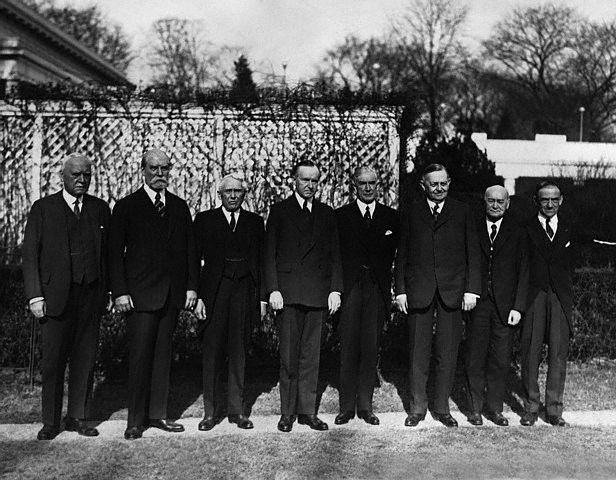
Members of the Pan American Conference to assemble in Havana, standing here on the grounds of the White House. L to R, they are: Judge Morgan J. O’Brien, New York; Charles Evans Hughes; Secretary of State Kellogg; President Coolidge; Henry P. Fletcher, American Ambassador to Italy; former Senator Oscar W. Underwood; Dr. James Scott Brown, Washington; and Dr. L. S. Rowe of the Pan American Union.