On the Use of A President’s Resume

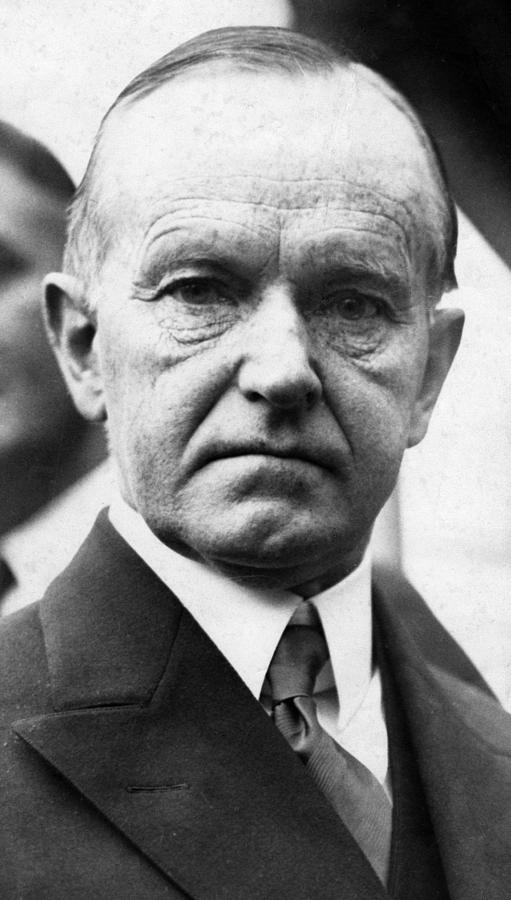
8-calvin-coolidge-1872-1933-granger

The Washington Post’s Richard Cohen, writing in the Columbia Daily Tribune out of Missouri this month, reminds us of whom began the now established tradition that former Presidents make a living from the Office. It was Gerald Ford, ever so briefly President after the resignation of Nixon, who started this ignominious employment of retired Presidents as high-dollar speakers. Even Jimmy Carter obtains generous speaking fees for every engagement secured through the American Program Bureau. It is the Clintons, of course, who have transformed this kind of post-Presidential legacy-building and marketing of the Office to a degree that rivals the GDPs of several small countries.

Who could even imagine Calvin Coolidge engaging in this kind of shameless self-aggrandizement at the expense of the Office? This is because he did not and deliberately refused to do so. He once told magazine editor James C. Derieux, “I’d like to go into some kind of business but I can’t do it with propriety. A man who has been President of the United States is not free–not for a time, anyway…Whatever influence I may have has come to me because of the position I have held, and to use that influence in a competitive field would be unfair. Some of the offers put before me never would have come if I had not been President. They are trying to hire a former President, not the individual, Calvin Coolidge. I can’t make that kind of use of the office…I can’t do anything that might take away from the Presidency any of the faith people have in it.”

He would not, as Ford would, engage in selling the Presidency by attaching his name to either an advertising campaign or marketing himself in causes that only came to him because of his “past life,” as Coolidge termed it to friend and Amherst classmate Charles A. Andrews. This refusal to market off of the Presidential prestige manifested itself in declining very lucrative offers from advertising agencies and business executives but also in precautions as simple as removing all tags and personal identifiers from clothing he wanted to sell, even sending his secretary, Herman Beatty, to another town lest the sale price be influenced by its association with a former President. He abhorred self-promotion and when he did finally take up the kind of “dignified employment…of service as others are” (to which he aspired in his Autobiography) he accepted the work out of a firm belief that the kind of labor it entailed was dignified, worthwhile, helpful, and of service to others.

His work for New York Life, which he insisted give him no special favors and no large salary, came from a conviction that sound insurance investments served regular people. He was even sued, ironically, for warning potential buyers against con artists and shysters in the industry. His work with the American Antiquarian Society, over which he was chosen to preside, came not with financial perks but with his belief that preserving the old documents and artifacts of our history remained an important and necessary service to future generations. His work as a writer, his most profitable venture, came not with a Scrooge-like disposition toward money but by presenting what he had to say in the most accessible and popular format, the printed word in magazines and newspapers, rather than at lush fundraising dinners and high society parties, he was striving to serve. While not loose with his money, he freely gave it to those in need unsolicited and unsought, to help those who struggled from time to time, especially as the Depression worsened. Even his more public work, the Transportation Committee and handling the bequest of the late Conrad Hubert, in distributing his estate, served others, not himself.

He had no Secret Service detail, no pension, no free medical care, no publicly-funded staff or Presidential Library. Not until Congress changed the law did that become the norm for Harry Truman and Herbert Hoover in 1958 and later for Dwight Eisenhower upon his retirement in 1961. The most compelling reason Cal did not do more than he did was because he had no patience for retaining the trappings of the Office he had once held to continue following him everywhere he went. He wished people understood that the “power” of the Presidency was no longer his, it had “shut off” when he left the White House. He welcomed retirement from the limelight and wanted to travel, to go and see places, to be a normal citizen again. In this, he did not succeed but he resolutely tried. In every way that a person can leave Washington behind he did, physically, mentally and spiritually. What a far cry from what the Office has now become in the eyes of too many, including, it seems, even some of our former Presidents.

On the Problem of Indian Administration

Committee of 100 on Indian Affaires 12-13-1923

In the months leading up to newly inaugurated President Coolidge’s first Annual Message in December 1923, he invested an enormous quantity of time seeking out advice, input, and counsel from a very broad range of sources. This was not because he needed an agenda, sought to be told what to do, or lacked his own confident sense of himself and what he believed. While many he would summon to the White House left perplexed at what usually constituted a reticent reception and visit devoid of guarantees or enthusiastic assurances that action would be taken, they failed to appreciate what Cal was actually doing. He was exercising the discipline and strenuous effort of good listening. This was no less the case when the Committee of One Hundred, appointed by Coolidge, presented their findings to the President on the conditions of American Indians a week after his Message.

The status of tribe after tribe subjected to government paternalism through the reservation system of decades standing and the land allotment scheme under the Dawes Act of 1887 had been issues either skirted or punted altogether by one administration after another for far too many years. The report of this Committee of One Hundred would prove to be the start of a task that would span all of Coolidge’s tenure to overturn years of accumulated failure in government policy.

304

It is to the credit of President Coolidge that the buck finally stopped with him. The grave inadequacies of government involvement which had kept these peoples from even the basic advantages of American citizenship would be ended only after a harsh analysis of the facts, however unpopular, had been undertaken. It would finally lay bare the reality that must lead to genuine changes for the better. It is significant that this finally happened under Coolidge’s leadership. It remains one of his finest accomplishments for civil rights. Three important actions by Coolidge merit brief consideration as we mark the day, ninety-one years ago, that one of these actions, his signing of the Indian Citizenship Act, took place.

34570v CC with Indians 1927

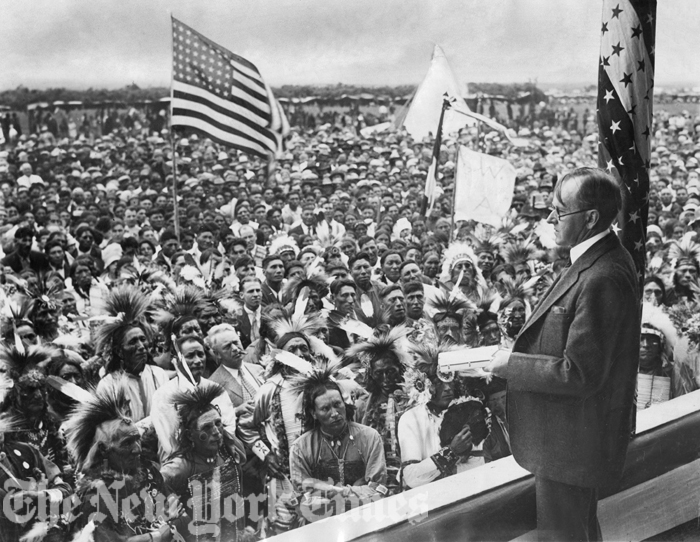
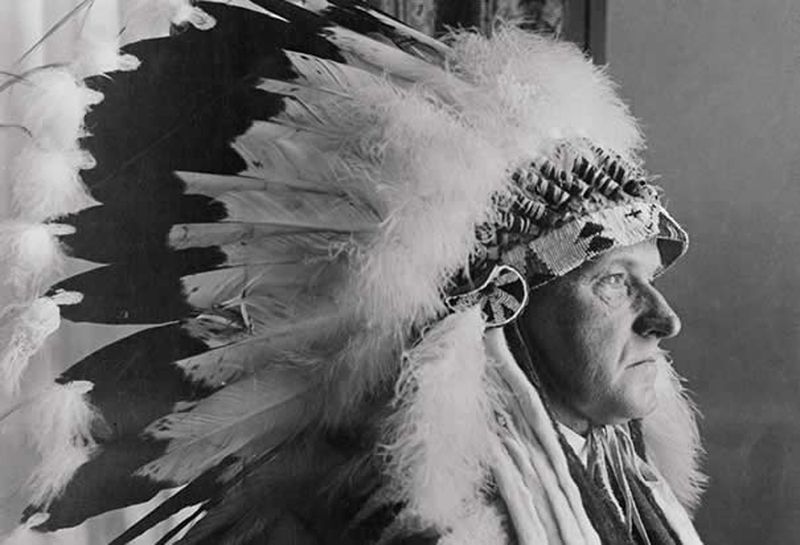
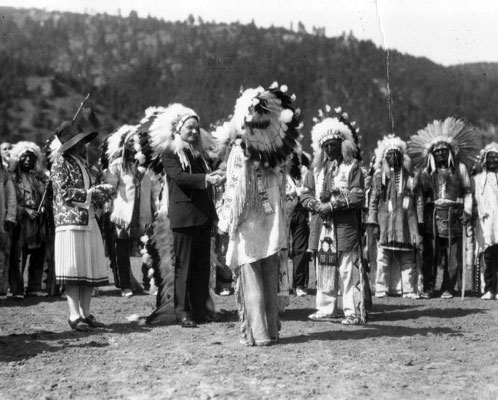
1. He took the time to meet with the tribes and later to be inducted into their membership. From the Navajo and Apache to the Sioux, Cherokee and Osage, Cal met with representatives from all of them and more. He accepted their gestures of regard and returned his gratitude for a proud and brave people. He appointed the Committee of One Hundred, meeting in mid-December 1923, to begin the process of correcting the deeply entrenched mistakes of a flawed system. Once asked about his frequent joining of Indian communities, Cal replied, “Just because I belong to one tribe is no reason why I shouldn’t belong to another.” When Coolidge was named part of the Sioux at Fort Yates in South Dakota in the summer of 1927, a chieftain turned to Calvin and said, “They tell us you are the thirtieth President of this great country, but to us you are our first President.”

Courtesy of the New York Times.

Courtesy of The New York Times

This was not calculated courtesy, or political opportunism, he had earned a respectful place among these men and women because he first respected them as individuals worthy of the fullest citizenship, as brethren not subjects or even foreign savages. They had sacrificed and died beside the rest of us, Coolidge asserted, in the Great War. Did not that alone warrant their full recognition as fellow heirs in all the blessings and responsibilities America made possible? He would return to the West after leaving the White House — when no possible political ambitions were even remotely sought — and dedicated the dam which bore his name, smoked a ceremonial pipe of peace with the local chief and ate together with the Americans of all backgrounds who lived and worked there.

947922306-peace-pipe-apache-calvin-coolidge-opening-inauguration

2. He signed the Indian Citizenship Act, June 2, 1924. By some calculations this one measure granted citizenship to more than 125,000 Indians from a population of 300,000. It did not create standards sure to exclude the lowly or reinforce a sense of class under the new law. Citizenship came to the illiterate just as equally as to those who could read and write. The arrangements for property, both tribal and personal, were not impacted at all by the law and it is significant that as early as two years later, the New York Times could report the progress of voluntary assimilation: twenty tribes out of 371 chose to remain in their ancestral tepees while the rest had willingly joined the mainstream of American society. Coolidge knew this was only the beginning but it had to begin somewhere. Closing his message to seven thousand Sioux, he set the scene of an instance at the Tomb of the Unknown Soldier, “A group of old Indian warriors…arranged themselves around the tomb, while one, acting for the whole Indian people, laid upon the bier his war bonnet.” Coolidge drew the lesson, this was “not an idle gesture…It symbolized the outstanding fact that the red men and their neighbors had been brought together as one people and that never again would there be hostility between the two races. As one of those old warriors said: Who knows but that this Unknown Soldier was an Indian boy?” (Johnson, Why Coolidge Matters 193-194).

44821v Jan-Feb 1925 44865v 1925741 cc with osage indians

20091128-185232-pic-225863481_t607

3. He commissioned the Meriam Report that resulted in the most careful study yet undertaken of overall policy direction, health, education, economics, family and social life, migration, legal issues, and missionary work among the Indians. To understand how important this was, a study this thorough had not been done since 1850 and the most determined effort to restore and correct the Indian problem had not been seriously waged since President Grant in 1871. Equally significant is the fact that Coolidge did not turn to the bureaucrats of Indian Affairs to accomplish a self-policing examination. He had his Secretary of Interior task a group of researchers independent of the government – members of the Institute for Government Research, what would later become the Brookings Institution – each assigned to their established specialty. The men and women of the project, working autonomously, visited 95 reservations in 23 states, interviewed hundreds of individuals, and spent seven months in the field gathering a body of data that would produce the necessary changes to the law in five, short years. Their findings, published in 847 pages as the Meriam Report (named for the team’s director, Lewis Meriam), were presented on February 21, 1928. It had the effect of an artillery shell in a tightly packed trench. Without resort to hyperbole, the Report furnished the solid reasons that policy needed to change. As with any government program, however, the wheels moved slower than Cal would have liked under his successor, Herbert Hoover. Still, it is a testament to Coolidge that any of these efforts took place at all, let alone that the opening volleys he authorized to end the old system would at last bear fruit the year following his death in 1934.

34715v with Indians 1927-8

On this day, we mark not only the citizenship of the American Indian but also Calvin Coolidge’s actions to bring the races together, to restore a peace long needed, and live an example of respect for every individual on the basis of character and sacrifice instead of color and class. We are all Americans now and in that, we should not only remain humbled but proud of our shared inheritance.

3c11398v Smoki 10-1924

(Note to the reader: The above caption, entered by earlier archivists at the Library of Congress and perhaps by news correspondents beforehand are mistaken about the Smoki tribe, which was not actually a tribe at all, but a group of white Americans appropriating some of the cultural elements and traditions of the Hopi, see here. Thanks to one of our attentive readers for making this distinction).


6a011279419f6128a4014e5f991d1b970c-800wi

On “Interesting” Times

Stephen Masty over at The Imaginative Conservative has struck a well-driven point. He reminds us that many “historians,” focusing on the most violent times and belligerent of men, heap praise and accolades on their subjects’ strength and power above the quietly constructive times. This is no where more evident than in how our Presidents are presented. The sweeping changes of the Depression and Second World War starring the dishonest, cavalier, but dashing and forceful, Franklin D. Roosevelt, have made for many a recurring narrative where intentions and appearances count more than results and substance. Or how about the violence of the Great War, the one Woodrow Wilson promised to spare America?

Though historical “scholars” enter academia with the bones of Wilson or FDR somewhere among their relics, what about the peacemakers, like Mr. Calvin Coolidge? What of those of whom it is said, “They shall be called sons of God”? Or is it the “God” part that scares “historians” so? What of those who believed that great times were not periods of destruction and bloody devastation but the rebuilding of what has fallen, the strengthening of those principles that matter, the fortification of character and faith, not animosity and upheaval? What of those who did not regard greatness as a thing only occurring in global scale or in large personalities but rather in the thousands of little things done rightly or in the strength of bravely-led, simply-lived, and humbly-walked lives all across history?

Mr. Coolidge again stands tall in this estimation. Perhaps a return to learning what the peacemakers have to offer is in order.

President Coolidge with Sir Harry and Mrs. Lauder at the White House, 1926. Churchill once called Lauder, famous for his musical and comedic talents, "Scotland's greatest ambassador."

President Coolidge with Sir Harry and Mrs. Lauder at the White House, 1926. Churchill once called Lauder, famous for his musical and comedic talents, “Scotland’s greatest ambassador.”