On New Year’s Receptions

The President’s House, December 1800 (Tom Freeman, 2000). Photo credit: White House Historical Association.

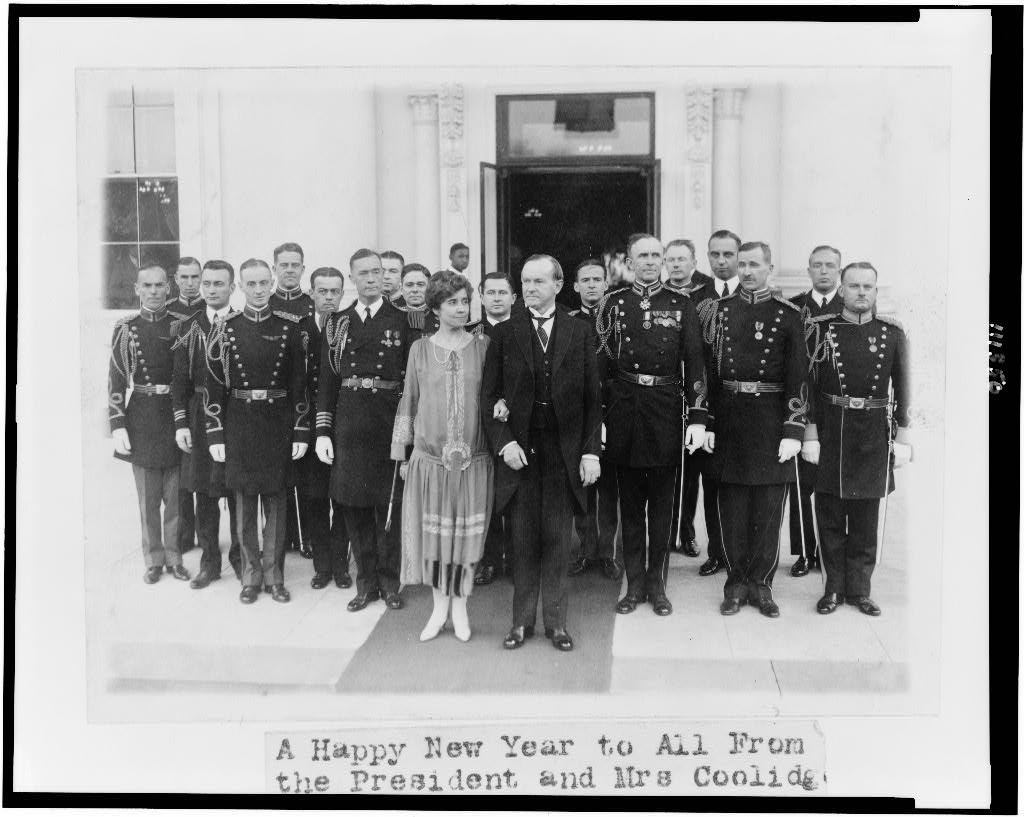
When the first New Year’s reception opened the doors of the President’s House to the American people in 1801, the Adamses, with two months left in office, had just ushered in a quintessential expression of popular access and established custom. It lasted, with some wartime disruption, for the next one hundred thirty-one years. New Year’s Day would long continue in this country as the fitting time to make calls on friends, reconnect with neighbors, and begin the year by visiting those who ought to matter to us. For the American public, it afforded the most opportune occasion to greet the nation’s executive couple face-to-face.

While the crowds averaged 4,000 during the Coolidge years, the President was well-acquainted with lines of 5,000 people from his days as Governor of Massachusetts. Shepherded through the historic Blue Room of the White House, the single-file lines easily continued past Executive Mansion grounds down the street along the old State, War, and Navy Department offices (today’s Eisenhower Executive Office Building) and beyond, most waiting hours for the chance to meet the President and First Lady. Calvin and Grace Coolidge were the last Presidential couple to observe this cherished tradition all six years of their tenure. The Hoovers, out of concern for economic exigencies, discontinued the reception in 1932.

Though President Coolidge, ever the numerophile, clocked both the times and number of handshakes given at these receptions, he enjoyed the human import of what these receptions meant to so many. The 3,891 people in 1924 was the first of his statistical tallies in that category. He noted the decrease in 1927 to 3,185. Nevertheless, he was a consummate public relations professional. He understood how definitive it was to maintain more than the perception of open access to the President but also how necessary to maximize that genuinely direct approachability to as many individuals as possible. Conscious of the time others were investing in one of the most personally and institutionally vital meetings of a person’s life — the greeting of a head of state by a citizen — Cal relished when he could keep a self-important matron impatiently waiting. When official decorum permitted, he prolonged the necessarily brief visit with any of those old Civil War veterans, small town mothers, and unostentatious folks from the heartland of the nation, knowing down the line was some public official’s wife annoyed that her more important visit with the Coolidges had been postponed by even a few moments. Cal never telegraphed any of his jokes and pranks. This is what made him, for some, so hard to read. Yet, as Colonel Cheney and Captain Brown, two of the President’s military aides, witnessed at the close of one of those formal receptions: As the official couple ascended the stairs one evening to their private rooms, Cheney and Brown witnessed Coolidge elaborately bow to his lady, who returned it with an exaggerated curtsy followed by a few feigned steps of a minuet. As the officers remarked, perhaps the Coolidges enjoyed those evenings more than they let on at the time.
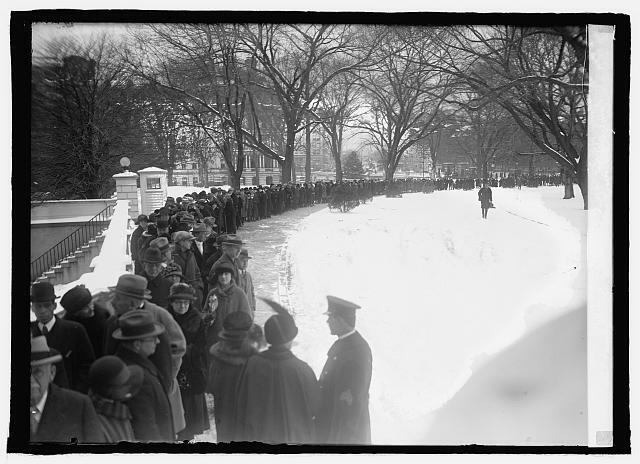
In 1924, the eighty-seven-year-old former doorkeeper of the White House, German immigrant and Civil War veteran Major Carl David Adam Loeffler, the proud father of seven children including the future Secretary of the Senate, was brought to the front of the line to be one of the first to enter the Blue Room on this day a century ago. He had served in the Quartermaster’s Department during the War, returned to civilian life, and then taken up service as doorkeeper under Grant in 1872 remaining until TR after the turn of the century. Holding a billet as doorkeeper that required salute, even by senior ranking officers, Major Loeffler passed away in 1926 at the age of ninety-one.

At the 1925 reception, President Coolidge held up the line for seventy-nine-year-old Colonel Robert Graham Scott, veteran of the 24th Iowa, who had been stationed on the Executive Mansion grounds during the War and had met Lincoln in a similar New Year’s reception in 1864. Colonel Graham lived another ten years, passing in 1935 at the age of ninety.

At the 1926 reception, the longstanding tradition of hosting the oldest citizens of the Washington, D. C. area continued with a quiet luncheon on the second floor of the White House. No less full of storied memories was New Hampshire house painter John William Hunefeld, who took his post at 9:30 in the morning to ensure he preserved his place at the head of the public line. In what came to be every year since 1924 (achieving first place in 1926, 1928, 1930, and 1931 to enter on New Year’s Day), Mr. Hunefeld became an institution in his own right. He would also be among the last on hand in 1934, waiting outside the gates to “make sure the president hadn’t changed his mind” about New Year’s Day receptions.

The New Year’s Day reception stood apart without comparison abroad. No equivalent head of state enjoyed such proximity to citizens. The protocol for restricted, exclusive interaction — citizens rarely even seeing their leaders outside of formal occasions – represented the norm around the world. This was true whether that leader was the Soviet chairman, the French premier, the German chancellor, the British king, or the Japanese emperor. Americans were the exception to that rule. Nor, for the Coolidges, did it entirely wait for the customary New Year’s visitations. The range of visitors between 300 to 500 persons daily became the new tradition. The Harding and Coolidge White House opened for Americans to an extent foreign to the Wilson and Hoover administrations on either side of them. It marked a sharp departure from usual custom when Harding made clear he wanted to return to an open, approachable Presidency, both symbolically and literally. However imperfect that ideal proved in practice, it became a policy the Coolidges intentionally expanded through the end of the decade.

It was true that three Presidents had been killed by assassins up to that time. That none had been perpetrated on the White House grounds was hardly cause for complacency, as the vigilant Secret Service Detail well understood. At the same time, neither was the risk of danger enough of a justification to overcome the openness due American citizens. It ran against that very principle to enclose the Executive residence inside palisaded ramparts as if it were to be a sealed citadel, behind unapproachable cordons. The greater obligation remained the ongoing access Americans deserved to their Presidents. It is regrettable that the New Year’s Day reception is now something of a distant past. Coolidge comprehended the connection of access to accountability. Insulation, both physical and institutional, would ultimately deprive the nation of a necessary avenue of civic participation, undermining the preservation and protection of popular oversight. Cutting off the ongoing involvement and investment available to all citizens, however great or small, would secure power in fewer hands who could now act unhampered by the inconveniences of representative procedures and democratic protocols.

In the interest of security, what else has been lost? What more constraints on unseen, invisible authority are citizens ready to delegate away? As Coolidge saw it, “We draw our Presidents from the people. It is a wholesome thing for them to return to the people…Although all our Presidents have had back of them a good heritage of blood, very few have been born to the purple.” He could also say at the time, “Fortunately, they are not supported at public expense after leaving office, so they are not expected to set an example encouraging to a leisure class.” Though such support is now accepted, Coolidge could freely declare that Presidents (and First Ladies) “have only the same title to nobility that belongs to all our citizens, which is the one based on achievement and character, so they need not assume superiority.”

Perhaps it is time to bring back some long neglected New Year’s Day traditions. Happy 2024!
On Christmas Presence

“Christmas was a sacrament observed with the exchange of gifts, when the stockings were hung, and the spruce tree was lighted in the symbol of Christian faith and love.” - Calvin Coolidge, Autobiography

Singing Christmas carols from the North Portico of the White House, December 1923

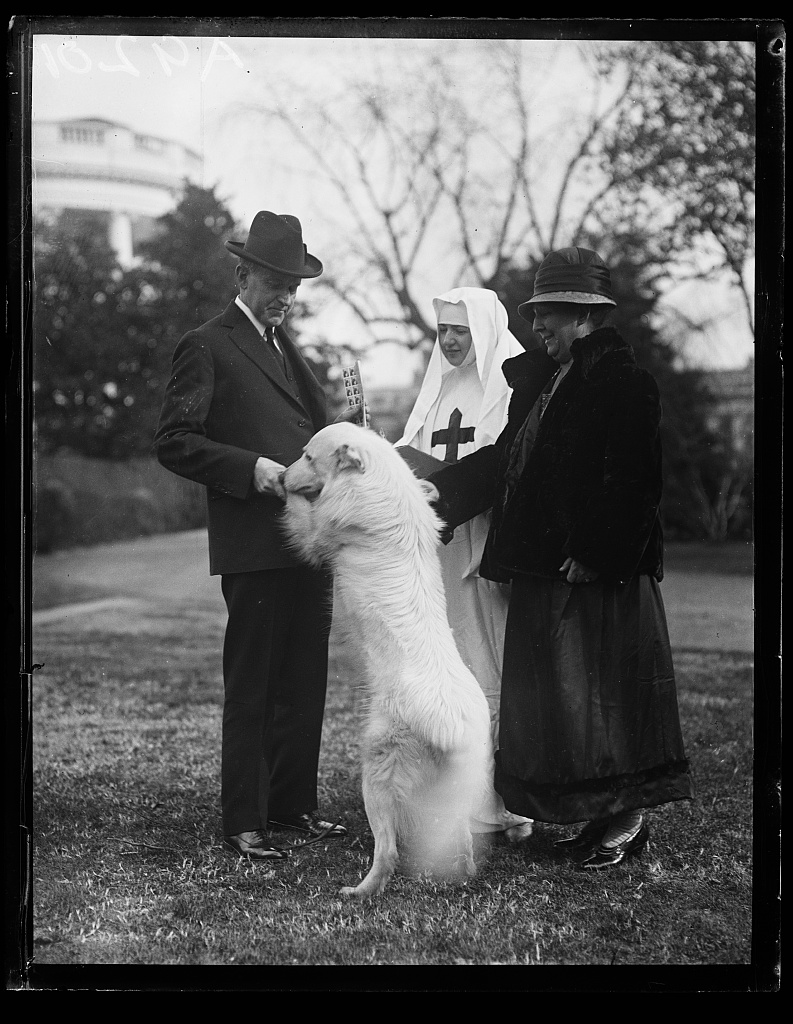
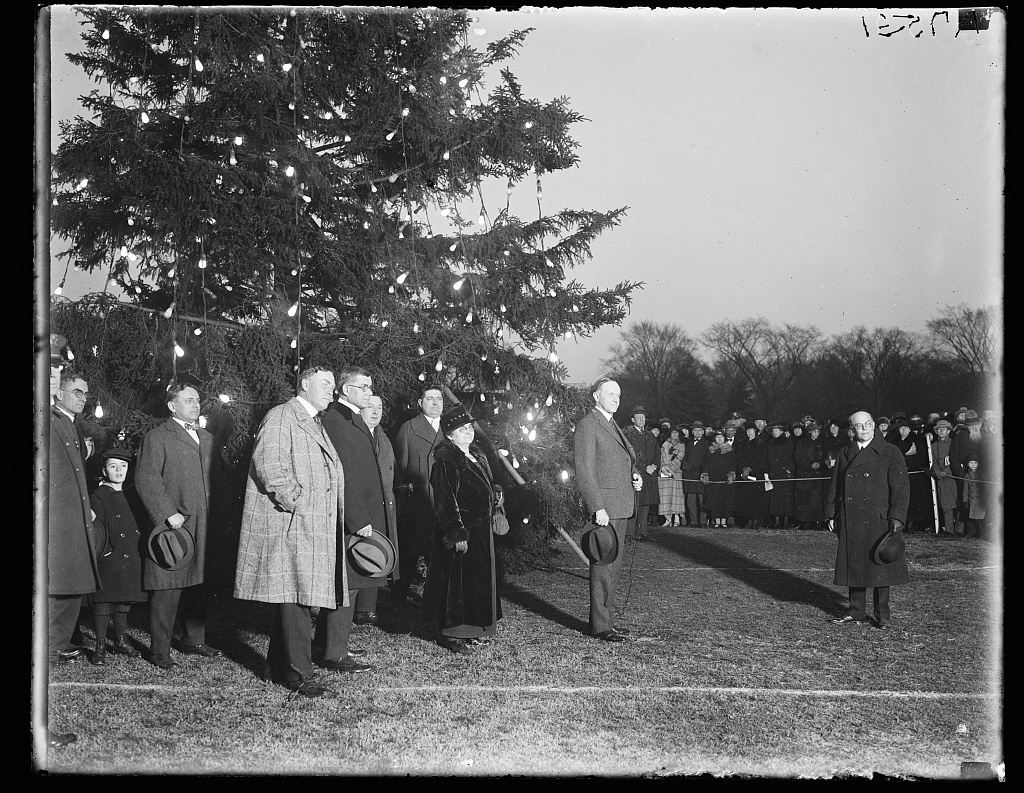
For the Coolidges, the season seemed to kindle an extra sense of the magical power inherent in its omnipotent roots, bringing everyone a little closer to those things of the spirit that no force can destroy, no will crush, no darkness extinguish. It harnessed, as Cal once said, far more than “just a season” but rather “a state of mind.” Its spirit found revived expression in the adornment of the White House as a home for young children once more, a tradition not enjoyed since the Taft years. The Blue Room returned to its place as the cozy spot for a humble tree trimmed by the First Lady and her boys. The spirit of service found rightful expression also in her preparation and distribution of food baskets and gift parcels. The President inaugurated the first community Christmas Tree lighting exactly one century ago. Together they launched the Christmas Seals campaign each year to support the work of the National Tuberculosis Association. It was their initiation of musical performances, though, that became a staple of Christmas during the Coolidge years. Nor were these programs limited to Sousa’s Marines or small groups of musicians but featured what became an annual — and beloved — custom: the singing, without accompaniment, of carols. The high point of these programs consisted of the sixty-member choir of the First Congregational Church under the direction of the talented Mrs. Ruby Smith Stahl. Alongside a full collection of established favorites, the lineup came to include Dr. Jason Noble Pierce’s “The Bells of Christmas,” composed in 1925 and dedicated to Mrs. Coolidge. When the Coolidges opened the grounds to the public and encouraged guests to sing along, they were tapping the power of music to reach souls.

They understood not every gift was tangible. Joining their inner official family, which included Mary Randolph and Laura Harlan, the First Lady’s secretaries, Ted and Henrietta Clark, the President’s personal secretary, Colonel Starling, the President’s Secret Service agent, Frank and Emily Stearns, and Dr. Joel and Helen Boone, assistant White House physician, who gave the Coolidges the daughter they did not have in their own little girl, Suzanne. Just six at the time, she became a regular recipient of the Coolidges’ adoration and generosity. When she learned from Dr. Boone that a Washington family had lost a father around Christmas, she gave up her presents to comfort the mourning children. Dr. Boone later remarked, “It gratified me, at her age to have her demonstrate her philanthropic disposition, which she has maintained throughout her life,” and whether acquired or born with that quality, he noted, “She was always most thoughtful of other people.”

It makes it easy to see the joy with which the President and First Lady both gave and received gifts, especially when Suzanne was concerned. When she gave them a carving knife and fork set (and cookies for good measure), Grace relayed the President’s playful doubt whether he had anything left to cut. Mrs. Coolidge shared her answer with Suzanne: If nothing else, “he can cut peas with it.” The next day (December 28, 1926), the President wrote his thanks to Suzanne, saying, “The Christmas cookies which you sent to me were all that you said of them in your note and you can be sure that they were much enjoyed.” The previous Christmas produced this note to Suzanne from Grace:

  For Suzanne’s dolly. An elderly lady made this quilt for me and Santa Claus and I knew that she would like to have Suzanne use it to keep her dolly warm this cold wintry weather. There are not enough squares to tell Suzanne how much Mrs. Coolidge loves her. Merry Christmas.

Dr. Boone became an older brother and confidante for the Coolidge boys too. He accompanied the boys almost daily during their Christmas break from school, especially Calvin Jr. Tragically, it proved his only Christmas at the White House. The boys came to relish their horseback rides through Rock Creek Zoo.

Without the Boones and the closely knit inner circle of extended Coolidge family, Christmas in the years to come would not have been as rich. We are shaped not only by the families in which we are born but also by the families which form by choice and circumstance. Without, however, that highest debt paid for us and which we owe everyone — selfless love — can Christmas be said to live, truly, in each of us?

A Merry Christmas to all this 2023!

Coolidge Back on the Campaign Trail

It is interesting to see that Calvin Coolidge has returned to the spotlight among Republican candidates this past week when they were asked “Which former President would you draw inspiration from for your own presidency and why?”

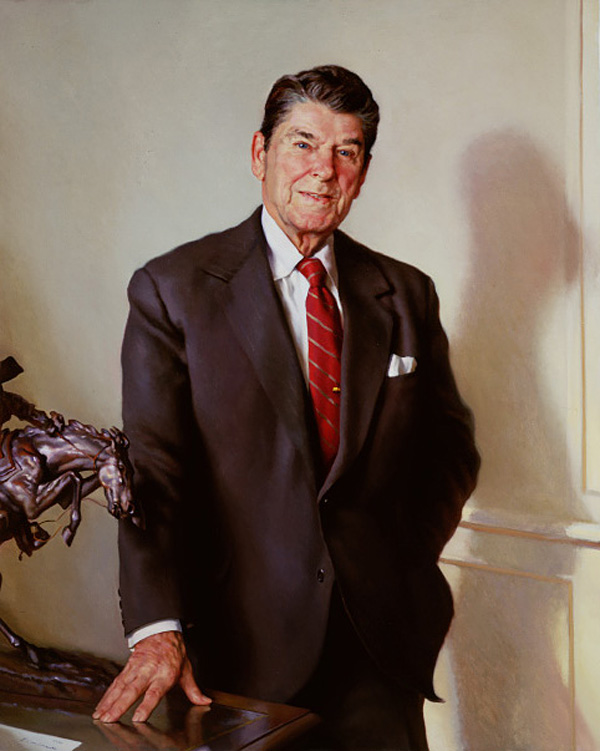
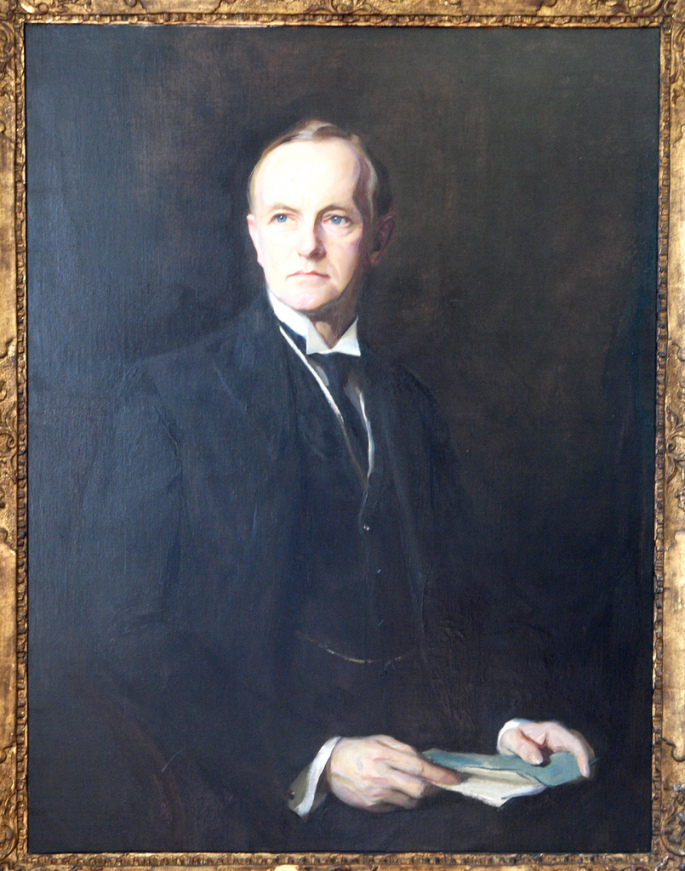
Former Governor of New Jersey Chris Christie declared that, for him, it had to be Ronald Reagan. Promoting his forthcoming book on the fortieth President (“What Would Reagan Do?”), Christie said Reagan was “a slave to the truth.” He was one who “stood up for the truth whether it was popular or unpopular at the moment.” Citing an example, Christie pointed to Reagan’s opposition to extremists in the anti-communist, socially right-wing John Birch Society in 1964, reflecting the kind of Presidency he aspires to have. Of all that could have been illustrative of Reagan, what an interesting choice of anecdote to make, Governor Christie. I suppose it reveals where your priorities rest. Of course, Reagan’s deep affinity for Cal — placing Coolidge’s portrait (by Frank O. Salisbury) in the Cabinet Room — is long known.

“Ron” Reagan (1981-1989)

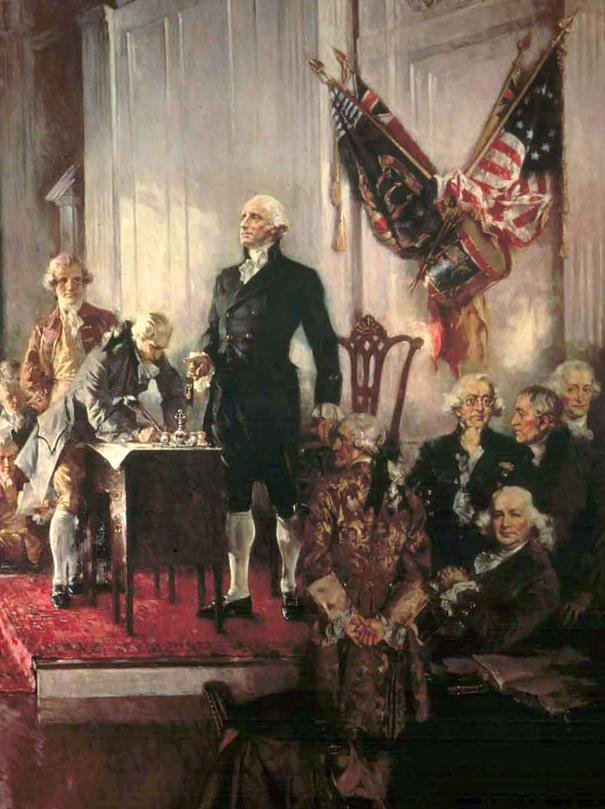
Former Governor of South Carolina and U. N. Ambassador Nikki Haley answered with both George Washington and Abraham Lincoln. For her, Washington’s sense of responsibility to “take on this great American experiment…intended to secure the rights and freedoms of the people” without becoming “all things to all people” illustrates the balance she would seek as President. Reflecting on the challenges and divisions Lincoln faced, she praised his ability “to lead in spite of the loud noises,” exemplifying a call for “what will bring out the best in people to get us to go forward,” supplying vital leadership that is needed “now more than ever.” Presiding at the 1926 sesquicentennial of American independence in Philadelphia, Coolidge learned that the half dollar minted for the occasion featured Washington’s profile alongside his own, an honor few Presidents have enjoyed. It is also consequential that among the possible Presidents recognized on Coolidge’s bookplate, it is Washington whose portrait features in the design. Cal made it clear that Washington deserved his preeminent standing “as the possession of all humanity, the first citizen of all the ages.” Of the sixteenth President, Coolidge also said: “In the greatness of Lincoln the people of this nation are lifted up to their own greatness. As they looked on him they beheld their better selves…The influence of Lincoln did not abide in America alone. The great cause which he led to victory went forth into the world…That vision has not yet been fully realized, but people see it more and more clearly; they strive for it with greater and greater success.”

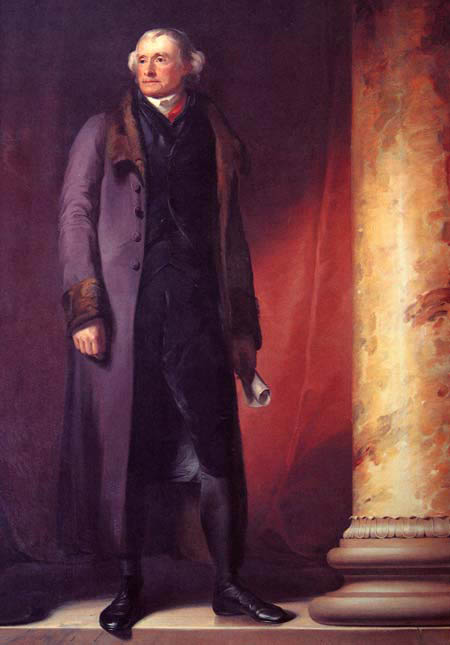
Vivek Ramaswamy, founder of Roivant Sciences, affirmed his inspiration was Thomas Jefferson. The man who wrote the Declaration at age 33 also invented the swivel chair, Ramaswamy asserted. Technically, the chair he used while writing the Declaration was a Revolving Windsor Armchair purchased the year before in Philadelphia and built according to his specifications. He did not patent the design and thus the now-familiar swivel chair is a later development. Nonetheless, Ramaswamy noted, Jefferson gives expression to that “founding spirit” of pioneers and explorers “that we miss.” Ramaswamy, in wondering what would Jefferson say to today’s Republican Party, averred that “one thing he’d remind us of” would be “freedom of speech” where “you get to express yourself freely no matter how heinous the opinion. Thomas Jefferson understood that. He’s an inspiration for me,” Ramaswamy said. Coolidge certainly felt a very strong link to July Fourth and the man who wrote its resonant Declaration. He could see, however, the ways in which Jefferson’s manifold ideas across a career of more than forty years had limits. When his ideas collided with conditions as they were, the dissonance provided a rich lesson in how governance by theoretical philosophy is not the same as governance by practical experience. As Cal wrote of Jefferson in his Autobiography, “In spite of all his greatness, anyone who had as many ideas as Jefferson was bound to find some of them would not work. But this does not detract from the wisdom of his faith in the people and his constant insistence that they be left to manage their own affairs. His opposition to bureaucracy will bear careful analysis, and the country could stand a great deal more of its application. The trouble with us is that we talk about Jefferson but do not follow him. In his theory that the people should manage their government, and not be managed by it, he was everlastingly right.” Coolidge was both a man of thought and ideas without ever being carried away by lofty abstractions. He kept his anchor, navigated the main currents, and proved how to win and how to govern well. Consequently, he could both sincerely admire and honestly disagree with his predecessors, however different they were from himself.

Thomas Jefferson (1801-1809)

When Florida Governor Ron DeSantis was asked, he chose Calvin Coolidge. As cheers went up in the hall, he continued, “Now people don’t talk about him a lot but he was one of the few Presidents who got almost everything right. He understood the proper role of the federal government under the Constitution.” DeSantis urged the need to restore the central role of the Constitution to our outlook and the importance of a President who sees how to rein in the administrative state. He summarized: ” ‘Silent Cal’ knew the proper role of the federal government. The country was in great shape when he was President of the United States, and we can learn an awful from Calvin Coolidge.”

One of those lessons for certain candidates might be the choice when not to run. Sometimes a seemingly lesser office is a more meaningful and powerful place for leadership. As Coolidge once said, “The states are the sheet-anchors of our institutions. On them falls the task of administering local affairs.” He also once observed, “What we need is not more Federal government, but better local government.” Some candidates have already recognized this higher principle of service. Despite virtually launching his Presidential campaign in February this past year at the Coolidge Centennial Conference in Washington, D. C., it is evident that former Vice President Mike Pence, another admirer of Cal, took that advice to heart in October.

Ramaswamy noted that while DeSantis may have picked a President born on the Fourth of July, Vivek selected the President who died on that day…on its fiftieth anniversary. There are other lessons to be learned from Cal. Coolidge remains one of the most successful political candidates in American history, winning every contest for elected office except one early in his career: school board. Moreover, he achieved a governance with few mistakes. For candidates looking how to win campaigns, there is little need to go farther than Cal, whose style, strategy, and technique bear study and replication. Perhaps a President who places great value on the spoken word and who refuses to see himself as great or deserving of his turn in office is just what Americans need. If Coolidge were here, there is little doubt he would not be standing on a debate stage touting his own credentials. He would be talking about Jefferson’s Declaration, Washington’s character, and Lincoln’s perseverance, reminding Americans to keep faith with their ongoing experiment in self-government. Whatever choice is made for President next year, however, it is welcome to see Calvin Coolidge back in public discourse.