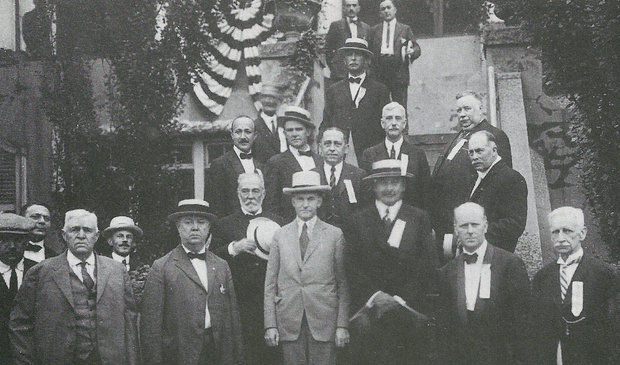
Vice President Calvin Coolidge with citizens of Elizabeth, New Jersey, July 1, 1922. Courtesy of the Elizabeth Public Library.
As public discussion turns to the tax plans of Presidential candidates and even to budget negotiations ahead this month, how about we also include spending discipline and debt payment as central components to any real discourse on policy? Calvin Coolidge made a point of repeatedly celebrating the accomplishment that combines real debt payment with spending reductions – whether one is an individual, a household, or a government. For Coolidge, tax cuts were secondary to debt payment and spending discipline. Plenty of people want to talk about the former and far less about the latter two. As Coolidge would say two years after this photo was taken,
“The prosperity of the people is intimately bound up with the financial policy of the Government. A considerable but disorganized number of people exist who are willing to talk about economy in public expenditure. There are a very few who, in addition to talking about it, are willing to act and vote for the actual practice of economy. But spread all over the land there are thousands upon thousands of organizations ceaselessly clamoring and agitating for government action that would increase the burden upon the taxpayer by increasing the cost of government. To my mind, the practice of public economy and insistence upon its rigid and drastic enforcement is a prime necessity of the people of the United States. In fact, the necessity is world-wide. That nation which demonstrates that it has sufficient self-control to adopt this course will immediately become the leader in the financial world. That leadership is easily within American grasp. But to secure it requires prompt action and constant vigilance.”
He knew any genuine solution to economic turmoil had to confront, sooner or later, the harsh conditions that debts not paid and expenditures flagrantly indulged inflict on people. The end will only be worse the longer we delay that day of painful but necessary reckoning in America. Here is Coolidge recognizing the people of the city of Elizabeth, New Jersey, for making the tough decisions and exercising the discipline required to pay off 50% of its debt. All this forty-three years after an earlier generation had declared bankruptcy, mistakenly believing the fiscal situation to be an irretrievable loss. The road back was not achieved by creating a constant climate of emergency whereby they could cover their procrastination with meaningless resolutions that did nothing but put off the real day of hard choices to some unknown time in the future. The way back toward solvency came by making their day the day of reckoning, not leaving the mess to get sorted out after they were gone. If we are ever to see a light at the end of our fiscal tunnel, it will demand the same kind of determination and courage that Coolidge’s generation had.
 The Importance of the Obvious