
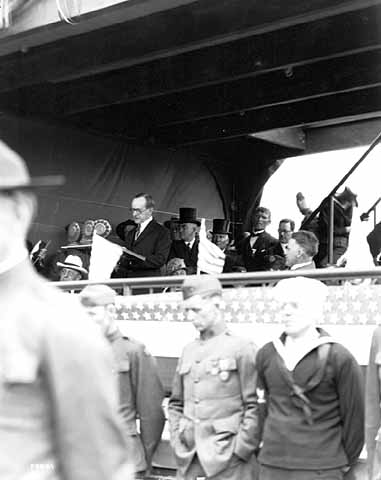
President Coolidge speaking at the Minnesota state fairgrounds in St. Paul, June 8, 1925.
Coolidge was the first to declare he was “not conscious of having any particular style” about his writings. So when The New York Times’ correspondent assigned to cover Washington, Charles Willis Thompson, wrote a piece on Coolidge’s distinctive style as a writer, Cal wrote from the White House on the day following its publication: “If I have any [style], it is undoubtedly due to my training in the construction of legal papers, where it is necessary in the framing of a contract, or the drawing of a pleading, to say what you mean and mean what you say in terms sufficiently clear and concise so that your adversary will not be able to misinterpret them, or to divert the trial into a discussion of unimportant matters. The rule,” Coolidge pointed out, “is to state the case with as little diffusion as possible.” He accomplished exactly that. In fact, that was his defining characteristic as a writer. Coming out of the last generation that elaborately adorned every phrase with intricate eloquence, Coolidge decisively broke this contemporary tradition with his signature: the short, pithy sentence.
Whether he fully recognized it or not, he had a unique style. Correspondent Thompson studied this in careful detail through Coolidge’s thirty years in public life. Thompson presents his analysis of the Coolidge Style in Presidents I’ve Known and Two Near Presidents, published just as Cal was leaving the Presidency. Thompson writes, “From standpoint of style alone, Coolidge is one of the two most gifted men who have lived in the White House for two generations. He is, in fact, one of the very few Presidents who can be thought of as literary men. The difference between him and such a stylist as Woodrow Wilson is that he used his style only as a tool and not as an ornament; he only used it when there would be some advantage in using it. In this, as a literary man, he somewhat resembled Lincoln. To hear people talk you would think Lincoln never opened his mouth without uttering a Gettysburg Address. The truth is that nearly all Lincoln’s public utterances are just as trite and commonplace as Coolidge’s or Taft’s or McKinley’s or those of any other President.”
Thompson, after comparing a few of Cal’s predecessors, returns to style of the Vermonter. “His weapon is the short sentence, but anybody who gives his mind to it can acquire, though with difficulty, the use of the short sentence. The difference is that each of Coolidge’s short sentences, when he is producing a real composition and not merely giving commonplace voice to one of the perfunctory utterances his position calls for, is the distillation of a long process of thought. What another man might need a page to express can be set forth by Coolidge in a sentence of a dozen words and set forth completely, so that it does not need another syllable.”
Thompson, having studied him so closely, discovered he was not the drowsy illiterate the “Intelligentsia” assumed him to be. “Coolidge’s wide reading” did not govern him. “[H]e thinks for himself.” This was brought home potently with his scathing veto of the McNary-Haugen bills, forcing the Washington clique to cast about for some explanation for this remarkable phenomenon. It ran against the very caricature they had constructed of him in their own minds, “a colorless Coolidge…dull, passionless, uninspired, heavy-witted,” an impression imposed on him that could not be wrong. Could it? Thompson cites their delusion as “The Coolidge Myth,” the one fellow correspondent Frank R. Kent identified. But Kent was mistaken. “There was, indeed, a Coolidge myth…one he and men like him created; the myth of a book in the White House. And whenever, as in the McNary-Haugen veto, he did something out of character for a boob, they concluded, not that they had created a myth, but that the man they understood so perfectly had an unaccountable habit of refusing to stay put.”
Thompson mentions that while while Coolidge disagreed with him on the existence of a distinct style, Cal was simply being modest. Wherever he got it, the point was, Thompson affirmed, Coolidge had it. Thompson was even so bold as to counter Cal’s argument: If he acquired it from the practice of law, then all lawyers should be “masters of style.” Everyone knows they aren’t. But the former President stuck to his humble guns and Thompson remained undeterred in the conclusion that Calvin Coolidge possessed one of the most remarkable and underrated styles of any President. No one notices that, Thompson says, but it remains so nonetheless.
Little could anyone suspect that sixty years later a student and admirer of ol’ Cal would rediscover the incredible wealth to be mined from #30’s cogency of thought and talent as a communicator. Her name, Peggy Noonan, would help give direction to the voice of Ronald Reagan. She writes in What I Saw at the Revolution, about but one sample of Cal’s rich writing, “Calvin Coolidge’s [Inaugural] was clear as crystal and written with a kind of dry fluidity; it didn’t ask you to like it” (187). Such could describe most of what Coolidge wrote. When much of current rhetoric is seen desperately begging for approval, we come to a style that just says what it means and doesn’t apologize to the hearer or ask for anything. “Take it or leave it” runs through Coolidge’s style. Perhaps that quality, more than anything, is what makes him so refreshing today. By returning to this fountainhead of expression, a clarity we seriously need in our public and private discourse now, we not only find the original “Great Communicator” (hailing from Vermont not Illinois) but we learn what it means to think and speak in simple truths again.

 The Importance of the Obvious