Merry Christmas 2015!

President Coolidge lighting the community Christmas tree, 1924.

President Coolidge lighting the community Christmas tree, 1924.

The Chief Historian for the White House Historical Association has completed a fine essay on the Coolidges and the White House during their stay, 1923-1929. As Mr. Bushong points out, “Throughout the Coolidge administration, Christmas celebrations were a mix of traditional family gatherings and the new community centered public ceremony” centered in the lighting of the community tree on the Ellipse. It was Coolidge who inaugurated that signature custom. Originally for the families and other residents of the District of Columbia, it has become a National Event.

Christmas Day was spent by the Coolidges giving of their time and service to those in need, from the preparation of food baskets at the Salvation Army to visiting the veterans at Walter Reed Hospital. Coolidge once said, “No person was ever honored by what he received. Honor has been the reward for what he gave.” The Coolidges lived that ideal.

While the lighting of the community tree was then a local highlight, the real focus at the Coolidge White House during Christmas came with the singing of carols. Singing and the music of the Marine Band were central to Christmas night with the Coolidges. In 1924, a new carol, “Christmas Bells” was composed by Jason Noble Pierce, the pastor of the Congregational Church in D.C., and dedicated to Grace Coolidge. “Ring, ye, Christmas bells of peace. Ring for days when wars shall cease.” That same night, the 1880 choral piece, “The Angel’s Song at Bethlehem” (setting the account of Luke 2:8-14 to music) was sung and heard from the North Portico of the White House by the thousands gathered there. It was the facts of Christ’s coming, His work, and His living again that made peace and goodwill possible, the Coolidges knew, as the hymn goes,

“Glory to God in the highest!

“And on earth peace, goodwill toward men!

“Glory to God!”

Merry Christmas!

Singing Christmas carols from the North Portico at the White House, 1923.
Singing Christmas carols from the North Portico at the White House, 1923.

A Review of Donald McCoy’s “The Quiet President”

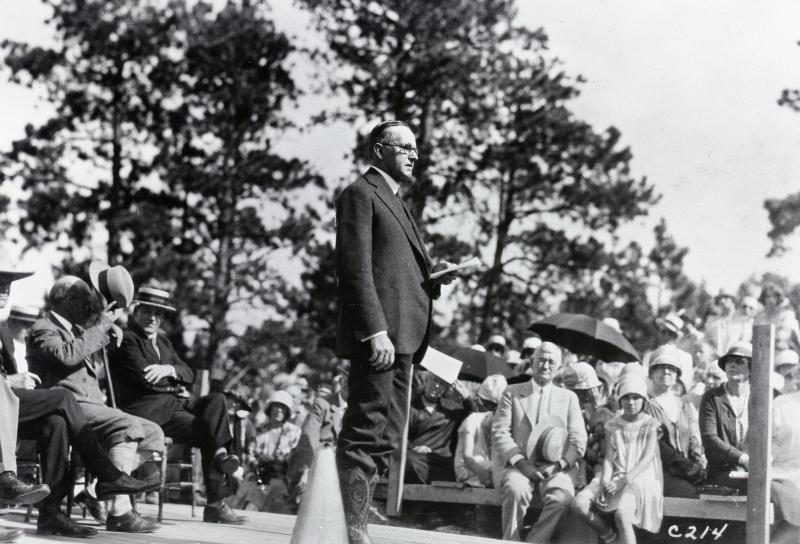
President Coolidge dedicating the Rushmore Monument, August 10, 1927.

President Coolidge dedicating the Rushmore Monument, August 10, 1927.

Published in the midst of the “Great Society” Era, McCoy’s interpretation of Calvin Coolidge strikes the reader as a calculated compromise with the times. McCoy cannot quite sympathize with Coolidge as Fuess did (eighteen years before) nor can he join White, Hoover, Schlesinger, and others in venomous indictment but he still has to find grounds for criticism. This is encountered from Cal’s handling of the Boston police strike to his failure to halt the speculation that led to the Stock Market Crash eight months after he left public life, at least according to McCoy. McCoy navigates a middle course overall, as our friend has noted, no less constrained by the temperament of his era than he attributes Coolidge to be in his own. While there is certainly less hostility in McCoy’s work than in the treatments of the preceding generation toward Cal, he still heaps unwarranted complaints against him for being reactionary in 1919 when the issues and attitudes were very much with then-Governor Coolidge, anything but out of touch. McCoy’s book, a product of its time, would finally receive due analysis in Thomas B. Silver’s excellent study, Coolidge and the Historians. Dr. Silver would not only expose the errors in the assumptions and preconceptions that had been thrown up against Cal for some forty years he would persuasively argue where McCoy and his forbears got it dead wrong when it came to #30.

Check out our friend’s review and please pick up a copy of Dr. Thomas Silver’s indispensable and timeless work, Coolidge and the Historians.

A Review of William Allen White’s “A Puritan in Babylon”

Coolidge, enjoying retirement from public life, with his dogs on the front porch of their first home, 21 Massasoit Street, Northampton, Massachusetts.

Coolidge, enjoying retirement from public life, with his dogs on the front porch of their first home, 21 Massasoit Street, Northampton, Massachusetts.

Our friend at Best Presidential Biographies has presented a review of the book that perhaps more than any other is responsible for the “Coolidge Stereotype”  that inspired later historians (using that term in the loosest possible sense) to officially declare Cal belongs to the lowest reaches of Presidential ranking games as a failure or, at best, a non-entity. Coolidge was neither, despite White’s best efforts to topple the reputation of a man who left the White House one of the most popular Presidents in history (no easy task!). Released in 1938 with the sweep of revisionism that displaced the admiration for the Coolidge Era with a systematic effort to shore up the FDR administration with equally popular support and historical legitimacy, White’s book inspired the Schlesingers and Francis Russell, among others, to take up the drum beat of literary hostility to Coolidge in academia. Despite Fuess‘ counter-punch, this narrative was left essentially unchallenged until the late 1970s when Marvin Stone at U.S. News and World Report, Thomas Silver at Claremont, and finally, Ronald Reagan, through his nationally syndicated radio program, rekindled a fascination for the wise Vermonter that inspired a renaissance in the 80s and 90s for the most “forgotten” of men, “Silent” Cal. Mistakenly relegated to the margins for too long, Coolidge is now experiencing a third wave of interest thanks to Robert Sobel, David Pietrusza, and Amity Shlaes, among many others.

Very few indeed can identify today the “Sage of Emporia,” as White was once known, but every day finds a growing multitude who not only know Calvin Coolidge but admire him deeply for very good reasons, respecting both what he represents and what he accomplished. In that way, White has failed, and deservedly so. White is long forgotten but Coolidge remains, speaking even now to an America that needs the importance of the obvious, a culture that needs what he said about the development of character, and a government that needs a return to his political principles.