Home Again: Touring the Homestead

426_1917-1934-2Bbpl

Courtesy of the Boston Public Library, Leslie Jones Collection.

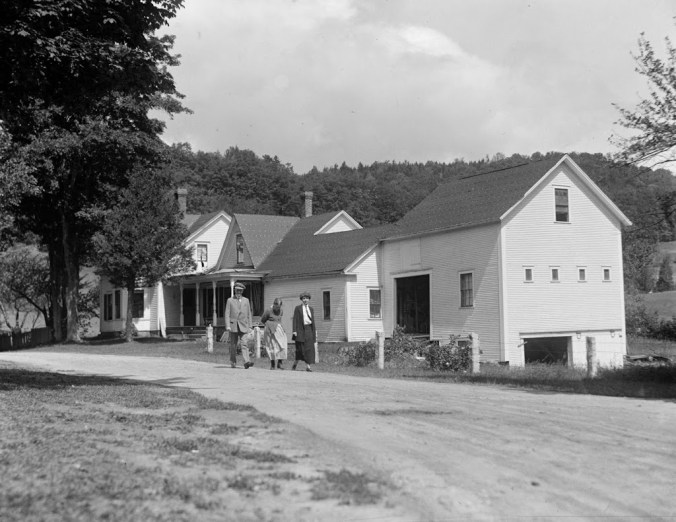
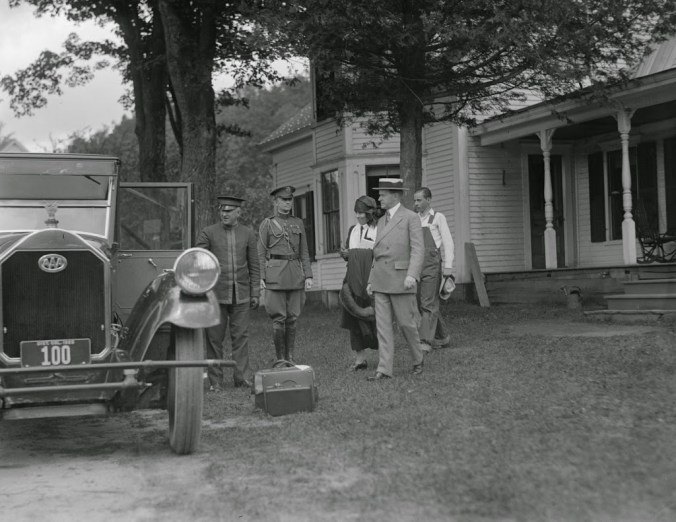
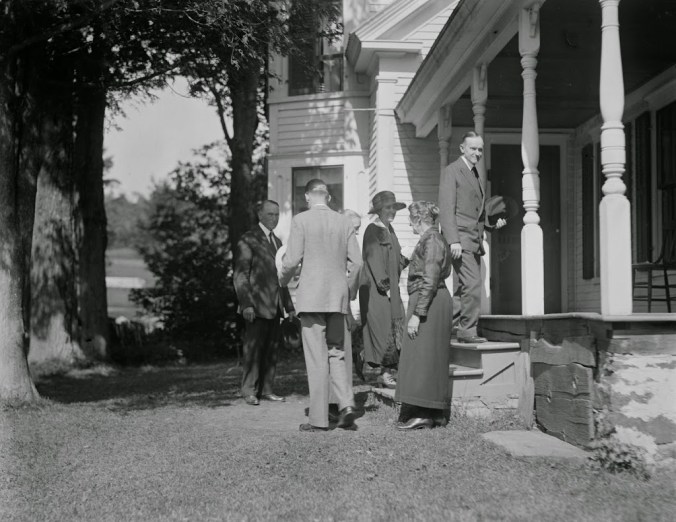
In his feature of the Calvin Coolidge Homestead a year ago, Bob Villa presents the unmistakable character of Vermont architecture as it continues to live on in the Plymouth Notch home of the former President. While it no longer includes the addition put on by Coolidge in the summer of 1932, to house his library and the overflow of gifts acquired during their stay in the White House, it remains a visual testament to the practical sense and organic growth – form following function in a sense – that is such a trademark of the Notch in particular and Vermont in general.
433_1917-1934-2Bbpl

Courtesy of the Boston Public Library, Leslie Jones Collection.

It bears the same kind of structural signature that recurs all across our nation wherever the sensible prevails over the ostentatious and the practical over the polished, where accomplishing the task against the challenge of the elements means more than a showy appearance or photogenic exterior. Isn’t that simply a reflection of the character of the men and women who lived there? They were more concerned about the day-to-day work and demands of the land and farm than packaging the house as an ornamental showpiece or gauge of status. This emphasis on the down-to-earth things is an outlook on life that captures its own beauty, don’t you agree?

As Coolidge thought about the house where he grew up, he wrote,

“About it were a considerable number of good apple trees. I think the price paid was $375 [this house stood across the street from where he was born, the Homestead pictured here being built upon two acres with a number of barns and a blacksmith shop, all bought by his parents when he was about 4 years old]. Almost at once the principal barn was sold for $100, to be moved away…Some repairs were made on the inside, and black walnut furniture was brought from Boston to furnish the parlor and sitting room. It was a plain square-sided house with a long ell, to which the horse barn was soon added. The outside has since been remodeled and the piazza built…Whatever was needed never failed to be provided.”

What does your childhood home – whether it still physically stands or not – reveal about you and your people? Perhaps, if we took a moment to listen carefully, we may hear what the walls have to say.
432_1924-08-2Bbpl

Photo courtesy of the Boston Public Library, Leslie Jones Collection.

Will Rogers’ Nomination Speech

Will_Rogers_1922

Will Rogers, two years before in 1922

After the methodical calm of the three-day Republican Party’s Convention in Cleveland a month before, the raucous and unhinged Democrat Party’s gathering in New York City could not have furnished a greater illustration in contrasts. The crowded field of candidates was only one of the concerns with vast disagreements brewing over the platform and baneful persistence of the Party’s two-thirds majority rule to approve business. The choice of one candidate would prove to be the worst sticking point for the delegates assembled at Madison Square Garden that July. Before the balloting even began, Will Rogers, in characteristically dry fashion, remarked that he missed five nominations alone one morning after arriving late to the convention hall.

It became such a circus that he composed a nominating speech for publication in the New York Times the day just before July 4th, ten long days after the Party had first convened. Rogers offers, in customary fashion for nominations of the time, his candidate of choice who remains nameless until the very last phrase.

He wrote,

“The man I am about to name is the only man in these grand and glorious United States who, if we nominate, we can go home and have no worry as to the outcome. Don’t, oh, my Democratic Colleagues listen to my friend [William Jennings] Bryan. He named ten candidates; ten men can’t win! Only one man can win. Oh, my newly made friends, have confidence in me. Trust me just this once and I will lead you out of this darkness and wilderness into the gates of the White House. Oh, my tired and worn friends, there is only one man. That man I am about to name to you is Calvin Coolidge.”

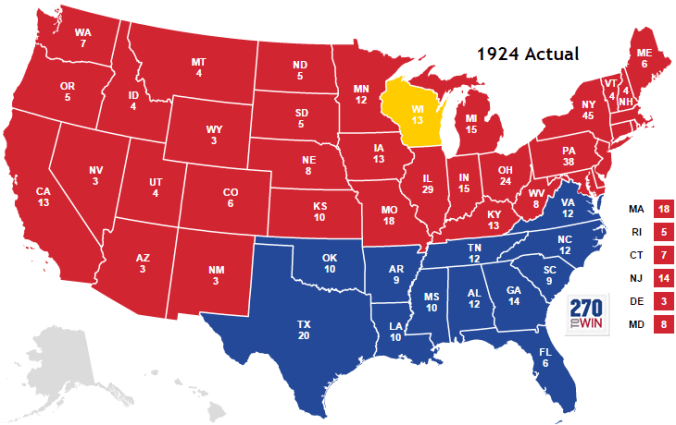
Of course, presented as it was to Democrats, it was proposed only half-seriously. He knew they would never seriously consider it, especially after mindlessly demonizing Cal and the Republicans for months leading up to this moment. Still, as conversant as Will Rogers was with humor, he knew the best jokes retained a kernel of truth. In Rogers’ estimation, when it came to Cal, there was a whole lot more than a single grain of merit there. Coolidge was an entire bumper crop of good sense and practical wisdom. He was exactly what the nation needed. The country certainly thought so too that November, electing Mr. Coolidge to his own four-year term in what for all intents and purposes was a landslide victory.

coolidge-two-coolidge-button1924_large

On Shakespeare and the Masters of English Composition

Hall, George Henry, 1825-1913; An Ideal Portrait of William Shakespeare (1564-1616)

Depiction of William Shakespeare by George Henry Hall (1825-1913). Courtesy of the Royal Shakespeare Company Collection.

This month, marking the four hundredth anniversary of the great William Shakespeare’s death (April also being the 452nd anniversary of his birth), we honor the “Bard of Avon” with this remembrance from Calvin Coolidge, the last classically educated President we had:

Reflecting on the impact of his immersion in the great literary Masters, Coolidge understood the civilizing and ennobling power of good literature on the character. It accomplishes what no other creative art can. The love of truth, beauty, and goodness all find their soul-nourishing expression in the poetry, prose, and creative thoughts of great English composition (first and foremost in the English Bible of Wycliffe), followed by Shakespeare and those who (like Philip Sidney, the Bard’s contemporary, explained it) were better at articulating eternal truths and more prescient than most philosophers at inspiring those who read them to love what is noble, seek what is good, disdain what is debased and reject what is evil.

Coolidge summarized this way his life-long appreciation for the ongoing conversation captured by Shakespeare and perpetuated by those both new and old to the dialogue of great ideas who, in turn, derived their inspiration from the authors of antiquity:

“My evenings I gave to some of the masters of English composition. I read the speeches of Lord Erskine, of Webster, and Choate. The essays of Macaulay interested me much, and the writings of Carlyle and John Fiske I found very stimulating. Some of the orations of Cicero I translated, being especially attached to the defense of his friend the poet Archias, because in it he dwelt on the value and consolation of good literature. I read much in Milton and Shakespeare and found delight in the shorter poems of Kipling, Field and Riley (The Autobiography p.73)

As Lysander replies to Theseus in Shakespeare’s Midsummer’s Night Dream, “It is not enough to speak, but to speak true.” The greatness of literature is not in its deconstruction or eradication as politically incorrect and embarrassing monuments to the supposed existence of white male oppression. It presents us the world as it is, in truer form than postmodernism can permit and from which would seek to escape through absurd theories that deny the very essence of creativity, the discrimination of values, and the capacity of all human beings to judge and discern truth, goodness, and beauty. Rather, the power and importance of great literature come from the truths universal to the nature of human beings and the colorful tapestry of reality. By tapping into that reflection of our natures we are taught principles that inspire and improve, declare words have precise meanings, feed our souls and train our minds, equip and correct with an insight that all can share, appreciate, and proudly claim as one’s own. Moreover, we can engage in this joyous ownership wherever and whenever we were born, brought to each of us by the great discourse of ideas found within the English Canon.

youngcal

Here is a young Calvin Coolidge launching out on the beginning of his life in public service, starting here with a thorough training in the classics.