
Vice President Coolidge, Fredericksburg, Virginia, July 6, 1922.
Coinciding with the week of the one hundred and forty-sixth year of American independence, Vice President Coolidge spoke before those gathered in Fredericksburg on July 6, 1922. They had gathered not only to honor the Great Virginians who led during some of the darkest hours in our history but to rescue what had become known as Kenmore, the home of Fielding and Betty Lewis, began in 1752. Colonel Lewis stood among those lesser known but no less bold patriots who gave themselves to ideals that were anything but universally accepted or settled in their outcome at the time. His wife was the sister of George Washington.
The home had taken the shelling and occupation of Fredericksburg during the War between the States and after passing through several owners was very much in need of repair. Consequently, it was scheduled for demolition. The history and significance of another monument to courage and conviction would be swept away forever. It was then that Mrs. Kate Barrett of the Daughters of the American Revolution entered the picture and began the campaign that would save Kenmore. Through the tireless energies of Mrs. Vivian Fleming and her daughter, who wrote dozens of letters without the aid of a single typewriter, an awareness of Kenmore’s significance reached all the way to those most sympathetic of preservationists, Calvin and Grace Coolidge. While the national drive to rescue colonial landmarks was already well underway, the enthusiasm by the Coolidges to help launch this campaign was decisive to its success. The inauguration of this work was scheduled for the already busy first week of July 1922.
As Coolidge characteristically approached the subject of a speech through its larger significance to the overall unfolding of events, so he does here. Kenmore represented something more than just another artifact of the eighteenth century, it was a piece of a much grander tapestry over which the Great Virginians labored. It was their contribution to the liberty of all individuals, their fight to attain what was gravely in doubt of vanishing permanently, their role in the working out of self-government. It was not perfect, their work was left incomplete (not because those Virginians failed) but wanting in the efforts of future generations to supply their part in the same spirit of those original ideals. It is for this reason that the Revolutionary generation is not known for merely one personality – it did not rest on so flimsy a foundation – but was forged by many contributors. Such a project then could not come from a state or a national government, extorted through taxation, it had to be carried by the people themselves. Raising funds over the next three years, the George Washington Foundation (formed to rescue Kenmore) saw hundreds of private citizens give to the work. By 1925, without a single state or federal dollar, the money had been supplied in full.

Moving Images Research Collections, Courtesy of the University of South Carolina.
Coolidge began,
“We meet here out of reverence for the past. We come with that resolution, which has characterized Americans, to show by our actions our adherence to those seasoned and established principles which have made our country the greatest among the nations of the earth. It is out of this that there is created the very natural desire to preserve those monuments which were associated with the great names and the great times which laid the foundation of our history.
“For more than three generations, now, America has been building, a necessary and desirable operation, worthy of high commendation. This has been a strong index of progress. But to preserve also is to build, and to save is to construct. No people can look forward who do not look backward. The strongest guarantee of the future is the past. Unless that which has been built shall stand with an assured security, the motive for further building is destroyed, and all our structures will go down in ruins.
“We need not only the story but the symbols of past history. We can best preserve our institutions by preserving our confidence in the men who did so much to establish them. It is only when men begin to worship that they begin to grow. A wholesome regard for the memory of the great men of long ago is the best assurance to a people of a continuation of great men to come, who shall still be able to instruct, to lead, and to inspire. A people who worship at the shrine of true greatness will themselves be truly great.”

Kenmore Plantation
Coolidge saw as did everyone else that America had experienced a leap of material advancements since those difficult, uncertain days of 1776. He understood, though, better than many that dollars and cents were not the ultimate end, they were simply additional blessings added because “America, as a nation, has held fast to the higher things of life, because it has had a faith in mankind which it has dared to put to the test of self-government, because it has believed greatly in honor and truth and righteousness.” These spiritual ideals, evident in our boundless giving and sacrificial service, are the driving force not its incidental or accidental passenger. Affluence and economic well-being are mere fruits of those deeply rooted principles. Coolidge, ever close to the hardscrabble reality of the farm, knew the quality of those fruits could only continue if the tree remained connected to the source of our ideals, healthy and whole. The spiritual always came first. To Coolidge, there was a kind of holiness, all its own, that accompanied the land on which righteous deeds had been done.
He continued,
“No State is so rich in history and tradition as the Old Dominion of Virginia…It has ever been the home of a proud and valiant race of pioneers and their descendants, of the early seventeenth century, strengthened and dignified by a dominant addition of Cavaliers and Huguenots, a sturdy and high-minded people, forever jealous of their rights and intent upon guarding and maintaining their liberties. There was always among them the courage of self-reliance and that true spirit of independence which results in local self-government. It was here in July, 1619, that there assembled the first parliament that was ever convened in America, when the first House of Burgesses met at Jamestown and there began those sessions which, being ever since continual, have made it the oldest of our legislative bodies. While the informal Mayflower Compact of November, 1620, holds a high place among the charters of free government, the first formal and authoritative charter which established free government on this continent was that granted to Virginia in July, 1621.
“This was the beginning of true representative government…How great a step toward freedom and independence this charter was, is disclosed by the provision that when a form of government should be adopted, ‘no orders of court afterward shall bind the said colony unless they be ratified in like manner in the General Assemblies.’ Here began an assertion of popular rights carried over into the realm of action which the people of Virginia never relinquished.”
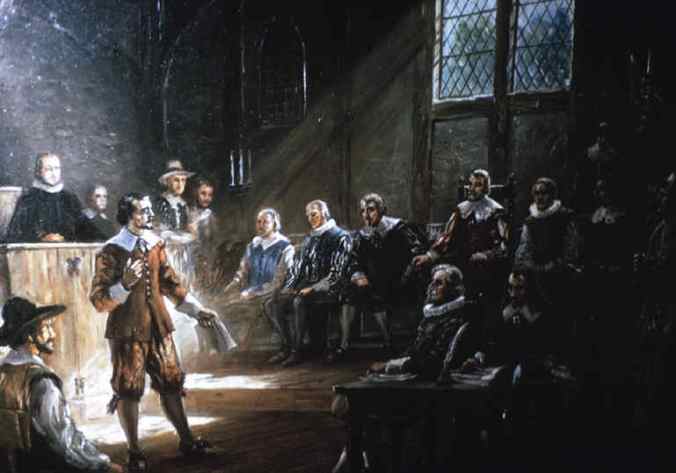
From the “unwarranted interference” in navigation and land ownership by King Charles II, which led to the Rebellion of 1676, through the French and Indian War, to the appeal first to the law before resorting to the sword, Virginians had exemplified not a spirit of freedom without restraint nor some specific genetic virtue but were the first to demonstrate the ideals of being American.
With the targeting of law enforcement officers in Dallas, a pattern continues to emerge not of justice served but of evil unleashed, victims chosen because they are white or suspected because they are black, we are fast experiencing what patriots of all colors and backgrounds sacrificed to avoid – the complete disintegration of law – before the rule of self-designated executioners given permission to choose who is to live and who is to die on the basis of no other crime than one’s incidental skin color. Trained to hate on the basis of group identity, the violent (on both “sides”) use force and despise the very idea of law, giving further credence to the lie that our institutions have always been this prejudiced and corrupt. The fact that they have not been until we helped transform them so is our debt incurred, not the Founders.
Cutting off the memory of what those Great Virginians were defending, we see only white privilege in everything that came before us, when reality flatly condemns us. The ideals the Virginians represented set in motion a series of results that would free all people to attain an independence not from the mildest inconveniences of life, the total escape from all human cruelty or injustice, but from an incontestable power in an elite few thought to be better prepared than ourselves to decide for us who we will be, how far we are allowed to succeed (if at all), what we will do, when and where we will do it. It meant living at the behest of a government expert. For all people , whatever color or background, that meant slavery. Virginians despised that kind of future for themselves and for all who would come after them. Not even God in His infinite power stripped people’s freedom of will, leaving them dehumanized chattel as the unlimited growth of government does. What the Virginians (and those great patriots of cosmopolitan Massachusetts) strove to restore were responsibilities completely foreign (even hostile) to the color consciousness that is eating liberty from the inside out today.

“Patrick Henry in the House of Burgesses” by Peter Rothermel
Coolidge recounts the stirring words of Patrick Henry, whose influence made Virginia the first to oppose the levying of taxes and regulation from distance legislators and overgrown bureaucracies. Henry stood firmly on the principle that Virginia already had duly chosen representation and it was in the House of Burgesses, not London’s Parliament. Virginians were capable of governing themselves. The “ample experience” Massachusetts saw in her “ancient” sister colony added to Henry’s efforts with George Mason, who composed the Virginia Bill of Rights, adopted on the 15th of June, 1776. Virginia became the first to declare its own independence even before the approval of the renowned Declaration by all the colonies in the Continental Congress early the following month. Virginians realized early on not only the need to resist illegal actions by government but the common cause this was for all the colonies. What happened to one affected the others. This was not merely a Massachusetts or Virginia issue, it was, as Patrick Henry put it, an “American” one.
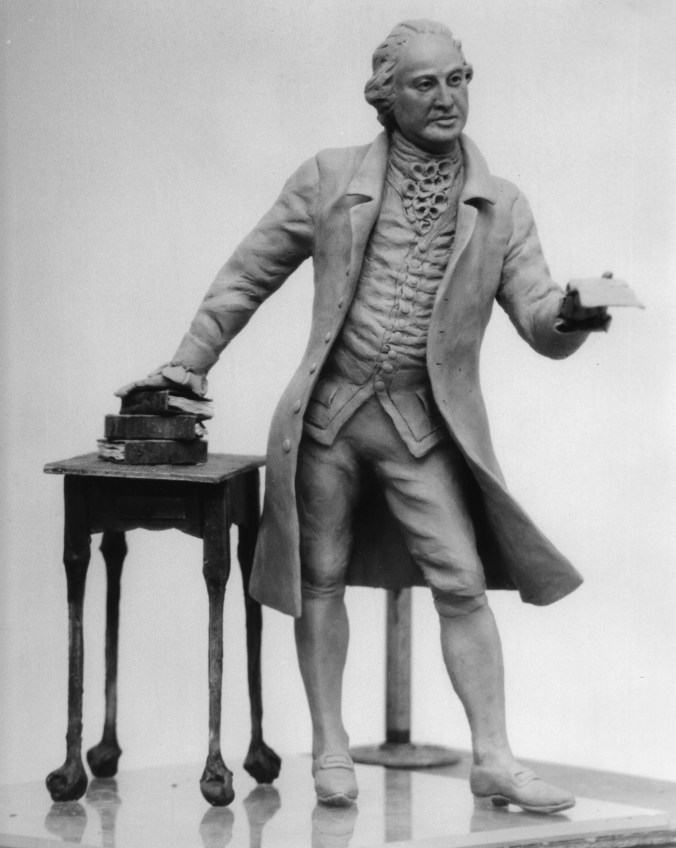
Clay maquette (model) of George Mason bronze sculpture created by Wendy Ross, 1992.
Just as our growing array of deepening problems continue, our interests are bound together. Ours are not white problems or black problems, rich versus poor, Republican versus Democrat. Neither are they one particular state or culture, they are first problems inherent in humanity of all colors and second shared by all who bear the responsibility (not just the reward) of being called Americans.
Even so, Virginians took the lead in America’s early days. Who will take the lead in our time? Texas? Colorado? South Carolina? Perhaps Virginia, again? Or will Americans across the country awaken to that duty which transcends both group politics and individual interest?
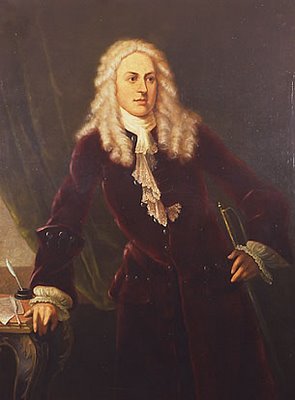
Peyton Randolph, first President of the Continental Congress
Coolidge continues,
“It was a Virginian, Peyton Randolph, who was president of the first Continental Congress. It was another Virginian, Richard Henry lee, who, on the 7th of June, 1776, moved the adoption of the Declaration of Independence…It was another Virginian, Thomas Jefferson, to whom belongs the immortal honor of having drafted the Declaration. It is to the everlasting glory of the Old Dominion that it produced two men of the ability of Mason and Jefferson, one of whom set out in the Virginia Bill of Rights the great fundamental principles of liberty on which our State governments are founded, and the other proclaimed the great truths of our national life in the Declaration of Independence. Along with these great names go Edmund Pendleton, John Marshall, James Madison, and James Monroe.
“There was yet another Virginian who towered above them all, who still stands as the first citizen of America, and is yet unsurpassed in greatness by any other man in history…In him there is the unusually remarkable combination of a great soldier, a great statesman, and a great patriot.”

Coolidge comes to the occasion for the address,
“It is pre-eminently our regard for the memory of George Washington, for all who were associated with him, and for all that they represent that has inspired this gathering. There is standing in this historic city of Fredericksburg a mansion, built about 1752, and named Kenmore, by Colonel Fielding Lewis, the husband of Betty Washington, the only sister of the first President. On its walls are frescoes designed by Washington himself, and said to have been executed by Hessian artists whom he had taken as prisoners of war during the Revolution. Here he had visited and been entertained with his friends, and here his mother often came during her declining years.
“Colonel Lewis was a patriot who sacrificed a fortune in supplying the Revolutionary forces with arms and ammunitions. The mansion not only has these associations, but is a good example of colonial architecture, well fitted to rank in interest with the home of Jefferson, of Mason, of Lee, and with Mount Vernon itself. It ought to be preserved for its own sake. It must be preserved for the sake of patriotic America.”

Coolidge brings his narrative to the point,
“But it must be remembered that these monuments of the past are only the form and not the substance of that which we would perpetuate. They are helps, they are reminders, but of themselves they will not suffice. It is necessary that there be in us a like spirit to that which was in the Virginians of the brave days which we seek to commemorate. There is but one way to demonstrate adherence to principles, that is by acting in accordance with them.
“…The institutions which were established in that day, the constitutions which were adopted, the laws which were enacted, did not arise from any new thought. It was the action which was new. It was the people of the colonies, living in accordance with these principles, which constituted a new era in human history…”
“The world to-day is filled with a great impatience. Men are disdainful of the things that are and are credulously turning toward those who assert that a change of institutions would somehow bring about an era of perfection.
“It is not change that is needed in our Constitution and laws so much as there is need of living in accordance with them. The most fundamental precept of them all–the right to life, liberty, and the pursuit of happiness–has not yet been brought into universal application. It is not our institutions that have failed, it is our execution of them that has failed.
“The great principles of life do not change; they are permanent and well known. Men are not ignorant of what justice requires. No power can ever be brought into existence which will relieve of obligation. The sole opportunity for progress lies in their faithful discharge…
“The life of the nation is dependent not on criticism but on construction, not on tearing down but on building up, not in destroying but in preserving. If the American Revolution meant anything, it meant the determination to live under the reign of law…
“The colonists of that day had had enough of the reign of force. They had had enough unlawful usurpation of their government, enough of the domination of a military force quartered in their midst. They wanted to escape from the rule of force imposed from without and live in accordance with the light of reason which comes from within. That is the real mark of progress…
“Those who now, under any form or for any purpose seek to substitute for the reign of public law their own private desire, or any species of force, coercion, or intimidation, are not in harmony with the aims of the great Virginians…Any other attempt will have as its result nothing but confusion, destruction, anarchy, and failure. Virginia has pointed out the way to harmony, to co-operation, to prosperity, and to justice. Her great example must still lead and inspire the nation.”
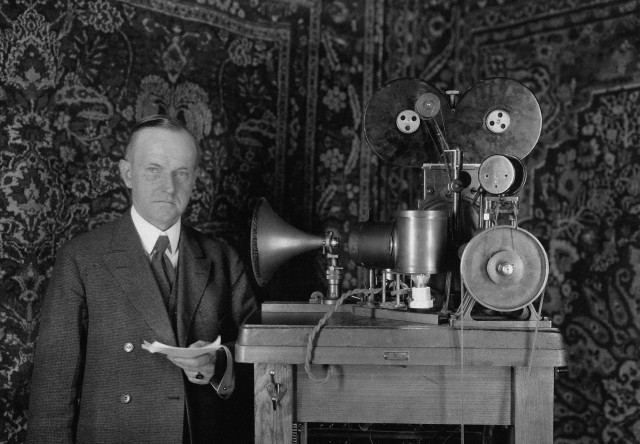
Vice President speaks into a pallophotphone, Washington, December 13, 1922, the forerunner of sound recording to accompany film. Courtesy of Schenectady Museum, Hall of Electrical History Foundation/CORBIS
The examples which inspire and lead us matter. They are not abstract trinkets like so many specimens in a butterfly collection with no bearing on how we live. Who we honor defines who we intend to be. We stand on the edge of nearly eight years of deliberate divisiveness and malicious vengeance spewing from the President himself. We are reaping what a nationwide policy of hate sows. We are poised to embrace another four to eight years of something even worse: an acceptance of these lawless, selfish, and violent reactions from all sides as “normal” or somehow cathartic. We believe fire will extinguish fire. If that actually worked, the fires of hell would have been put out long ago.
Experience tells us we need higher examples than we currently pursue if justice is to be returned to a land crying for it, a people in desperate need of it. The Great Virginians, including the patriots of Kenmore, furnish an excellent start but it must not end there. It has to go back to the original Source they sought, the Creator who gives to all people life and liberty but expects more if either is to be preserved.We find ourselves having to relearn that our disobedience always comes with a high price and the obligation to love our neighbor has never expired. Without doing justice, loving mercy, and walking humbly with God we have found no salve for our souls to replace our lack of self-control, the absence of truth, or the debt of love we owe. No force of private desire or public will can either substitute for or cancel these out. That duty is personal and it is absolutely colorblind.
Having placed our hope in one institution after another, we stand amazed that the broken reeds keep piercing our hands. Like the disciples we continue asking the Lord to restore kingdoms, while marveling that our timidity and self-censorship toward the culture actually turns people away from Him. Cowering in our upper rooms, we shrink before even the suggestion that God is not neutral at all about our culture or our politics. Our hope for a force yet strong enough that will check evil and redeem the world in which we live is not some hitherto unknown quantity or secret combination of resources. It is not a call to enter the ranks of passive conformity to whatever government wants in the name of “compassion” or with some smug excuse that ours is a “heavenly mission” only, as if physical space and time register no meaning to us. Our commission means confrontation and courage, deprivation and sacrifice, taking up the cross daily and following where He has led. Peace will not come when the world attempts to administer it. It is in the transformative power of Christ that what is missing will be supplied fully. He remains the only One capable of salvaging what humanity calls “hopeless.” Even Christ was tempted in every point we are and learned obedience through the things He suffered. Our profession is not the avoidance of all conflict it is the knowledge of Christ to a world truly lost and dying without Him. Genuine peace will only ever come when we come to Christ for it.



 The Importance of the Obvious