The assertion that America has unfairly led the rest of the world is not a new claim. For decades the argument has been pushed forth that it is incumbent on the United States to lower its standards around the globe, share its power, scale back its presence and a fairer, more equitable world would rise. We are led to believe that for civilization to advance it must all be in the direction of less individual freedom and more bureaucratic control. It is unjust, they insist, for America to realize such unprecedented prosperity, success and progress while the rest of the nations live in poverty, decay and oppression. Meanwhile, the denial of individual liberty and government by men instead of laws — notions irreconcilable with America’s ideals — are never recognized as central causes to all the suffering. It is as if the subordination of America’s ideals is something over which to rejoice and hasten. Such attitudes are like condemning the victim for the crime rate.
Why America is different is only impugned and criticized, never understood. After all, they assume, Americans took all this wealth, opportunity and its historic living standards from everyone else. Containing far more envy of America’s power than reality warrants, it is conveniently omitted that America is the exception to the rule because of a voluntarily agreed upon set of principles. These ideas, including government by consent, freedom of conscience, the sanctity of individual life, liberty and one’s pursuit of happiness, do not originate from the tyranny and injustice that have defined normal human existence since the beginning.
The rule of a few on the backs of the many has been tried, weighed and found wanting. It makes no difference whether it be called absolute monarchy, democracy, socialism or liberalism, it is the same prevalent, recurring weed that releases the same toxins upon society every time. America, founded as a refuge from suppression of conscience, denial of political choice and refusal of economic opportunity, applied the years of practical experience gleaned since ancient time to forge a government that served a sovereign people, not the people enslaved to government. Authority would reside not in personalities and social classes but in duly enacted laws through representatives delegated with specific responsibilities from the sovereign people. Endowed with the infusion of freedom, restrained by virtue and directed by sound education, America worked beyond the highest expectations of our visionary and audacious founding men and women. Preserved by the duty and service of each generation to those proven ideals, America demonstrated the exception not only succeeds, it perpetuates a very real good at home and for the rest of the world.
Simply because America is no more perfect than any other nation does not disprove that goodness and righteousness are either unattainable in her future or altogether absent from her past. In less than two and a half centuries, America has empowered millions with unprecedented upward mobility, withstood dictators, toppled regimes wedded to personal power rather than the might of its ideals, ventured into every corner of the globe not to dominate and conquer but to defend the weak, build trade and goodwill with all, share with those in distress and serve those in need. Where there has been need for improvement, our constitutional system affords remedy through amendment and circumspect legislation insofar as it follows reform in the people themselves. America has soberly embraced what Coolidge understood so well: With great blessings come greater responsibilities.
America has done all these things because at one time or another, no one else in the “room” stood up when the occasion demanded. The world has been and will continue to be far better off as long as moral power triumphs over material power. While the few redistribute wealth and call it “fairness,” the only commodity being equalized is misery and its attendant restriction of opportunity for everyone. The only ones who gain from this denial of eternal truths are those who already hold political power, and seek to extort more from the rest of us.
America’s ideals, as the exception to the ancient “might makes right” governance of world affairs, will prevail only if the original sovereigns — we, the people — reclaim our governance. The world will not rise simply by our descent. The vacuum will not be filled by some other equally legitimate set of lofty standards. We will do nothing for the world by relinquishing moral leadership now, expecting that fairness comes by descending to the lowest common denominator. The world will simply be less equal, less just, less free and less morally coherent.
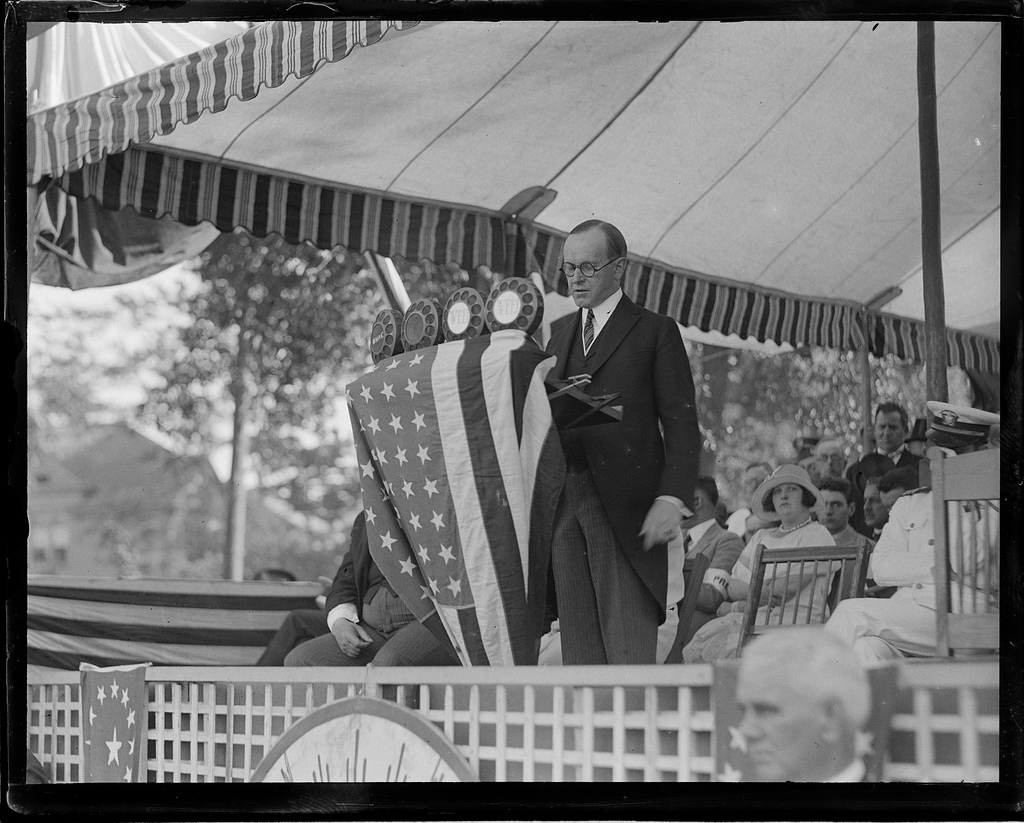
As Calvin Coolidge said, “Some say we cannot go on maintaining a higher standard of living for our people than that enjoyed in other nations. We have done so for generations. That is the fact. The theory that it cannot continue may be no better than the theory that it will last indefinitely. Some nation always has taken the lead. But supposing we shall finally reach the same position as others that is no reason why we should now relinquish our supremacy and descend to their level. It is our business to make our conditions the best as long as we can. We would not be justified in tamely surrendering our treasure now because at some time it may be exhausted. To become equal to others we must go down or they must go up. For us to go down would not in itself raise others. Our example of a free and prosperous people has been the sovereign remedy for world oppression. The truth is our trade regulations are more fair to others than theirs are to us. And what is of chief importance is the great service we render by giving credits and furnishing markets. The higher our standards, the greater our progress, the more we do for the world.”
Coolidge once put it even more concisely, “Do not expect to build up the weak by tearing down the strong.” Those who advocate ultimate liberation on the wings of America’s departure from exceptionalism expect more than reality can give. As with so many observations on government and human nature, however, Coolidge could not be more correct. It is a wisdom that can never be escaped, however much nations or individuals wish to jettison the obligations of righteousness or the constraints of moral standards.



 The Importance of the Obvious