On a Story Worth Repeating

Image

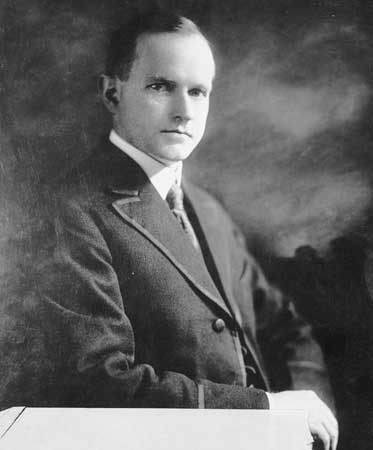
It is readily discovered that shy people are not reticent with everyone all the time. There is usually at least one subject that draws even the most introverted soul out to talk freely, openly and uninterruptedly. We know meeting new people was difficult for the shy Mr. Coolidge. As one of his earliest biographers describes, American history touched the Vermonter so profoundly that merely mentioning the obscurest pilgrim, pioneer or adventurer would provoke “Silent Cal” to speak volumes. Roland Sawyer, who had served in the Massachusetts General Court with Coolidge, recounts this instance during one of their weekly train rides home from Boston,

     Personal shyness, Yankee reticence, mental pre-occupation, Vermont reserve–these all combined to make Mr. Coolidge no travelling companion for anyone, in the average sense of the word.     

     Imagine the surprise one day among that group of legislators, when Cal unbuckled and for a cool half four talked as much as the average man. Now it all happened in this wise. Cal asked me to ‘sit in a minute’ on a matter of Hampshire county legislation, and after a brief discussion of the various points, Cal turned as usual to light another cigar, and look from the car window. We were just entering the old town of Rutland in central Massachusetts. Here had lived Rufus Putnam, a Revolutionary soldier, legislator, and one of the pioneers of the settlement of Ohio. I chanced to make some remark about the career of Col. Putnam, and, without removing his eyes from the window, Cal began to talk. Now I have ever had a keen interest in Massachusetts and New England colonial history, and have considerable information, and can carry on a conversation upon the matter with fair intelligence. And so I ventured some ideas upon some of the earliest customs of the colonial people: of their courage and other qualities. And Cal came back–and for a full half hour we talked about the pioneers of New England and the Middle West; of old customs and events; of the heroism of the men and women who were founders of America. Before we knew it, so engrossed were we in our talk, we had reached Hudson, where an influx of passengers broke into our seats, and I went back to my colleagues, to find an excited group of men who wanted to know, ‘What in the devil ails Cal this morning?’

Sawyer answers their question in the biography,

     Now what had happened was this–Cal had found a kindred spirit, who was interested in, and full of admiration for that group of pioneers in whom he was so interested, and for whom he felt such admiration; and there sprang up for a time an intellectual and spiritual fellowship which was strong enough to break the bonds of a native reticence (Cal Coolidge, President, pp. 95-96).

What America is and in what way it stands as the exception to the rule of human history inspired him to express in volumes the admiration he held in his mind and heart. This admiration was not merely some “revisionist” nostalgia, it was honest appreciation of real history and what it had to teach. Moreover, this admiration was shared by Mr. Sawyer himself, who, though politically a Socialist, could still genuinely agree that America’s story furnished reason to love and learn from it.

America’s story is worth repeating. It is truly a great story. It deserves to be recounted in our time with the same honesty and respect for what so many men and women accomplished in order to give us America’s exceptional inheritance.
On Preemptive Involvement Abroad

Image

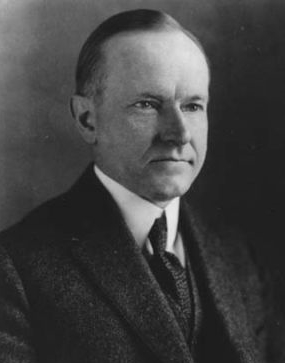
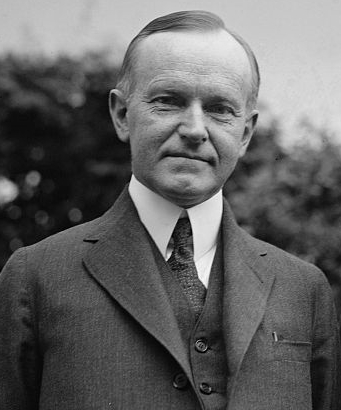
“Nations which are torn by dissension and discord, which are weak and inefficient at home, have little standing or influence abroad. Even the blind do not choose the blind to lead them. Foreign peoples are certainly going to seek assistance only from those who have demonstrated their capacity to maintain their own affairs efficiently. If we desire to be an influence in order and law, tranquility and good will in the world, we must be determined to make sufficient sacrifices to live by these precepts at home. We can be a moral force in the world only to the extent that we establish morality in our own country. — President Coolidge, May 30, 1927.

“I wish crime might be abolished; but I would not therefore abolish courts and police protection. I wish war might be made impossible but I would not leave my country unprotected…” — Coolidge in a Letter to the National Council for Prevention of War, July 23, 1924 (cited from ‘The Mind of the President,’ pp.235-6).

“America represents the greatest treasure that there is on earth, the greatest power that there is to minister to the welfare of mankind; to leave it unprepared and unprotected is not only to disregard the national welfare, but to be no less than guilty of a crime against civilization” — May 30, 1923

“America stands ready to bear its share of the burdens of the world, but it cannot live the life of other peoples, it cannot remove from them the necessity of working out their own destiny. It recognizes their independence and the right to establish their own form of government, but America will join no nation in destroying what it believes ought to be preserved or in profaning what it believes ought to be held sacred” — February 22, 1922

If we are sincere in our expressed determination to maintain tranquility at home and peace abroad, we must not neglect to lay our course in accordance with the ascertained acts of life. We know that we have come into possession of great wealth and high place in the world. There is scarcely a civilized nation which is not our debtor. We are sufficiently acquainted with human nature to realize that we are oftentimes the object of envy. Unless we maintain sufficient forces to be placed at points of peril when they arise, thereby avoiding for the most part serious attack, there would be grave danger that we should suffer from violent outbreaks, so destroying our rights and compromising our honor that war would become inevitable. It is to protect ourselves from such danger that we maintain our national defense. Under this policy it is perfectly apparent that our forces are dedicated solely to the preservation of peace…We have sufficient reserve resources so that we need not be hasty in asserting our rights. We can afford to let our patience be commensurate with our power” — May 30, 1927, emphasis added.

On Being Worthy of Freedom

Apprehensions over the future have always remained an ever-present concern for a wise and circumspect people. When Americans stop being concerned for the next generation, it will be because we are no longer free individuals. The prospects for freedom stand in greater doubt than perhaps they have for many years, but a lack of confidence in our system is only new to us, not to generations of Americans who came before us.

Any one of the hardships overcome by prior generations could have halted the experiment of self-government in its tracks. It has certainly had no shortage of critics who proclaimed “failure” and “defeat” only to be proven flatly wrong time and time again. Inequity and unfairness have been present in human history from the outset, but neither has had the power to prevent individuals of determination from accomplishing truly great things despite it. Our time is hardly the first to ask, “who is worthy of freedom?”

The Progressive Era produced an almost overwhelming array of reasons to change the way this country was established. It would answer our question with pessimism: the people were ultimately not to be trusted with freedom. It was an intelligent few who merited such power. Coolidge knew, on the other hand, freedom was safest in the hands of the people.

The charge that our system was both too wild and too unequal, compared to the “enlightened” societies of Europe, led to calls for regulation of human behavior on a scale never before known. The pursuit began to implement an efficient and intelligent approach to government that would mitigate risk, remove inequities and shepherd the people to progress.

These activists, predisposed to intense skepticism about capitalist systems, trusted government implicitly with greater and greater control. Enamored with a lopsided admiration for methods foreign to American ideals of law and liberty, these generally middle class intellectuals failed to appreciate the remarkable nature of our constitutional system. They overlooked the careful balance worked out by the Framers, infusing a disastrous measure of good intentions with a reckless accumulation of new laws.

They entrusted government with the power to supply the shortfalls of human nature with legislation. Each effort undervalued, even ignored, the unquantifiable worth of freedom. Government, endeavoring to be “smart” and “humane,” hurt those it proclaimed to help by robbing them of the dignity of free will, the moral judgment of those given sovereignty in our system.

Ours is a history of accomplishment and success because people were recognized not as subjects in service to the State but individuals whose value comes from a Divine Creator. Made in the image of God, it logically follows that the dreams, aspirations and abilities to create, construct and succeed are within every person’s power. It is that power now being denied our young people as unrealistic and unattainable. This is nothing more than the latest incarnation of those who denied Edison could harness light, the Wrights could fly and Ford could mobilize America.

The avoidable tragedy of all this is that it literally destroys the wholesome yearnings of millions for something better than marginal existence. Instead, the young are told to be content with mediocrity, cease the pursuit of success, and consign all future faith and hopes to Washington’s management. No less self-deluded than the Progressives of Coolidge’s day, this operation dehumanizes humanity. History proclaims it will ultimately fail but the cost to countless lives in the process can never be known.

Coolidge, grappling with these problems, said in 1923,

[T}he motive power of progress and reform has not come from the high and mighty but from the mass of the people…It is not the quantity of knowledge that is the chief glory of man…It is in the moral power to know the truth and respond to it, to resist evil and hold to that which is good, that is to be found the real dignity and worth, the chief strength, the chief greatness. This power, even in the humblest and the most unlettered, rises to a height which cannot be measured, which cannot be analyzed. It is this strength of the people which can never be ignored. Of course it would be folly to argue that the people cannot make political mistakes. They can and do make grave mistakes. They know it; they pay the penalty. But compared with the mistakes which have been made by every kind of autocracy they are unimportant…

…Unless the people struggle to help themselves, no one else will or can help them. It is out of such struggle that there comes the strongest evidence of their true independence and nobility, and there is struck off a rough and incomplete economic justice, and there develops a strong and rugged national character. It represents a spirit for which there could be no substitute. It justifies the claim that they are worthy to be free…

     …Civilization and freedom have come because they are an achievement, and it is human nature to achieve. Nothing else gives any permanent satisfaction. But most of all there is need of religion. From that source alone came freedom. Nothing else touches the soul of man. Nothing else justifies faith in the people.

Like the generation who saw beyond the narrow confines of subsistence imposed upon it by king and Parliament, it is time to refuse to participate in a supervised decline. Being taught to doubt our own judgment is merely a prelude to forfeiting the ability to make our own choices, to strive, to fail, to triumph — in short, to live free. If we are to be worthy of that freedom, we cannot surrender to this latest effort — however organized it is — to train out the moral ideals and intangible dreams of people.

Image