On Being “Progressive”

Asked to define the terms “reactionary” and “progressive” during one of his 521 press conferences, President Coolidge responded that his answer would likely not be helpful. After all, the definition was in the “eye” of the definer. Having experienced the back and forth of politics for twenty years before even reaching the White House, Coolidge had seen just about everything. Illustrating his point, he explained, “That reminds me a little of the old definition of ‘orthodoxy’ and ‘heterodoxy.’ I think they used to say that ‘orthodoxy’ was ‘my doxy’ and ‘heterodoxy’ was ‘your doxy.’ Sometimes the person is not well thought of and he is labeled as a reactionary. Sometimes if he is well thought of he is called a progressive. As a matter of fact all the political parties are progressive” (The Talkative President, p.9).

This was not some cynical resignation to the “way the real world works” but rather a refusal to surrender the term progress to be freely redefined and misappropriated by any one side of the political arena. The word carried a positive good and he would not be drawn in to an acceptance of a false premise. Coolidge did not stop there. One of his most profound contributions to the science of political thought revolves around the enduring importance political parties do have in our system. “I can’t conceive of a party existing for any length of time that wasn’t progressive, or of leadership being effective that wasn’t progressive.”

The key is not a denial of progress, or an eradication of all that has preceded us but rather connecting founding truths to our current situation. Progress is not progress which cuts all ties with the universal truths encapsulated in our Declaration and applied in our Constitution. This seemingly paradoxical concept for a progress that retains long-established, foundational ideals is expressed when Coolidge, two years later, said, “It is often asserted that the world has made a great deal of progress since 1776, that we have had new thoughts and new experiences which have given us a great advance over the people of that day, and that we may therefore very well discard their conclusions for something more modern. But that reasoning can not be applied to this great charter. If all men are created equal, that is final. If they are endowed with inalienable rights, that is final. If governments derive their just powers from the consent of the governed, that is final. No advance, no progress can be made beyond these propositions. If anyone wishes to deny their truth or their soundness, the only direction which he can proceed historically is not forward, but backward toward the time when there was no equality, no rights of the individual, no rule of the people. Those who wish to proceed in that direction can not lay claim to progress. They are reactionary. Their ideas are not more modern, but more ancient, than those of the Revolutionary fathers.” Quite a profundity from a man inaccurately and unfairly dismissed as an intellectual lightweight, characterized as a “do-nothing” president and classified as a vapid reactionary, don’t you agree?

Image

“Why America Will Stay On Top”

“Why America Will Stay On Top”

Interviewing the ever-insightful scholar Paul Johnson, Brian M. Carney discusses why ideas matter more than people and how the World’s deepest thinkers have been anti-intellectuals. Johnson, who has explained the substance behind Coolidge’s record in “The Last Arcadia,” chapter 6 of his book Modern Times, keeps an enduring confidence that Americans will find a renewed strength from the power of its founding ideals. This unshakable faith in the people of the country to summon both the will and the work to clean up the mess left by a self-anointed ruling class of intellectuals is right at home with the full assurance Calvin Coolidge held toward Americans as a people. Our thirtieth president, the last to earn a classical education, would firmly agree with Mr. Johnson. In fact, Coolidge would likely find himself quite at home with the most profound philosopher of civilization (a distant second to Christ, of course), the plain, simple-living, anti-intellectual Socrates.

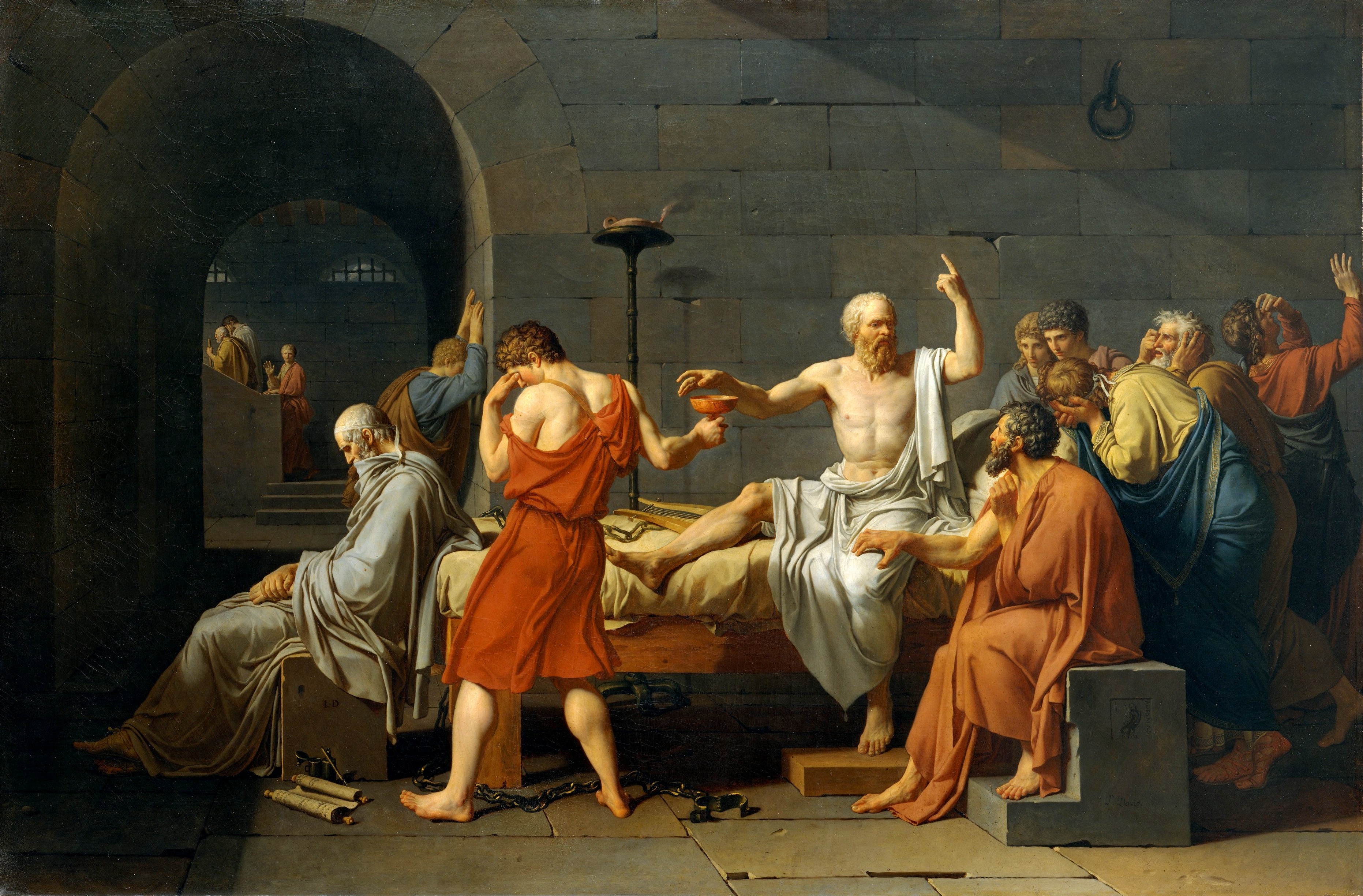
Jacques-Louis David's "Death of Socrates" depicting the ultimatum imposed on the philosopher to recant his ideas or be forced to drink hemlock. He continues to discourse on the truth of the eternal and spiritual. The painting dates from 1787, the year the Framers were thinking through the principles of sound, constitutional government.

Jacques-Louis David’s “Death of Socrates” depicting the ultimatum imposed on the philosopher to recant his ideas or be forced to drink hemlock. He continues to discourse on the truth of the eternal and spiritual. The painting dates from 1787, the year the Framers were thinking through the principles of sound, constitutional government.


“We do not need more of the things that are seen, we need more of the things that are unseen. It is on that side of life that it is desirable to put the emphasis at the present time. If that side be strengthened, the other side will take care of itself. It is that side which is the foundation of all else. If the foundation be firm, the superstructure will stand” — Calvin Coolidge, June 19, 1923, “The Things That Are Unseen,” delivered at Wheaton College, Norton, Massachusetts.

“We live in an age of science and of abounding accumulation of material things. These did not create our Declaration. Our Declaration created them. The things of the spirit come first. Unless we cling to that, all our material prosperity, overwhelming though it appear, will turn to a barren sceptre in our grasp” — July 5, 1926, spoken at the Sesquicentennial Stadium in Philadelphia.

Coolidge-75

Julius Caesar…Coolidge and Family

Julius Caesar...Coolidge and Family

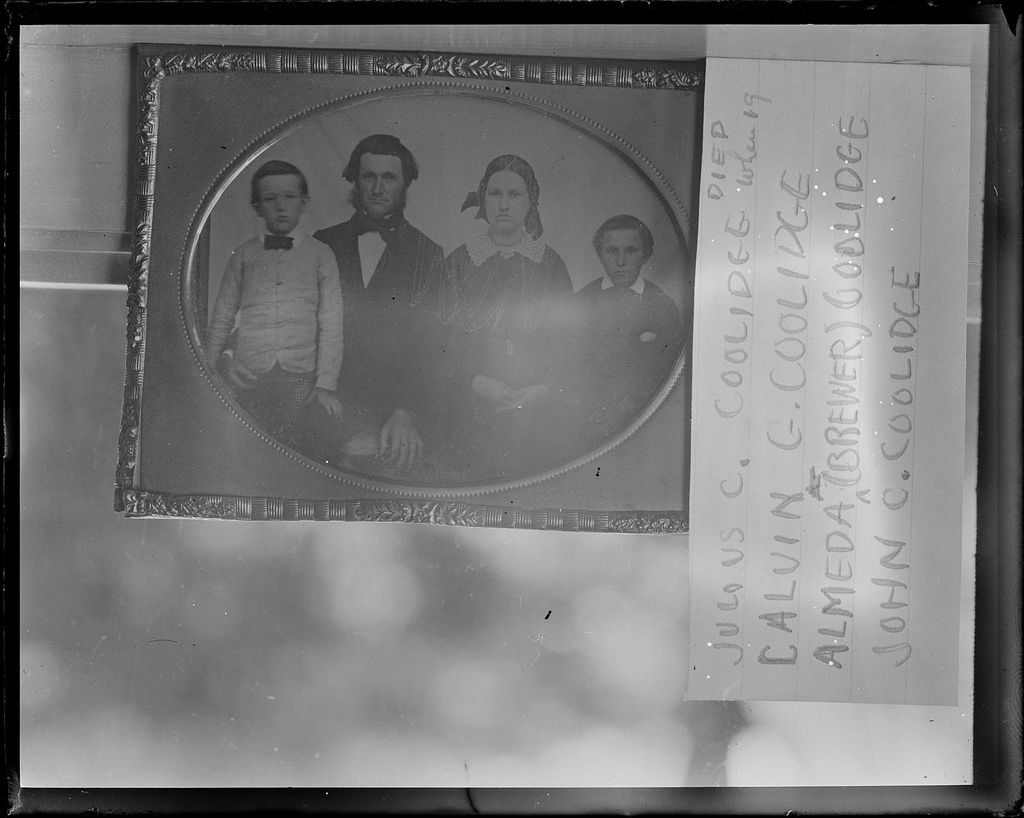
In observance of the Ides of March, here is an old offering from the Coolidge family album: a photo of Julius Caesar Coolidge (far left) as a boy, the President’s uncle, taken with his family: father, Calvin Galusha; mother, Almeda Brewer; and brother, John Calvin (far right). While Calvin Coolidge never met Julius, who died two years before the future President was born, he experienced much the same mixture of joy and sorrow, play and hard work of which Calvin later summarized from his own experience:

“It would be hard to imagine better surroundings for the development of a boy than those which I had. While a wider breadth of training and knowledge could have been presented to me, there was a daily contact with many new ideas, and the mind was given sufficient opportunity thoroughly to digest all that came to it. Country life does not always have breadth, but it has depth. It is neither artificial nor superficial, but is kept close to the realities” (The Autobiography, p.33).

Like many families of the early nineteenth century, the courageous deeds of heroes from antiquity intermixed with the unshakeable convictions of religious heroes from the Reformation and Great Awakening to be perpetuated in the choice of names for babies born to those early pioneers of Vermont and beyond. What better way to evoke great things for new lives than to name one for the brave conqueror and another for the stalwart reformer?