On Government Dependence and the Meaning of Freedom

cc_040823_11
“The individual, instead of working out his own salvation and securing his own freedom by establishing his own economic and moral independence by his own industry and his own self-mastery, tends to throw himself on some vague influence which he denominates society and to hold that in some way responsible for the sufficiency of his support and the morality of his actions. The local political units likewise look to the States, the States look to the Nation, and nations are beginning to look to some vague organization, some nebulous concourse of humanity, to pay their bills and tell them what to do. This is not local self-government. It is not American. It is not the method which has made this country what it is. We can not maintain the western standard of civilization on that theory. If it is supported at all, it will have to be supported on the principal of individual responsibility. If that principle be maintained, the result which I believe America wishes to see produced inevitably will follow.

“There is no other foundation on which freedom has ever found a permanent abiding place. We shall have to make our decision whether we wish to maintain our present institutions, or whether we wish to exchange them for something else. If we permit some one to come to support us, we cannot prevent some one coming to govern us. If we are too weak to take charge of our own mortality, we shall not be strong enough to take charge of our own liberty. If we can not govern ourselves, if we cannot observe the law, nothing remains but to have some one else govern us, to have the law enforced against us, and to step down from the honorable abiding place of freedom to the ignominious abode of servitude.

“…If there is to be a continuation of individual and local self-government and of State sovereignty, the individual and locality must govern themselves and the State must assert its sovereignty. Otherwise these rights and privileges will be confiscated under the all-compelling pressure of public necessity for a better maintenance of order and morality. The whole world has reached a stage in which, if we do not set ourselves right, we may be perfectly sure that an authority will be asserted by others for the purpose of setting us right” — President Calvin Coolidge, at Arlington National Cemetery, May 30, 1925.
On Agriculture

Born of hardy farming stock, Calvin Coolidge knew firsthand the costs and difficulties of such an investment. With the vote against passage of the Federal Agriculture Reform and Risk Management Act (H.R. 1947), roles have certainly reversed from the days when the President, not Congress, was acting to restrain federal spending as the best help government could render.

President Coolidge would veto both McNary-Haugen farm relief bills for their mechanisms to fix prices artificially, instead of letting the market decide value. The equalization fee of both pieces of legislation encouraged a special favor to one segment of the country — farmers — a device Coolidge never supported toward anyone, regardless of the form of their contributions to commerce. He held that constructive economy, not spending to compensate farmers for overproduction or veterans for their incalculable sacrifice, was for the benefit of all alike. Lobbyists, like George N. Peek who pressed Congress for “farm parity, as Gilbert C. Fite termed it, should not dissuade legislators from this commitment to represent the interests of all their constituents.

What was conspicuously missing in the legislation of McNary-Haugen, who were both Republicans (a fact that did not hold any weight with President Coolidge), was a recognition of what farmers can do for themselves. The haste for government to spare people (voters) from the consequences of certain choices was no less acute then as it is now. It was the President, in two powerfully written veto messages, who reminded the large and influential farm bloc of some obvious truths when it came to farmers. Farming has always and will ever be a supremely difficult task. No law can take all the risk or uncertainty out of working with the land.

Farmers can still help alleviate some of the difficulties they face by altering how they operate instead of running to Washington for help. For instance, farmers can diversify the crops they grow. By cultivating a variety of foods, the farmer is expanding the scope of yield without overproducing any one commodity. The farmer, as Coolidge would write in his daily column after the Presidency, best helps the soil — the center of the farmer’s world — and himself, when he expands into greater self-sufficiency in both crops and stock. Making an unpopular but glaringly simple observation, Coolidge saw the solution to overproduction (be it wheat, cotton or any other item on the market) was producing less in single-crop operations by broadening into different areas of agriculture.

In areas, particularly those in the West, creating discord between farmers, ranchers and consumers, co-operatives instead of government price-manipulation schemes could be an answer. Coolidge saw better results possible when farmers voluntarily collaborated, as used to be the case in rural communities, to form co-operatives that deploy their own efforts to improve efficiency, find markets for their produce and enable local problems to be resolved by the people directly involved. Government would not do any favors helping reward overproduction, prop-up higher export rates or rescue farmers from hard times. President Coolidge, through articulating reminders of the obvious, spelled out a way farmers can escape the many unintended consequences that follow when government gets involved. Many farmers wanted the assistance in spite of what it meant for the rest of the country. Coolidge knew he could point the way to self-reliance applied to the problems facing agriculture, but it would only succeed if farmer’s made it work for themselves.

It is thanks to the resolve and foresight of President Coolidge that farmers were spared the loss of their independence from Washington’s management, at least for the rest of his administration, while constructive economy continued for everyone. It is a reminder that we are much more capable of effecting solutions to our own problems than we may realize. At its heart, Coolidge’s reasons for vetoing these bills were grounded in a confidence that we, as free men and women, possess all the abilities we need to “work out our own salvation,” as he would put it. Therein lies greater potential for success than any of us imagine.

Image

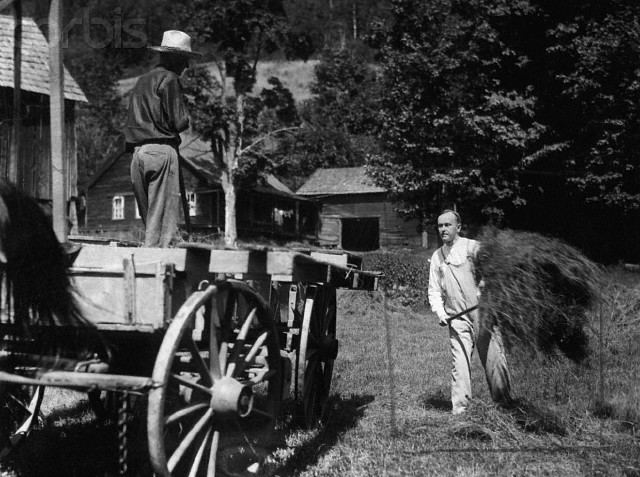
President Coolidge pitching hay on the Blanchard Farm in Pinney Hollow, up the road from Plymouth (Thanks to Corbis Images).

“Why I Am A Republican”

“Why I Am A Republican”

The recent statement of Mr. Elbert Guillory explaining his change of support for the historical principles of the Republican Party echoes many of the thoughts expressed by our thirtieth President, Calvin Coolidge. He would have stood with this man, an American who understands the duties of freedom, to advance our common cause of citizenship. As Coolidge would say back in 1922, “The meaning of America is not to be found in a life without toil. Freedom is not only bought with a great price; it is maintained by unremitting effort. The successful conduct of our economic life is not easy. It cannot be made easy. The burdens of existence, the weight of civilization, cannot be taken from the people.” The government that promises to lift such burdens cannot and never will. It will only result in further loss to people’s liberty in the name of protection.

Coolidge would assess difficulties not unlike what we now face, “The final solution of these problems will not be found in the interposition of government in all the affairs of the people, but rather in following the wisdom of [George] Washington, who refused to exercise authority over the people, that the people might exercise authority over themselves.” Addressing men and women at Howard University he spoke with the fullest confidence in individuals just like Mr. Guillory to embrace the opportunities of self-government and to realize the potential freedom holds from all forms of enslavement, mental as well as physical. He would champion the example of folks like Mr. Guillory without pretense or condescension, when he said, “The Nation has need of all that can be contributed to it through the best efforts of all its citizens…We can not go out from this place and occasion without refreshment of faith and renewal of confidence that in every exigency our Negro fellow citizens will render the best and fullest measure of service whereof they are capable.”

That service, seen in the examples of Senator Guillory, Dr. King, Dr. Robert Moton, Justice Thomas and Dr. Carson (to name but a few), is not to preserve the “masters” of the Democrat Party establishment, to prop up dependance on Washington (or bondage to any administration for that matter) but is living up to the highest ideals of American citizenship. It is an expression of the spirit of self-reliance, a fulfillment of duty to God and family, and a giving of one’s self in civic participation, that makes our freedom possible.