Remembering Good Women

On this day in 1885, twelve-year old Calvin Coolidge lost his mother. Her worth and the power of her loving impression on the boy who would become our thirtieth President cannot be measured. Though her passing was clearly a devastation for the Coolidge family, it did not crush Calvin’s spirit. It could have. Through the grief, Calvin tenaciously persevered. At any point in life Coolidge could have given way to despair. Essential to his resolute optimism, however, was the influence of good women. This was a fact he fully credited to those ladies in his Autobiography. Among those women were his mother’s sister, Aunt Sarah Pollard.

“…She was wonderfully kind to me and did all she could to take the place of my own mother in affection for me and good influence over me while I was at the Academy and ever after. The sweetness of her nature was a benediction to all who came in contact with her. What men owe to the love and help of good women can never be told.”

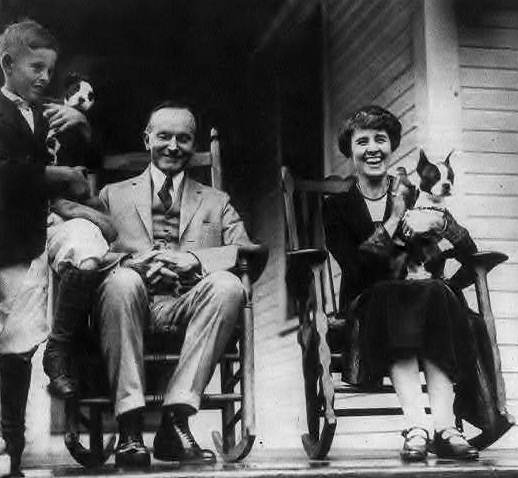
Superlative among those “good women,” however, was Mrs. Grace Coolidge. Her parents, the Goodhues, aptly named her for her graciousness. It was evident to all she met. Her kind regard for all people, however great or small, as well as her joyful manner and readiness to serve smoothed many a ruffled feather and diffused more than one potentially explosive situation through the years. Ever thankful for Grace, Coolidge would express that love and appreciation with this tribute to her in the Autobiography: “For almost a quarter of a century she has borne with my infirmities, and I have rejoiced in her graces.”
          Image

On Communism, Education and Women

Before Ronald Reagan’s resolute policy to press the inherent weakness of the Soviet system, his predecessor was forecasting the fall of the Berlin wall…years before it was even built. His secretary during the year of 1930-1931, Herman Beaty, recalling some of his many conversations with a very talkative Mr. Coolidge, noted in the series “The Real Calvin Coolidge” which ran from February through June 1935 of “Good Housekeeping” magazine:

” ‘Communism,’ he once commented, ‘will fail because what it attempts is against human nature. No man will provide me with food and other necessities of life unless he is gainer by it in some way.’ Concerning Russia’s propaganda among the youth of the country: ‘Their effort to proselyte among youth will fail. It may appear to succeed for quite a time–for years, perhaps. But as these young ones mature, they will be influenced by those same age-old currents. The result will be counter-revolution unless they recognize the danger and compromise in time.’ A keen student of social trends, he gave this opinion of Russian women in the tides of the new experiment: ‘Another ever-present danger to them is in the women. A woman is essentially a conservative. She wants to assure to the last degree protection for her children. The Soviets may appeal to the young girl but when she comes to bear children, she will abandon the fallacy of Communism as against their interests. Perhaps that explains the Soviet policy of taking children into state institutions in an effort to breed out gradually the urge of mother-love.’ ”

Quite a set of insights from a President who never said anything, never accomplished much in public life and is not worth remembering, at least according to self-appointed experts on history these days. Keep in mind these words were uttered in 1930 and 1931 and published twice in 1935 and again in 1960. To assert that Coolidge was unimaginative and without vision one has to censor these revealing observations. In the public “education” of young people today, Coolidge is missing for a reason. He indicts their attempt to indoctrinate in the advancement of socialism. An honest educator is not afraid of Mr. Coolidge, his insights here or how his principles can empower the next generation.