Thanksgiving Proclamation, 1923

Continuing the custom instituted by President Washington in 1789, the new President, reflecting over the past year, composed in 1923 the first of six Thanksgiving Proclamations during his service in the White House. It echoes the thanks we owe the Lord not only for His goodness to us this year but also for the exceptional success His favor and providential care have given to America, now in its two hundred and thirty-seventh year since independence:

“The American people, from their earliest days, have observed the wise custom of acknowledging each year the bounty with which divine Providence has favored them. In the beginnings, this acknowledgment was a voluntary return of thanks by the community for the fruitfulness of the harvest. Though our mode of life has greatly changed, this custom has always survived. It has made thanksgiving day not only one of the oldest but one of the most characteristic observances of our country. On that day, in home and church, in family and public gatherings, the whole nation has for generations paid the tribute due from grateful hearts for blessings bestowed.

“To center our thought in this way upon the favor which we have been shown has been altogether wise and desirable. It has given opportunity justly to balance the good and the evil which we have experienced. In that we have never failed to find reasons for being grateful to God for a generous preponderance of the good. Even in the least propitious times, a broad contemplation of our whole position has never failed to disclose overwhelming reasons for thankfulness. Thus viewing our situation, we have found warrant for a more hopeful and confident attitude toward the future.

“In this current year, we now approach the time which has been accepted by custom as most fitting for the calm survey of our estate and the return of thanks. We shall the more keenly realize our good fortune, if we will, in deep sincerity, give to it due thought, and more especially, if we will compare it with that of any other community in the world…

“…We have been blessed with much of material prosperity. We shall be better able to appreciate it if we remember the privations others have suffered, and we shall be the more worthy of it if we use it for their relief. We will do well then to render thanks for the good that has come to us, and show by our actions that we have become stronger, wiser, and truer by the chastenings which have been imposed upon us. We will thus prepare ourselves for the part we must take in a world which forever needs the full measure of service. We have been a most favored people. We ought to be a most generous people. We have been a most blessed people. We ought to be a most thankful people.

“Wherefore, I, Calvin Coolidge, President of the United States, do hereby fix and designate Thursday, the twenty-ninth day of November, as Thanksgiving Day, and recommend its general observance throughout the land. It is urged that the people, gathering in their homes and their usual places of worship, give expression to their gratitude for the benefits and blessings that a gracious Providence has bestowed upon them, and seek the guidance of Almighty God, that they may deserve a continuance of His favor.

“In Witness Whereof, I have hereunto set my hand and caused the seal of the United States to be affixed.

“Done at the City of Washington, this 5th day of November, in the year of our Lord, One Thousand Nine Hundred and Twenty-three, and of the Independence of the United States, the One Hundred and Forty-eighth.”

                                                                 Image


On Facing Consequences

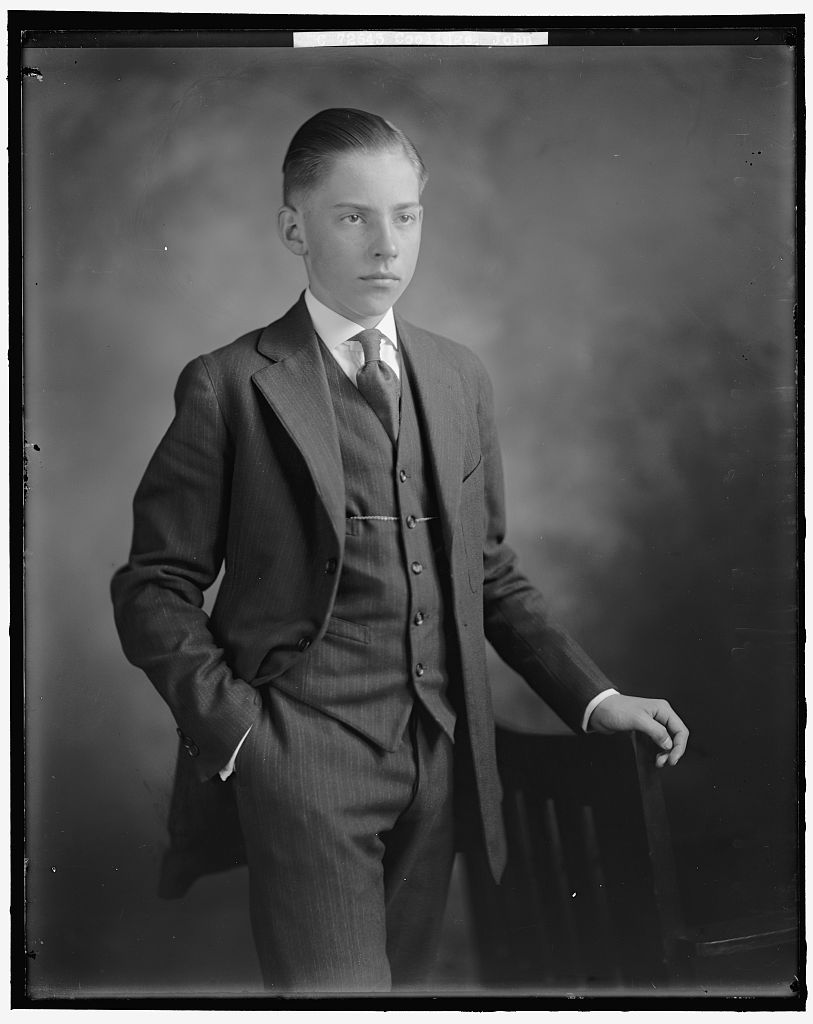
ImageJohn Coolidge, circa 1924

In the April 1935 issue of Good Housekeeping, the President’s son, John, recounted this portion of a father’s wisdom all too absent in political leaders at present. It is best to let John do the telling,

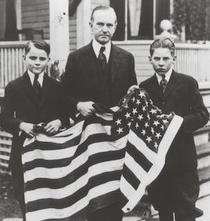
“Mother bought for us one Hallowe’en jack-o’-lanterns made of paper-mache with candles in them. When Father saw these, he warned us to be careful lest they take fire. However, we heedlessly went right ahead, lighted one, and, regardless of drafts, placed it on the window sill in the front room. During the excitement we went off and forgot about it. When we returned, it was in flames. 

“Father had been there all the time, and had seen the jack-o’-lantern going up in smoke and scorching the window sill. But he made not a move to put the fire out. He wanted to impress upon us the danger of what we were doing. He succeeded. The charred window sill served as a lasting reminder.”

Parents and politicians alike might be appalled at such “unfeeling” inaction on the part of Father Coolidge. How could he allow the children to lose their jack-o’-lantern and burn the window sill? Why did he not intervene sooner to spare the loss and destructive consequences of his boys’ actions, despite their neglect? They were just children, who cannot be expected to suffer for their negligent disregard, can they?

The same principle holds as we see millions of Americans, including those who supported Obamacare, who are now feeling the pain of lost insurance coverage, while politicians seek cover for the electoral consequences coming to them next year. The ad campaign launched this week by the Administration to promote government insurance is equally a part of this refusal to instill responsible conduct. Such is equivalent to Father Coolidge helping pour gasoline on the fire in order to put it out before any harm could be done, expecting future self-restraint to prevail. Would the boys have learned the lesson? Or, would John and Calvin Jr. dismissed it as a sign that any future costs of recklessness will be paid for by their parents? Should the government, or anyone else for that matter, not only “bail out” but actively promote reckless behavior in order to “save the day”? Are we not losing sight of what a wise father was trying to teach his children?

An escape from any and all suffering is now perceived humane and compassionate. Coolidge warned his boys what would happen if the fire was not watched but did not immediately take charge, forcing them to comply to his will, when the fire spread. As a father he could have done so. He did not.

Just as members of Congress or the President now strain to spare next year’s voters from the personal and political consequences of past elections, Coolidge could have put out the fire and lectured them later. Instead, he gave them the freedom of their own self-reliance, providing the opportunity to exercise that freedom conscientiously.

Having failed to watch the fire, the boys did not permanently lose the ability to choose nor was any future confidence in them to govern themselves suspended. Father Coolidge kept a vigilant eye on the fire, allowing the boys to experience the proportionate degree of pain for their choice. Obviously, he was not letting the house burn down to illustrate the point. Nor could the point be made without allowing a corresponding measure of suffering for what the boys had failed to do.

The gravity of political choices carries infinitely more weight than a paper-mache jach-o’-lantern. As such, those choices must bear a commensurate cost: defeat at the ballot box for those who voted for it and the pain Obamacare was designed to inflict for millions of Americans. Repeal, instead of prolonging the agony by subsidized reforms, is the responsible course forward.

We do no one any favors by dulling the pain of these consequences with desperate attempts to delay the individual mandate, reform the Health Care Act to “make it work,” spare politicians from the heat of their votes and generally salvage failure so that relatively less suffering occurs in the short-term.

We remember what it felt like to touch that hot burner, despite our parents’ warning, and as such did not repeat it. A child never learns to leave reckless and irresponsible conduct so long as someone is there to insulate him or her from the consequences. It is the genuine exercise of compassion that teaches children to listen, to remember what it felt like to be irresponsible, and not repeat the mistake. It is compassion in the purest sense that prompted Father Coolidge to impress upon his children the lesson they had to experience to remember. Rushing to rescue others from the physical, emotional, and spiritual costs of persisting heedlessly despite the danger is neither caring nor compassionate.

For John and his brother, the consequences were slight because the actions were minor. Heavier consequences inescapably face us now because our choices at the ballot box were far greater in scope. It underscores that voting is indeed no trivial matter. It literally concerns life and death. There is no escape for voting recklessly. Elections have consequences. As Coolidge put it on another occasion,

“Of course it would be folly to argue that the people cannot make political mistakes. They can and do make grave mistakes. They know it, they pay the penalty, but compared with the mistakes which have been made by every kind of autocracy they are unimportant.” Even the People must be allowed to suffer that penalty if the lesson is to be learned. There is no short-cut or magic formula to exempt us from every painful consequence of our actions. It is precisely why Coolidge, knowing the people who comprise the marketplace restore sound conditions if allowed to do so, quoted the precept of Hebrews 12.11, “Now no chastening for the present seems to be joyous, but grievous: nevertheless afterward it yields the peaceable fruit of righteousness…”

Father Coolidge reminds us that suffering has a redemptive value to it as well. It raises mature adults like John, instead of coddling children to remain life-long dependents. By knowing that consequences are certain, an individual will not willfully defy this reality and the responsibility owed to others, oneself, and to God. The future is all the more secure when mature men and women take up each one’s responsibilities. After all, this is simply another word for “self-government,” the system of liberty under law envisioned by the Framers.

Image

On the Pilgrims

Image

As Liberty and Rush Revere take every reading list by storm across the country, this day observes not only the honor we render to our veterans but also the day the Pilgrims committed themselves to the rule of law through the Mayflower Compact in 1620. Derided as “Puritans” for their belief in the sanctity of conscience, committed to live by higher standards than the mediocre choices made for them by the King, the Pilgrims separated themselves from the coercive government of England for the freedoms, first, of Holland and then after two treacherous months crossing the Atlantic, the risks and opportunities of the New World. Still aboard the Mayflower on this day in November, three hundred ninety-three years ago, thirty-one Pilgrims signed the first charter of government by consent in the New World, binding all under the authority of just and equal laws. Their courage, faith and exceptional sense of purpose — risking everything for the fundamental truth of the God-given liberty of conscience — set America from the start on a vastly different foundation than the accepted norm practiced by the rest of the world’s despotic and lawless governments.

It was Governor Coolidge who saw the cause joined for which both the Pilgrims sacrificed and our veterans’ sacrifices now of everything in this life so that we would attain a society not subsisting at the behest of government force but thriving under the reign of law over governor and governed alike. In official proclamation, Coolidge declared, “War is the rule of force. Peace is the reign of law. When Massachusetts was settled the Pilgrims first dedicated themselves to a reign of law. When they set foot on Plymouth Rock they brought the Mayflower Compact, in which, calling on the Creator to witness, they agreed with each other to make just laws and render due submission and obedience. The date of that American document was written November 11, 1620.

“After more than five years of the bitterest war in human experience, the last great stronghold of force, surrendering to the demands of America and her allies, agreed to cast aside the sword and live under the law. The date of that world document was written November 11, 1918.”

Rush Limbaugh’s look at the historical record restores an unjustly excised chapter from our exceptional American life. It simply is not being learned by our children under the stifling regime of modern education. Americans, thanks to this superb book, are being taught again what Coolidge and his generation not only knew by heart, humbly cherished with warranted pride, but found from those men, women and children, despised and rejected by tyrants and despots, an inspiration to greater faith and perpetuation of exceptional achievements.

In a history replete with exceptional people of all kinds, Coolidge held these Pilgrims, who left all they knew to undergo hardships we do not even approach today, with the highest esteem and admiration. No trivial reason drove them to so profound a step into the unfamiliar and deadly in order to secure the blessings of freedom endowed, not by monarchs or Parliaments, but by our Creator.
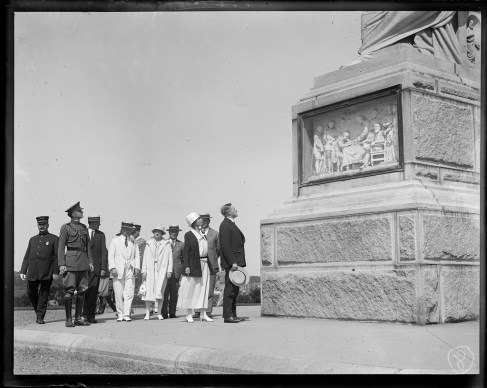
ImageThe Coolidges looking up toward the memorial to the Pilgrims, Plymouth, Massachusetts

As Coolidge speaks, in his own account of those brave Pilgrims, we can hear in his words the enthusiasm and reverence for the moral power of their example, a force that no arbitrary force, however strong, can withstand. An unchallenged management of every choice in life from Washington can only and absolutely succeed, not by disarming the people physically but by severing Americans from their history — disarming the people intellectually and spiritually. Coolidge spoke then and Rush speaks now so that we retain the long memory of our liberties, as it resists the slow, yet destructive, encroachments of those who sincerely believe they are acting for our own good.

Addressing the National Geographic Society in 1923, Coolidge recounts the Pilgrim’s exceptional accomplishment, “Whatever power is lodged in a monarch, always he has sought to maintain and extend it by encroachment upon the liberties of the people. When the more advanced of the Puritans sought to put their principle of freedom into practical effect by separation from the established church, they were met by the notorious threat of the King that he would make them conform or he would harry them out of the land.

“In that threat lay the foundation of Massachusetts. That little band, from among whom were to come those made forever immortal by that voyage of the Mayflower, sought refuge in Holland, where, by an edict of William the Silent, freedom of religion had been established…”

Citing the words of their preacher, John Robinson, Coolidge continued, ” ‘The people…are industrious and frugal. We are knit together as a body in a most sacred covenant of the Lord, of the violation whereof we hold ourselves strictly tied to all care of each others’ good and of the whole by every one, and so mutually. It is not with us as with men whom small things can discourage.’ In that simple statement is to be found,” Coolidge summarized, “the principle of prosperity, responsibility, and social welfare, all based on religion.” That was not the end of the story, however. “They were of humble origin,” Coolidge noted. These families were not living high on the backs of the poor. They did not get where they were going by confiscation or oppression of others. “The bare necessities of existence had been won by them in a strange country only at the expense of extreme toil and hardship. They did not shrink from the prospect of a like experience in America…

“It was such a people, strengthened by such a purpose, obedient to such a message, who set their course in the little Mayflower across the broad Atlantic on the sixth day of September, 1620…

“A providential breeze carried them far to the north, while storms and the frail condition of their ship prevented them from continuing to their destination. They came to anchor off Provincetown far outside the jurisdiction of their own patent and the authority of existing laws…

“Undismayed they set about to establish their own institutions and recognize their own civil authority. Gathering in the narrow cabin of the Mayflower, piously imploring the divine presence, in mutual covenant they acknowledged the power ‘to enacte, constitute, & frame just & equall lawes, ordinances, actes, constitutions & offices,’ to which they pledged ‘ all due submission & obedience.’ So there was adopted the famous Mayflower Compact. It did not in form establish a government, but it declared the authority to establish a government, the power to make laws, and the duty to obey them. Beyond this it proclaimed the principle of democracy. The powers which they proposed to exercise arose directly from the express consent of all the governed. The date of this document, remarkable for what it contains, but more remarkable still because it reveals the capacity and spirit of those who made it, is November 11, 1620, old style; under the new calendar it is destined long to be remembered as Armistice Day…

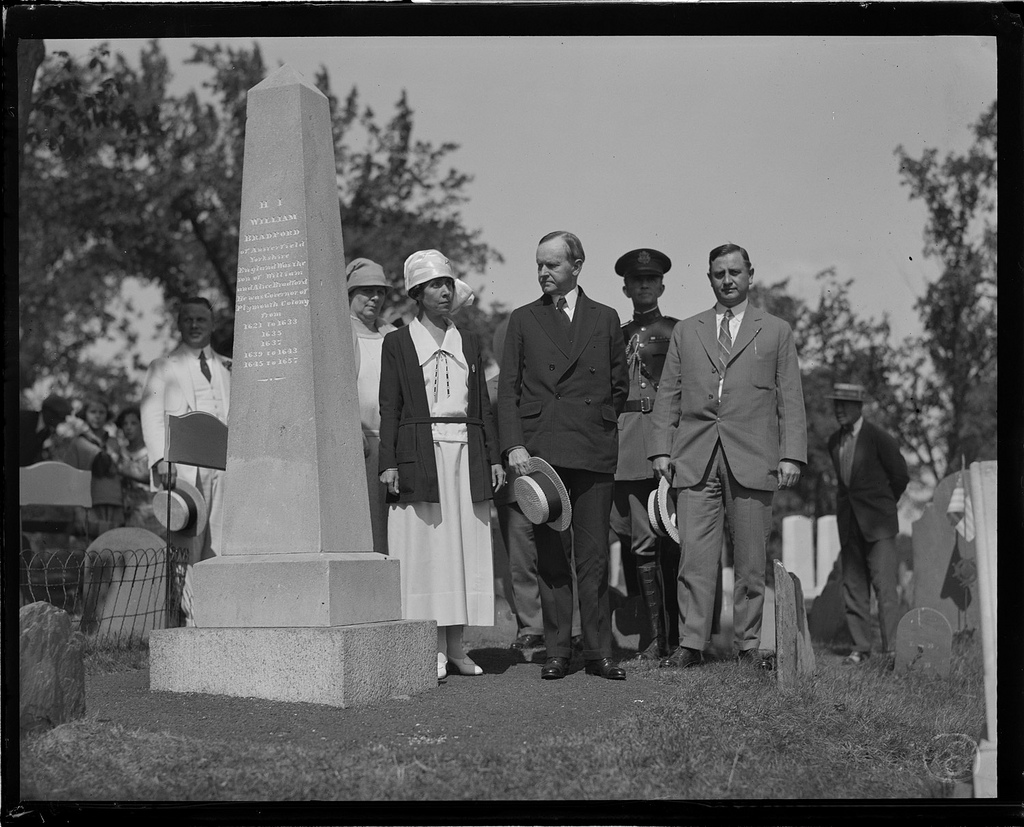
ImageThe Coolidges visiting the memorial marker of William Bradford, leader of the Plymouth settlement

“Such was the beginning of Massachusetts, men and women humble in position, few in numbers, seemingly weak, but possessed of a purpose, moved by a deep conviction, guided by an abiding spirit, against which both time and death were powerless. It is said that upon the old Colony of Plymouth there is no stain of bigoted persecution. They carried with them the atmosphere of holy charity. Their efforts and their experience stand forth distinctly, raising a new hope in the world…” Indeed, they still do, inspiring even the youngest Americans among us to love and share the same great principles those brave Pilgrims demonstrated nearly four centuries ago.

ImagePilgrims signing the Compact aboard the Mayflower, November 11, 1620