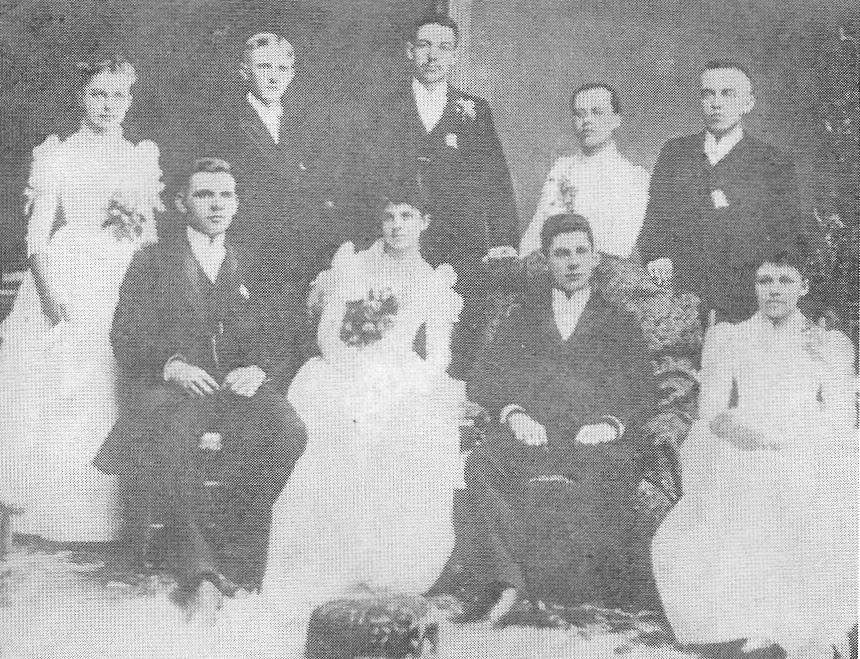
Coolidge attended B.R.A. from 1886 to 1890, where he would officially graduate on May 23rd of the latter year. As secretary of the class, he would deliver the first of many carefully written speeches during his long life in public service, this one aptly surveying the power of “Oratory in History.” Standing from L to R: Avvie L. King, Plymouth; Coolidge, Plymouth; Henry M. Hicks, Perkinsville; Clara S. Pollard, Ludlow and Amos K. Pollard, Ludlow. Sitting from R to L: Ellen M. Adams, Ludlow; Albert A. Sargent, Ludlow; Jessie Arminton, Ludlow and Rufus N. Hemenway, Ludlow.
It was on the occasion of his survey of oratory’s power on events that he observed, “In the history of our own country, the triumphs of oratory have been hardly less marked than those of the Old World. In the night of tyranny, the eloquence of the country first blazed up, like the lighted signal fires of a distracted border to startle and enlighten a community. Everywhere as the news of some fresh invasion of our liberties and rights was bourne on the wings of the wind, men ran together and called upon some earnest citizen to address them…” When James Otis rose in 1761 to denounce the British Writs of Assistance, “every man of the vast audience went away resolved to take up arms against the injustice.” Patrick Henry’s “Liberty or Death” speech “gave an impulse which probably decided the fate of America.” Young Calvin ended his oration in not too unfamiliar a fashion when he said, “The effects of sacred oratory on the history of the world would fill volumes…It would hardly be too much to say, that since the dawn of civlization, the triumphs of the tongue have rivaled, if not surpassed, those of the sword. Although some of the most fiery themes of eloquence may have passed away with the occasions of tyranny, outrage, and oppression that created them…yet so long as wickedness and misery, injustice and wretchedness prevail on the earth, so long as the millennium is still distant and Utopia a dream, the voice of the orator will still be needed to warn, to denounce, to terrify, and to overwhelm.”
For Coolidge, the education of the mind and soul never stopped. There were no graduates when it came to real education — the finishing of character and the constant preparation of not merely the intellect but the spirit of the individual. As he would write, looking back on his life at fifty-seven years of age, in The Autobiography, “My education began with a set of blocks which had on them the Roman numerals and the letters of the alphabet. It is not yet finished.”

 The Importance of the Obvious