“History is to be studied and applied not for the purpose of advocating reaction. It is not the accurately informed who continually appeal to the good old times to the disparagement of the present. That is characteristic of those who substitute fable and hazy tradition for fact and reliable record. True history which includes all the records of the past, however obtained and wherever recorded, whether made upon the surface of the earth by the ceaseless shifting of air and water, or transmitted by written signs on tablet and parchment, or through oral repetition handed down from sire to son, or that most indelible of records the accumulated experience of generation after generation moulded into the brain of man, while ever a conservative force, yet holds the only warrant for real progress. It is ignorance of its teachings, which leads men of good intentions to advocate either reaction or revolution, and a knowledge of its forces, which aids men to promote the public welfare. In judging of the strength of a state it is necessary to know what has gone before, what point of development has been reached by the people of that state, and whether their present plan of society is justified by their past experience…
“Liberty is not bestowed, it is an achievement but it comes to no people who have not passed through the successive stages which always precede it. It is very far from a state of nature. It is not light and easy thing to secure or to maintain, but difficult of accomplishment and hard to bear. While there are no conditions under which it is better to be a slave than to be free there are many conditions under which it is infinitely easier to be a slave than to be free and for the sake of their ease there are those who have chosen to relinquish much of liberty rather than bear the responsibilities of the free…
“Coincident with the political development of mankind has gone along the forces of philosophy and of religion, revealing to the race the meaning of nature, of man, of his relation to his creator and to his fellow man. Not enough credit is attributed to these forces in the development of government, society, and civilization. It was by comprehending the natural forces of the universe that man saw he had in them a right of property and set them to be his servants. It was through a realization of the fatherhood of the Almighty that came a knowledge of the brotherhood of man, of his innate nobility, of equality, of his right to be free…
“Human institutions are prone to change but there are certain great principles that do not change. I have hastily sketched the development of the forms of government. That which is based on the rule of the people through a republic in principle is the ultimate. There is no beyond, there is only reaction. To that point we have arrived…
“This is by no means the equivalent of saying that further effort is no longer necessary. Perfection requires not less effort but more. Great privileges means great responsibilities. Truly freedom is not easy but hard for the people to endure. There is always the force of evil without and within. It is difficult to say that any great nation perished by reason of an attack by forces from without. Disintegration begins within…The great question of the preservation of our institutions is a moral question. Shall we use our power for self-aggrandizement or for service? It has been lack of moral fibre which has been the downfall of the peoples of the past. There came a time when they were sunk in indulgence and no longer strove for achievement. But there has been revealed to us the nobility of man, not formerly so well understood, which has taught us to appeal not to his selfishness but to his sense of duty. A nobility which reaches from the highest to the lowest and justifies our firm faith in the abiding convictions of the people…
‘ O Heart be strong!
Be valiant to do battle for the right,
Hold high truth’s stainless flag,
walk in the light,
And bow not weakly to the rule of wrong.’ ”
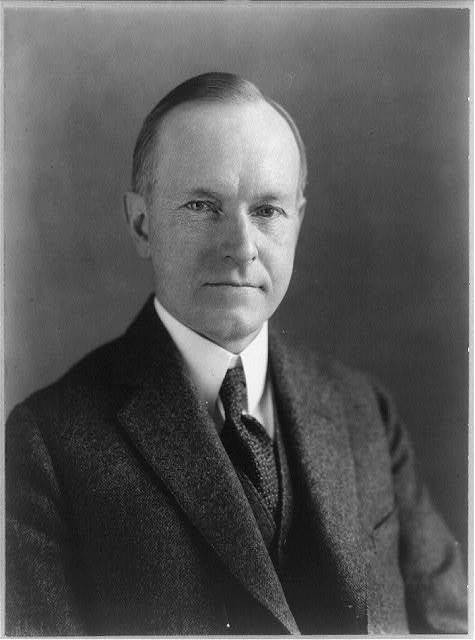
— Vice President Calvin Coolidge, addressing the Vermont Historical Society, Hall of Representatives in the Capitol, Montpelier, Vermont, January 18, 1921 (emphasis added).

 The Importance of the Obvious