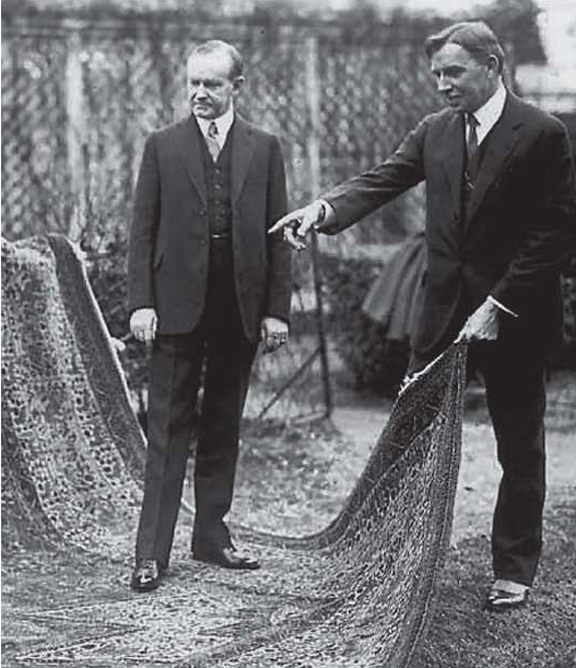
President Coolidge meets Sargeant Henry Lincoln Johnson, September 20, 1923

It was on the second night of a double watch stint on May 15, 1918, that then Private Henry Johnson, with another soldier of the legendary 369th Infantry Regiment (better known as the “Harlem Hellfighters”), suddenly discovered that upwards of two dozen Germans were patrolling right beside their exact position. About to be captured, Private Johnson opened fire, killing at least one and wounding two others before engaging another in hand-to-hand combat with his bolo knife. Thrice wounded, Johnson kept fighting until his friend was rescued and what was left of the German patrol fled. Returning home, he and his family enjoyed the full star treatment for his heroic actions. He even took up the lecture circuit to talk about racial colorblindness but disappointed some when he also spoke of the bigotry that took place in the trenches.

As time went on, many simply forgot the great men of the 369th who put on the uniform and fought for America so fiercely. It would not be until 2003 that Sargeant Henry “Black Death” Johnson, as he was affectionately dubbed by his friends and fellow servicemen for his actions on that fateful night, was posthumously awarded the Distinguished Service Cross. In his time, however, he was not completely forsaken. Coolidge certainly never forgot the men of the illustrious 369th. Sargeant Johnson was both remembered and recognized in two distinct ways. It would be none other than President Calvin Coolidge who made a point of setting aside a day to meet this young, commendable American. As Coolidge’s schedule was especially full in the weeks after President Harding’s death, it is very telling that the most powerful man in the world took the time to start the business of September 20th 1923 in the company of this brave and honorable man. When Henry died in July 1929, it is worth mentioning that long before he was officially rewarded for his exceptional service, he was buried among many who had served with him, at Arlington National Cemetery, an honor not bestowed flippantly but one befitting the caliber of his courage and the dignity of his deeds. It matters not what race or background he was. He was, as Coolidge saw him, an extraordinary American. He therefore sleeps among those who are in every essential his people, Americans of all services, colors and creeds.

Corporal Johnson wearing the Croix de Guerre, bestowed on him by the French, 1918.

Private Johnson wearing the Croix de Guerre, bestowed on him by the French, 1918.


President Coolidge meets Sargeant Stubby, October 29, 1924

President Coolidge meets Sargeant Stubby, October 29, 1924

Having met this amazing Boston terrier twice before (in 1919 when Coolidge was Governor and 1921 as Vice President), Coolidge received a visit from Sargeant Stubby and his adopted owner, Robert Conroy, at the White House. Stubby not only accompanied Conroy to the Front during World War I, but the bold canine exhibited an extraordinary measure of courage, surviving a gas attack and wounds in battle, warning soldiers of incoming artillery, locating wounded troops stuck in “No Man’s Land” and even detaining a German long enough for Allied forces to catch up to his position. The blanket he is wearing, made for him by grateful French ladies, includes his unit badge, his sargeant stripes and an unprecedented array of medals from his service in combat. Coolidge would take time from an otherwise important day of military leaders, Congressional meetings, and even the visit of foreign diplomats to recognize the honor of service, the dignity of courage and the importance of fidelity, even when it is exemplified in one of our best of friends — the tough, little Sargeant Stubby.

Miss Louise Johnson and Stubby, May 13, 1921

Miss Louise Johnson and Stubby, May 13, 1921

Set for release on the 13th of this month, get ready for Sergeant Stubby: How a Stray Dog and His Best Friend Helped Win World War I and Stole the Heart of a Nation by Anne Bausum. The book includes Stubby’s meeting with President Coolidge and his collaboration in charitable work with Mrs. Coolidge.


White House to finally display Armenian Orphan Rug given to President Coolidge

White House to finally display Armenian Orphan Rug given to President Coolidge

At long last, after much effort on the part of some determined Americans, the White House is going to display the rug woven by Armenian orphans in gratitude for the United States and her leading role in the rescue, relief and friendship for those who survived the genocide perpetrated against Armenians in 1915. It was to President Coolidge that the intricate rug was given in 1925, an honor he cherished the rest of his life, ensuring its preservation through his son, John. The rug, displayed by President Reagan in 1984 and President Clinton in 1995, was subsequently put away and, despite countless requests, has not been allowed a showing…until now. A sincere thanks goes to everyone who refused to take “no” for an answer. It reminds us all of the devotion Americans still hold, as Calvin Coolidge did, for helping the innocent, standing by those in pursuit of freedom, defending the sanctity of an individual’s life, and supplying that spirit of good will and generosity that unite, not divide, us. It is also a reminder that when Americans rally together behind a just and noble purpose, nothing can stand against them. Coolidge would be proud.

“Instead of putting all the emphasis on the great amount of wealth our country has accumulated, some thought should be given to the amount it is continually giving away. These are our permanent investments on which the returns are most satisfactory” (Calvin Coolidge, May 4, 1931).

Coolidge_Armenian_Orphan_Rug

Keep posted at the Armenian Weekly