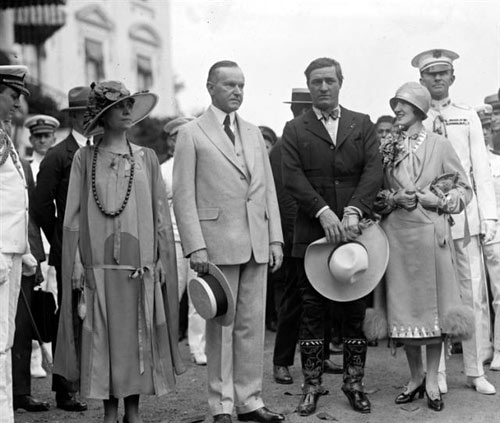
Long before John Wayne there was the “King of Cowboys,” Tom Mix. Here Calvin and Grace meet this talented horseman, shooter and Western actor.
Long before John Wayne there was the “King of Cowboys,” Tom Mix. Here Calvin and Grace meet this talented horseman, shooter and Western actor.

Calvin Coolidge shakes hands with renowned pioneer, Ezra Meeker, who set out in an ox-driven cart with his wife and young son on the Oregon Trail across some 2,000 miles in 1852. Having made the trek again by covered wagon (1906-1908), automobile (1916) and finally by airplane (1924), he was flown to Washington, D.C. to meet President Coolidge. Here the legendary adventurer and entrepreneur stands at ninety-three years of age, ready to advocate air and highway travel to a President already on board with modern technology.
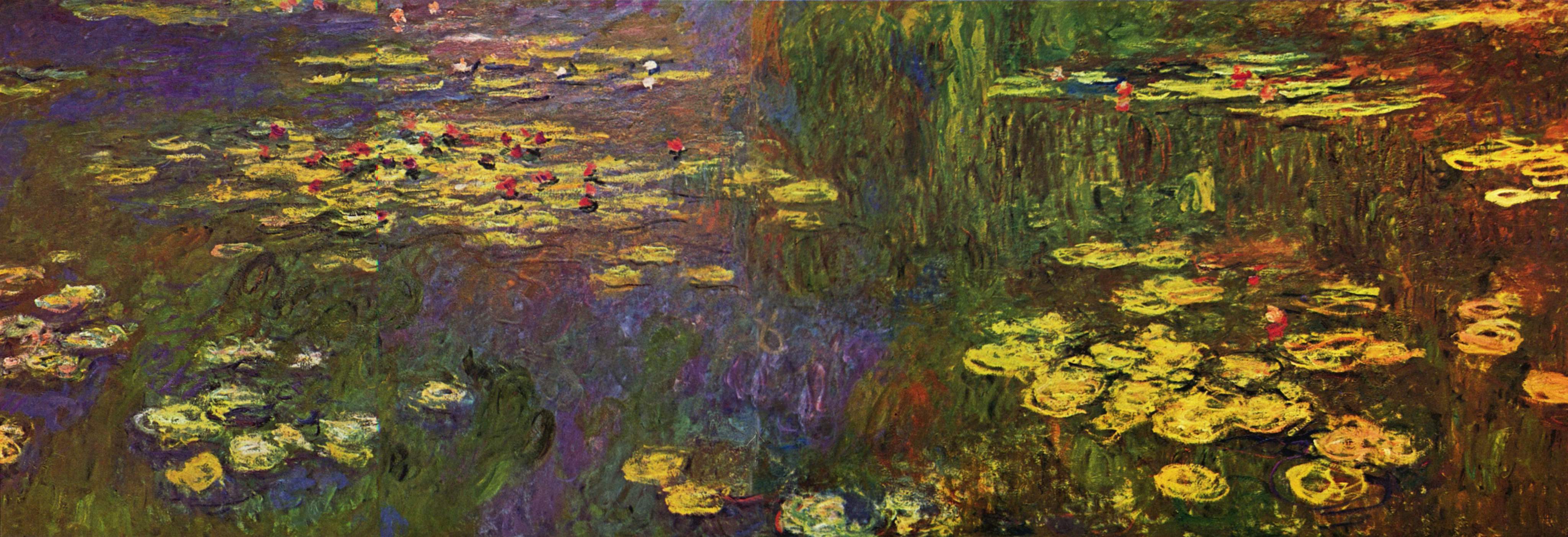
Les Nympheas – Painting of water lilies by Claude Monet, completed in 1926.
When British critic and socialite Beverly Nichols interviewed Calvin Coolidge in 1927 for Nichols’ book, “The Star Spangled Manner,” the subject turned to modern art. When it came to the frequently random images hailed as great work, “Silent Cal” was anything but taciturn. As he peered into the canvases of those paintings, he saw something far more profound than haphazard brush strokes. He told Mr. Nichols,
“Not long ago, I happened to visit an exhibition of modern pictures. it was held in Pittsburgh, and almost every European nation was represented–[the United Kingdom], France, Germany, Italy–the whole lot of them. And as I looked at those pictures, I felt that I could see through them, into the minds of the nations which had created them. I could see the torment out of which they had been born. If that nation’s psychology was still diseased, so was its art. The traces of neurosis were unmistakable. If, on the other hand, the nation was on the road to recovery, if its people were rediscovering the happiness which they had lost, the story was told in the picture, too.”
Art reflects a nation’s health and well-being. Artists are usually the earliest prophets of a nation’s direction. A nation’s art reflects its grasp, or refusal to face, reality. Coolidge’s understanding of this simple yet profound truth illustrates how deep a thinker he actually was.
 The Importance of the Obvious