On Economy

     Calvin Coolidge cherished the classics. He admired the wisdom of older thinkers and writers for what insights they discovered about human nature. He recognized that the old is not equivalent to the wise just as the younger and newer are not necessarily more enlightened or more modern. He distinguished between rediscovering and reapplying what is timeless from the blind emulation of the past. As Sheldon Stern has noted, he translated Cicero and Dante for relaxation. It was the practice of economy in public service that stood pronounced among the lessons he learned. As he knew, “economy” derived from the Greek compound oikonomos, which literally meant, “house law” (Bauer’s “A Greek-English Lexicon” p.559). To the Greeks, it referred to the management and direction of a household.

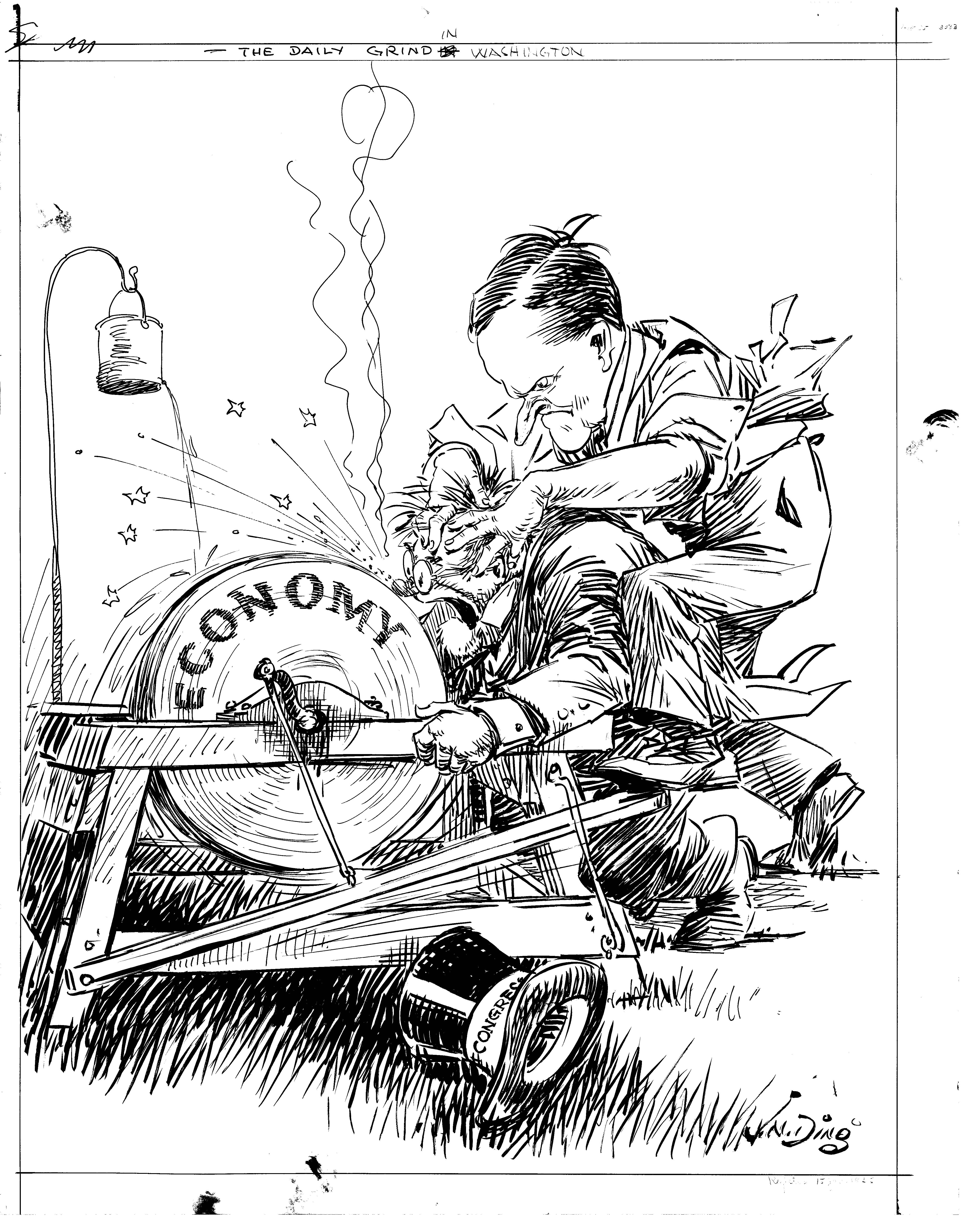
     Together with Coolidge’s profound sense of service, it was a call to lead by example. If he was to preside as the most powerful man in the world, it meant serious responsibilities were upon him. This meant requiring of himself the standards he expected in others. If he was to convince the Congress that government should economize, cutting wasteful expenditures and unnecessary costs, it would forfeit any credibility were he an extravagant spender on the White House staff. It meant the President would have to demonstrate it in his own “house.” This is why he constantly scrutinized the spending of the White House housekeeper, Mrs. Jaffray. It was wasteful to insist on shopping at specialty establishments when the cheaper grocery stores would save money. Why purchase more hams than could be eaten for the occasion? This is why President Coolidge commended his second, and more conscientious, housekeeper, “Ella” Riley for a “very fine improvement” bringing expenses down $2,550.71 in one year, just short of a 22% decrease. This is why President Coolidge prioritized his meetings with Budget Director General Herbert Lord above those with his own Cabinet and Congress. Their exacting work made possible tax refunds of $150 million in 1926 from budget surpluses of $378 million that year and $599 million in 1927. This is why President Coolidge maintained his original $32 a month, two-family residence in Northampton. He was not going to “live large” at the people’s expense. This is why President Coolidge was personally involved when it came to trimming grocery lists, cutting down ostentatious furnishings, and unnecessary costs, though it meant overturning tradition at times. Not even the seemingly inconsequential ribbon and paper used in official correspondence was spared in order to save tens of thousands of dollars each year.

     Coolidge, Lord and Mellon cut and then kept cutting wherever they could. Such was simply the demand of leading by example. The Congress, when faced with each year’s surplus (largely made possible by the trio’s thrift), would look for every possible device on which to spend it. Not so with Coolidge, as the manager of his “household.” The Presidency was not a chance to spend because it was there or waste because he could. That was not an example befitting the President. If he could not live within his “household” budget, he had no ground on which to demand such habits from Congress and thus no credibility as a responsible leader. If he abdicated this duty, the next expansion of government benefits would likely be assured but the cost would not be merely material. A deep moral debt would be created from which no tangible material could deliver. For Coolidge, the morality of saving people by saving money must start at “home.” Without example, words and intentions alone ring hollow.
            Image

Annual Message to Congress, December 3, 1924

                  Image

President Coolidge’s first Annual Message to Congress delivered the previous year, December 6, 1923

President Coolidge would open his second Annual Message to Congress by assessing the pervasive destruction of unsound economics, declaring,

          The fallacy of the claim that the costs of government are borne by the rich and those who make a direct contribution to the National Treasury can not be too often exposed. No system has been devised, I do not think any system could be devised, under which any person living in this country could escape being affected by the cost of our government. It has a direct effect both upon the rate and the purchasing power of wages. It is felt in the price of those prime necessities of existence, food, clothing, fuel and shelter. It would appear to be elementary that the more the Government expends the more it must require every producer to contribute out of his production to the Public Treasury, and the less he will have for his own benefit. The continuing costs of public administration can be met in only one way — by the work of the people. The higher they become, the more the people must work for the Government. The less they are, the more the people can work for themselves.

To restore the proper ownership of what people earn was what drove Coolidge and Mellon to insist upon Congress cutting rates across the board, fighting to eliminate penalties like the estate tax and genuinely reducing expenditures (remember this was before baseline budgeting). While the Revenue Act of 1924 retained the tax on estates (to Coolidge’s disappointment), it would continue the decrease of rates from 58 to 46% at the top and down to 1.125% at the bottom. For Coolidge, tax and expenditure reduction was a moral obligation. Higher and higher rates bore inescapable costs on everyone. Though the Federal minimum wage would not arrive until 1933 ($0.25/hr), it (like all taxes on what is earned) only harm everyone, employer and employee, rich and poor alike, shackling the future to government spending habits. Higher rates, as they had become in Coolidge’s lifetime, were an avoidable source of division for what should be a United States. As President Coolidge knew all too well, feeding class warfare as the basis for tax policy would only spread suffering and prevent the return of economic health.

On Taxation

The Revenue Act of 1932 was the single largest peacetime tax increase up to its time. It raised the top rate from 25% to 63%, doubled the estate tax, increased the corporate tax 15%, and ushered in taxes on numerous items that had never before been charged. A tax on gasoline, now taken for granted, began that year. Sales taxes were imposed on candy, toiletries, refrigerators, tires, cars, checks, stamps, telephone messages and numerous other items. All this was intended to save the country from the first deficit to occur in ten years. The loss of revenue from the Smoot-Hawley Tariff combined with the repeated hemorrhage of expenditures on everything from “work-sharing” programs to Veteran’s bonuses to maintaining wage and price rates to launching the National Credit Corporation and other government-driven actions gave the country a $2 billion deficit in 1931. Hoover had to correct the correctives by stopping the outflow of capital and “balance” the budget with more revenues. In marked contrast to 1921, 1922, 1924, 1926 and 1928, the “balance” was to be achieved not by cutting down the spending of government but by raising revenue to meet those expenditures. In his annual message to Congress in December of 1931 he presented the coming rate increases as the measure to restore “balance” and “cushion the violence of liquidation.” As Secretary Mellon had urged though, liquidation was exactly the medicine required for a sound economy to return. The marked differences between the President and his Treasury Secretary by this time were publicly known. President Hoover no longer permitted Mellon to set policy, as he was allowed to do under President Coolidge. Instead, he was instructed, managed and kept on a shortening leash. It was the Assistant Secretary Ogden Mills who had the President’s ear and confidence. Mellon was no more than a face to “sell” the tax increases. He had lost the internal battle in Hoover’s Administration for continuing what had been achieved during his two predecessors. Virtually being shown the door, Mr. Mellon was about to experience the price of crossing Hoover: Go before Congress and propose what would become the rate increases of 1932. He, with Ogden Mills as the principal speaker, did. By then, however, no one was interested in what Mr. Mellon thought on the subject. He was a liability now to the Administration. The Democrat majority in Congress would pass the Act decisively and while it stopped the flow of capital, Mellon’s predictions for high rates would come true. Revenue fell even more to $1.9 billion, suffering spread more equally and a decade of tax reform was repealed. But, as Mr. Cannadine observes in his biography of Mellon, “[E]ven before the measure was passed, Mellon had ceased to be even nominally responsible for it” (p.449). Commenting on what the looming decisions of Congress from his embattled friend’s department, former President Coolidge recalled the danger at work when taxes are increased, “Secretary Mellon has convincingly stated the approaching necessity of devising a tax system when business becomes normal to make national revenues more nearly depression proof. Assessing taxes where they can best be borne is sound enough. The rich are necessarily the immediate source of the income taxes. But mixed up with our tax laws have been certain social theories for dispossessing the rich in the name of reform rather than for revenue.” The former President then elaborated a warning that rings true in our current “tax the rich” redistribution climate, “Now, when we especially need surplus money for relief purposes, we find Treasury receipts greatly reduced. The vacillating income of persons and corporations does not supply certain sources of revenue. Taxes should provide a sure income and a balanced budget for the government without reference to social theories. It would be cheaper for the people of small incomes to pay one direct tax to the government than many indirect taxes on what they consume. A broad base of income assessments enabled Great Britain to balance its recent budget with little increased taxes. If government is to be able to relieve future depressions and encourage business it must first provide a revenue system that will not itself be depressed and also demonstrate ability to pay its own bills from current receipts” (May 28, 1931).