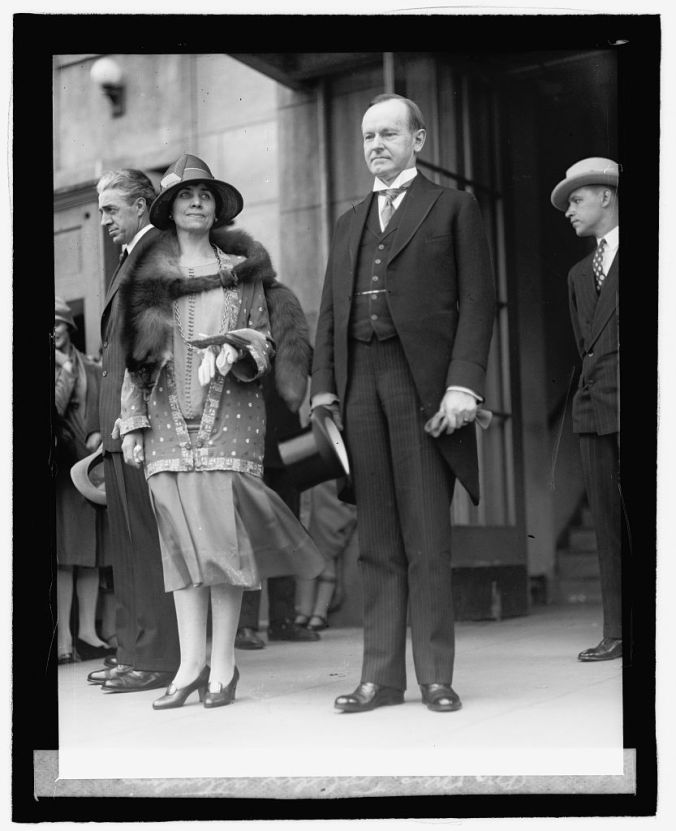
The Coolidges attending Easter Sunday services on April 17, 1927.
The Coolidges attending Easter Sunday services on April 17, 1927.
One of the best insights into a person comes from the honest assessments of those with whom one works. President Coolidge had many such witnesses. Not everyone accurately understood him nor did they all respect what they did not “get” about him. Still, there remain many whose firsthand experience with the man emphatically contradict the popular image of Coolidge as a cold, unfeeling and callous individual. On the contrary, Ira Smith, the director of the White House mailroom for fifty-one years (including the entire Coolidge era), has one of many such examples of Coolidge’s spontaneously given kindness. His thoughtfulness was not unexpected because it was rare but because it manifested a degree of attention and regard the recipient never thought a President would deign to feel let alone show. Underestimated all his life, Mr. Coolidge enjoyed doing the unexpected. More than this, though, he was a kind man. He noticed the small things and took care to express concern, be it little Anne Morrow’s hurt finger, “old man” Mellon’s morale in the midst of the tax cut fights or a complete stranger as in the case recounted here:
“He had a temper that could make itself felt in high places, but he always felt a strong sympathy for the ordinary citizen and frequently went out of his way to perform some little act of thoughtfulness for a stranger. One Sunday morning when I was at the office trying to catch up with a heavy flood of mail he came over from the White House and stood beside my desk while I opened a large pile of letters. One of them was a special delivery letter from a woman who wanted to know what church the President would attend that day and at what time he would be there. She explained that she was in Washington only for a few days and that she wanted her small son to get a glimpse of the President while he was in the capital because it would be something he would remember always and could tell his friends about. She asked whether it would be possible to telephone her at her hotel and tell her which church Mr. Coolidge would attend. I handed him the letter and he read it carefully. Without saying anything, he picked up a pencil and wrote: ‘Phone 10:30 A.M. Monday.’ He handed the notation to me and went abruptly away. Such notes were typical of Mr. Coolidge, and I understood that he meant for me to telephone the woman and tell her to bring her son to the White House on Monday at 10:30 A.M. for a visit with the President. This I did, and the delighted mother and son were received by Mr. Coolidge.”
Some may cynically dismiss this as mere political calculation but to those who knew and understood him well, he was simply thinking of others. Conscious of his limitations as President, he exercised the power he held as a moral example that should inspire with humble service, not arrogant disdain for people. When he declined to use the powers he could have wielded as President, he did so with respect for his Constitutional oath and the rightful exercise of state and local governance. To blame Coolidge for the silence toward Charles D. Levy, a Jew facing boycott and expired leases in Ohio from the Klan, overlooks that the President was acting — to both preserve local self-government from federal good intentions and to set the moral example of presiding. The President presides, he does not take all powers into his hands to intervene on behalf of select citizens. To do so, would have undermined the freedoms of others and compromised the purpose of the Office. It would have been unjust, a variation of “picking winners and losers.” It would only help legitimize the Klan for a President to treat them seriously with a public statement. Ignored as insignificant, the lack of attention would defeat them. It had nothing to do with a lack of compassion and everything to do with an overriding concern for what was fair to all and respectful of liberty. He knew the disaster of good intentions and so the situation Mr. Levy faced was referred to the Bureau of Investigation, under the Justice Department led by Attorney General Stone. This was the Coolidge way: to take care of issues if they are his to handle; If not, to delegate to the proper person what is their responsibility. To explain to Mr. Levy, or anyone else what he was doing, would have undermined his actions and undone the effectiveness of addressing the problem versus discussing what one intends to do about it. In this way, Mr. Coolidge imparts even greater thoughtfulness for Mr. Levy (safeguarding his lawful liberties and the freedoms of all concerned) than his sharpest critics understand or will admit.
It was on this day in the cold of March eighty-seven years ago that “Colonel” John Coolidge, the father of the President, died. His oldest grandson and namesake, would recall the words of Calvin Coolidge spoken in an interview six months after “Grandfather Coolidge” passed. The thirtieth president had this to say about the man popularly known around the nation as “Colonel” Coolidge, the notary who had sworn in his son three years before:
“My father had qualities that were greater than any I possess. He was a man of untiring industry and great tenacity of purpose…He always stuck to the truth. It always seemed possible for him to form an unerring judgment of men and things. I can not recall that I ever knew of his doing a wrong thing. He would classed as decidedly a man of character. I have no doubt he is representative of a great mass of Americans who are known only to their local neighbors; nevertheless, they are really great. It would be difficult to say that he had a happy life. He never seemed to be seeking happiness. He was a firm believer in hard work. Death visited the family often. But I have no doubt he took a satisfaction in accomplishment and always stood ready to meet any duty that came to him. He did not fear the end of life, but looked forward to it as a reunion with all he had loved and lost.”
Such regard for the qualities of men like Calvin’s father deserve both mention and honor. They are no less imperative if a proper perspective of the family and society is to be preserved. In the haste to jettison all that is masculine in culture, an irreplaceable and detrimental cavity has been opened. Devoid of the particular kind of strength supplied by fathers, like John, homes are compromised and civilization, without these crucial pillars, collapses underneath the weight of its own weakness.

 The Importance of the Obvious