On Being American

Standing before those gathered at the American Legion Convention in Omaha, Nebraska, President Coolidge on October 6, 1925, offered one of the plainest expositions of what it means to be an American citizen ever uttered. He could have said any number of vague platitudes to avoid alienating anyone. He could have tried placating the supporters of the Klan with sympathetic doublespeak. He could have even appealed to the emotional and racial invectives of two administrations before, under President Wilson. To Coolidge, being “American” meant far more than any of these attitudes could comprehend. Weighing the heavy costs of the war, concluded a mere six years before, Coolidge recognized the long-term burdens but also the exceptional example of service Americans of all national origins had demonstrated to the world. Despite the dangers personal and national, the humble and devoted efforts of individuals serving side by side for common defense of life and liberty, that is, “Americanism” (as Coolidge would call it) shone forth. For Americans, it was not an imperial conquest. It was not the racial or ethnic superiority of “Americanism” that willingly shouldered the burden and cost. It matters not from where you came or how long you have been here. What matters is the sharing of a common respect for law, our founding institutions and our sense of moral obligation.

Being American, to Coolidge, is a unity of spirit not a physical birthright. It is an agreement on what is eternally essential, not earthly, racial and unessential. This is why Coolidge never appeals to class differences or racial distinctions. They are irrelevant and counterproductive to being American. “Americanism” is not a call to absolute conformity, emptying the individual into “cookie-cutter” blueprints. It is a voluntary enterprise ventured upon together with a common set of navigational truths that do not grow old with time or fade with use. By these essentials, Americans assimilate to embrace not only the freedoms of self-government but also the responsibilities. Both are necessary to ensure liberty remains intact. Liberty is not to be a cover for license. Flouting the law is just as un-American as is enforcing laws in contradiction to those essential truths of human nature discovered by the Founders. As Coolidge would aptly summarize,

“We must not, in times of peace, permit ourselves to lose any part from this structure of patriotic unity. I make no plea for leniency toward those who are criminal or vicious, are open enemies of society and are not prepared to accept the true standards of our citizenship. By tolerance I do not mean indifference to evil. I mean respect for different kinds of good. Whether one traces his Americanisms back three centuries to the Mayflower, or three years to the steerage, is not half so important as whether his Americanism of today is real and genuine. No matter by what various crafts we came here, we are all now in the same boat. You men constituted the crew of our ‘Ship of State’ during her passage through the roughest waters. You made up the watch and held the danger posts when the storm was fiercest. You brought her safely and triumphantly into port. Out of that experience you have learned the lessons of discipline, tolerance, respect for authority, and regard for the basic manhood of your neighbor. You bore aloft a standard of patriotic conduct and civic integrity, to which all could repair. Such a standard, with a like common appeal, must be upheld just as firmly and unitedly now in time of peace. Among citizens honestly devoted to the maintenance of that standard, there need be small concern about differences of individual opinion in other regards. Granting first the essentials of loyalty to our country and to our fundamental institutions, we may not only overlook, but we may encourage differences of opinion as to other things. For differences of this kind will certainly be elements of strength rather than of weakness. They will give variety to our tastes and interests. They will broaden our vision, strengthen our understanding, encourage the true humanities, and enrich our whole mode and conception of life. I recognize the full and complete necessity of 100 per cent Americanism, but 100 per cent Americanism may be made up of many various elements.”

It is the current cultural climate that is intolerant of these essentials and fixated on non-essentials that forecasts even rougher waters ahead for the American enterprise. If we are to navigate safely to port, we have to rally around the moral nature of our voyage while giving no berth to those resolved on dragging the ship back from real progress into the barbarity of ignorance, lawlessness and government paternalism.

On ‘Freedom and Its Obligations’

Addressing those assembled at Arlington National Cemetery, May 30, 1924, President Coolidge spoke, 

“American citizenship is a high estate. He who holds it is the peer of kings. It has been secured only by untold toil and effort. It will be maintained by no other method. It demands the best that men and women have to give. But it likewise awards to its partakers the best that there is on earth. To attempt to turn it into a thing of ease and inaction would be only to debase it. To cease to struggle and toil and sacrifice for it is not only to cease to be worthy of it but is to start a retreat toward barbarism. No matter what others may say, no matter what others may do, this is the stand that those must maintain who are worthy to be called Americans.”

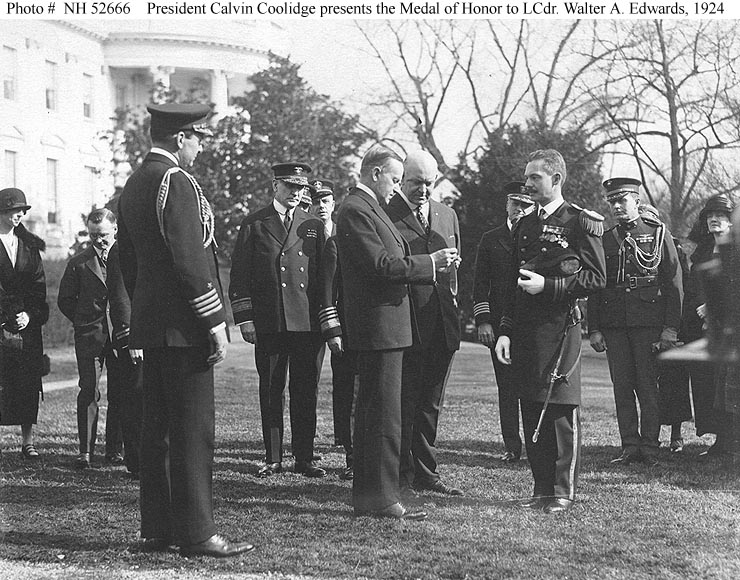
During the Coolidge presidency, there were nine individuals whose actions merited the Medal of Honor, the highest recognition to those who distinguish themselves while wearing the uniform. Their actions were not all combat-related, as the years between 1923 and 1929 was a time of peace. Their courage and selfless service, however, be it in behalf of their brothers-in-arms, those around the world in need, or in the cause of greater possibilities (with nothing but uncertain flying crafts and their navigational skills) were testaments to what President Coolidge referred — those “worthy to be called Americans.” That tradition of selfless service will continue unbroken and it remains, rightly so, a reason to honor and aspire to those worthy of the name “American” to this day.

Image

President Coolidge awarding the Medal of Honor to Machinist Floyd Bennett, USN (in front of him) and Commander Richard E. Byrd, Jr., USN (behind Coolidge), for their courageous risk of life in the first “heavier than air flight” to and from the North Pole in a tri-motor Fokker F-VII called the Josephine Ford.

Image

The awarding of the Medal of Honor to Torpedoman Second Class Henry Breault, USN, for his quick actions to rescue a shipmate in their submarine 0-5, which sank within one minute. Confined by the hatch that closed after him, he kept himself and his mate alive for thirty-one hours below the surface until rescued.

Image

Chief Gunner’s Mate Thomas Eadie, USN, received the Medal of Honor for an extraordinary rescue of his shipmate, Chief Torpedoman Michels, whose line fouled 102 feet below while trying to connect an airline to the sub USS S-4. CGM Eadie (as his citation states) “knowingly took his life in his hands,” diving down to skillfully extract Michels, bringing them both back to the surface after two hours of heroic effort.

Image

Lieutenant Commander Walter Atlee Edwards, USN, was awarded the Medal of Honor for his rescue of 482 men, women and children from the sinking French transport Vinh-Long, while aflame in the Sea of Marmora, off the coast of Turkey. While commanding the USS Bainbridge, he placed and kept his ship alongside the burning wreck until all alive were safely transferred to the American vessel.

Image

Machinist’s Mate William Russell Huber, USN, was recognized here with the Medal of Honor for his exceptional heroism after a boiler exploded aboard the USS Bruce in Norfolk Navy Yard, 11 June 1928, he went into the “steam-filled fireroom and at grave risk to his life” successfully carried shipmate, Charles H. Bryan, to safety. Machinist’s Mate Huber went below again to aid in removing others from the room despite suffering severe burns to his arms and neck.

Image

Captain Charles A. Lindbergh, Army Air Corps Reserve, was recognized with the Medal of Honor for both courage and skill despite the risk in navigating by nonstop flight from New York City to Paris, France, in the Spirit of St. Louis, a custom-built single-engine monoplane, achieving (as his citation, held here by President Coolidge, states) “not only…the greatest individual triumph of any American citizen but demonstrated that travel across the ocean by aircraft was possible.”

Image

Ensign Thomas John Ryan, USN, was presented with the Medal of Honor for heroism in rescue of a woman trapped when fire broke out at the Grand Hotel in Yokohama, Japan, September 1, 1923, as the result of an earthquake that hit the city. Ensign Ryan disregarded his own safety to help another, as unexpected events demanded decisive action.

Image

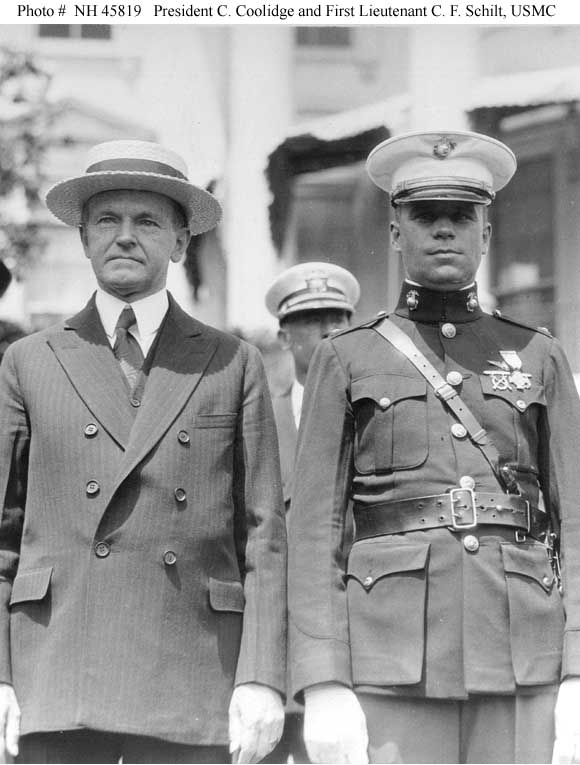
Here is First Lieutenant Christian Frank Schilt, USMC, to whom the President has just given the Medal of Honor for his superb actions in Quilali, Nicaragua, over the course of three grueling days in January 1928. First Lieutenant Schilt, following an intense fight to restore peace to the area, volunteered to evacuate all of the wounded by air and bring in a new commanding officer as relief. Taking off a total of ten times while under steady enemy fire from rough urban terrain, he removed all the wounded, saved three lives and brought back the necessary supplies to those in dire need on the ground.


‘On the Nature of Politics’

Here follows some powerful excerpts from an essay Calvin Coolidge wrote as a state legislator. The piece is printed in his first collection of speeches entitled, “Have Faith in Massachusetts” 2nd ed. Boston: Houghton-Mifflin, 1919, pp.69-84.

“Politics is not an end, but a means. It is not a product, but a process. It is the art of government. Like other values it has its counterfeits. So much emphasis has been put upon the false that the significance of the true has been obscured and politics has come to convey the meaning of crafty and cunning selfishness, instead of candid and sincere service. The Greek derivation shows the nobler purpose. Politikos means city-rearing, state-craft. And when we remember that city also meant civilization, the spurious presentment, mean and sordid, drops away and the real figure of the politician, dignified and honorable, a minister to civilization, author and finisher of government, is revealed in its true and dignified proportions…

“…Public men must expect criticism and be prepared to endure false charges from their opponents. It is a matter of no great concern to them. But public confidence in government is a matter of great concern. It cannot be maintained in the face of such opinions as I have mentioned. It is necessary to differentiate between partisan assertions and actual conditions. It is necessary to recognize worth as well as to condemn graft. No system of government can stand that lacks public confidence and no progress can be made on the assumption of a false premise…

“…The first care of despotism seems to be to control the school and the press. Where the mind is free it turns not to force but to reason for the source of authority. Men submit to a government of force as we are doing now when they believe it is necessary for their security, necessary to protect them from the imposition of force from without…

“…This leads to the larger and all important field of politics. Here we soon see that office-holding is the incidental, but the standard of citizenship is the essential. Government does rest upon the opinions of men. Its results rest on their actions. This makes every man a politician whether he will or no. This lays the burden on us all. Men who have had the advantages of liberal culture ought to be the leaders in maintaining the standards of citizenship. Unless they can and do accomplish this result education is a failure. Greatly have they been taught, greatly must they teach. The power to think is the most practical thing in the world. It is not and cannot be cloistered from politics.

“We live under a republican form of government. We need forever to remember that representative government does represent. A careless, indifferent representative is the result of a careless, indifferent electorate. The people who start to elect a man to get what he can for his district will probably find they have elected a man who will get what he can for himself. A body will keep on its course for a time after the moving impulse ceases by reason of its momentum. The men who founded our government had fought and thought mightily on the relationship of man to his government. Our institutions would go for a time under the momentum they gave. But we should be deluded if we supposed they can be maintained without more of the same stern sacrifice offered in perpetuity. Government is not an edifice that the founders turn over to posterity all completed. It is an institution, like a university which fails unless the process of education continues.

“The State is not founded on selfishness. it cannot maintain itself by the offer of material rewards. It is the opportunity for service. There has of late been held out the hope that government could by legislation remove from the individual the need of effort. The managers of industries have seemed to think that their difficulties could be removed and prosperity ensures by changing the laws. The employee has been led to believe that his condition could be made easy by the same method. When industries can be carried on without any struggle, their results will be worthless, and when wages can be secured without any effort they have no purchasing value. In the end the value of the product will be measured by the amount of effort necessary to secure it…”

Quoting the profound philosopher, Dr. Charles Garman, he continues,

” ‘Critics have noticed three stages in the development of human civilization. First: the let-alone policy; every man to look out for number one. This is the age of selfishness. Second: the opposite pole of thinking; every man to do somebody’s else work for him. This is the dry rot of sentimentality that feeds tramps and enacts poor laws…But the third stage is represented by our formula: every man must render and receive the best possible service, except in the case of inequality, and there the strong must help the weak to help themselves; only on this condition is help given. This is the true interpretation of the life of Christ. On the first basis He would have remained in heaven and let the earth take care of itself. On the second basis He would have come to earth with his hands full of gold and silver treasures satisfying every want that unfortunate humanity could have devised. But on the third basis He comes to earth in the form of a servant who is at the same time a master commanding his disciples to take up their cross and follow Him; it is sovereignty through service as opposed to slavery through service. He refuses to make the world wealthy, but He offers to help them make themselves wealthy with true riches which shall be a hundred-fold more, even in this life, than that which was offered them by any former system.’

“This applies to political life no less than to industrial life. We live under the fairest government on earth. But it is not self-sustaining. Nor is that all. There are selfishness and injustice and evil in the world. More than that, these forces are never at rest. Some desire to use the processes of government for their own ends. Some desire to destroy the authority of government altogether. Our institutions are predicated on the rights and the corresponding duties, on the worth, of the individual. It is to him that we must look for safety. We may need new charters, new constitutions and new laws at times. We must always have an alert and interested citizenship. We have no dependence but the individual. New charters cannot save us. They may appear to help but the chances are that the beneficial results obtained result from an increased interest aroused by discussing changes. Laws do not make reforms, reforms make laws. We cannot look to government. We must look to ourselves. We must stand not in the expectation of a reward but with a desire to serve. There will come out of government exactly what is put into it. Society gets about what it deserves. It is the part of educated men to know and recognize these principles and influences and knowing them to inform and warn their fellow countrymen. Politics is the process of action in public affairs. It is personal, it is individual, and nothing more. Destiny is in you.”