“Too often the world turns its eyes to the high places, thinking that from them will come its revelations and its great events, forgetful that a greater wisdom is in those who ‘mind not high things, but condescend to men of high estate.’ The greatest epoch in all human history began in a manger. This great American [speaking of Abraham Lincoln], the foremost world figure of the nineteenth century, came out of a frontier clearing and spent his early manhood in a village of a few hundred souls.
“In the memory of these facts there lies a solid basis for our faith. There is in the people themselves the power to put forth great men. There is in the soul of the nation a reserve for responding to the call to high ideals, to nobility of action, which has never yet been put forth. There is no problem so great but that somewhere a man is being raised up to meet it. There is no moral standard so high that the people cannot be raised up to it. God rules, and from the Bethlehems and Springfields He sends them forth, His own, to do His work. In them we catch a larger gleam of the Infinite” — Calvin Coolidge, February 12, 1922, at the Lincoln Birthplace, Springfield, Illinois.
While frequently on the speaker’s circuit as Vice President, Mr. Coolidge is here articulating an assurance that under God’s rule solutions to our problems do not come by Washington’s decree but, being spiritual in their essence, it takes righteous standards to address them. It is God, not people, who elevate individuals for the times through moral character. God even now prepares men and women of integrity who are being prepared for the problems confronting us. By looking to heavenly principles rather than the material accumulations of affluence, security and progress, a nation turns back to the foundations that stand. Ultimately, all problems are spiritual ones.
As Coolidge knew, like the Founders before him, a “nation that is morally dead will soon be financially dead.” Sound economics mean nothing without a firm grasp of moral principles. In the haste to cut away all reliance upon God and His moral order for society, we are simply hastening our own destruction. We are denying the eternal means of redemption when we live in defiance of our nature’s spiritual needs. The redefinition of marriage into something it has never been, the systematic denial of rights belonging to the smallest and weakest of society, and the refusal to acknowledge our Creator, our Lord and our Savior, will not spare us from reaping what we now sow. The fruits of our optimism will forever elude us if they do not rest in the clear moral standards originating from our Lawgiver and Lord.
service
On Public Image and the Press
“Whenever any section of our press turns on America and on American institutions, and assumes a foreign attitude, every informed person knows it has fallen from the high estate which is our common heritage, and becoming no longer worthy of regard is destined to defeat and failure. No American can profit by selling his own country for foreign favor” — Calvin Coolidge, April 25, 1927, Messages and Papers of the Presidents p.9689. Cited in “Silent Cal’s Almanack” by David Pietrusza, p.90.
Among the most striking ironies of the Coolidge years is the rapport that persisted between the President and the press. It was observed as extraordinary at the time and it is no less fascinating now. Even so, more animosity for Coolidge among the press rose up in later generations than existed at the time. The man known for placing substance above appearances, handled the members of the Fourth Estate shrewdly and sincerely. It is interesting that while Harding, a newspaperman himself, never quite mastered the relationship between his administration and reporters, Coolidge did. It is not as though Coolidge was forcing a fake “public image” on the country, he was merely adept at preempting problems with his own excellent skills in public relations. As John L. Blair has noted, an extensive public relations staff was not there in the 1920s. Coolidge, through a consistent and attentive approach, succeeded in politics where most have failed: the battle of perception. Policy fights could be waged with Congress but it could all be lost if “the artificial” things as Coolidge would describe the Washington mindset in his Autobiography (p.229), were neglected. He wisely understood that if the best results were to be obtained, he had to succeed in marketing what he was trying to “sell,” be it constructive economy in government, income tax reductions, war debt reparations, or the Kellogg-Briand Treaty. All of this took cultivation in advance. Coolidge, as any good marketer knows, sold his audience without telling them he was doing so. Coolidge would not pretend to be someone he was not.
As one veteran journalist urged at the beginning of the Harding administration, “Don’t slap us on the back and call us ‘old man,’ as did that genial fellow, Elihu Root [T.R.’s legendary Secretary of State].” Journalists were not naive, ready to be duped, or to be treated with condescension. An examination of the record before and after Coolidge makes this clear. Nor was the Coolidge era without public relations problems. It had more than one conflict between the “White House spokesman” (as the President was to be known in print, at least until Coolidge discontinued the policy in 1927) and the press. What distinguished the Coolidge approach was its even-handed respect for news work and its sincere transparency in explaining what the government was doing. Coolidge’s unprecedented 520 press conferences over the course of five and a half years outranks all previous and many subsequent Chief Executives, including the three terms of F. D. R.
While Coolidge required questions in advance — at times only answering the inconsequential or giving vague answers — he consistently allowed thorough follow-up questions on policies that remained unclear. This enabled the press to fulfill their constitutional obligation of “interpreting the administration to the country” (Coolidge, March 1, 1929 in “The Talkative President,” p. 34). At times, the press violated their mutual agreement, such as publishing speeches ahead of time, citing President Coolidge directly, or defending foreign countries against the policy of their own. Each met with Coolidge’s consternation but were well-handled so that the press knew where he stood and respected the clarity of his consistency. Coolidge surmised the press handled him so favorably because of this approach (“The Autobiography,” pp.185-6). Whether they agreed or not, they knew principles motivated him. Even the fearless crusader, William Randolph Hearst, mustered his publications to favorably expound Coolidge to readers.
At the same time, Coolidge observed in his address to the National Press Club that the news business was changing. News reporting had its constitutional protection but it also had responsibilities. It was coming to the realization that journalism was not mere demagoguery but there were obligations to be upheld as a business in the service of the American people. In light of today’s failing newspapers, struggling ratings and the self-deluded cloak of “objective journalism,” perhaps it is time to look back to what works instead of replicating what fails. This is why the sympathies for foreign institutions and their political decisions against those of the United States never sat well with Coolidge. It undermined the very basis for sound judgment which journalists are to exercise as they report the news. Honest journalism suffers when reporters dispense with a respect for truth and the pursuit of the ideal. It was not for himself that Coolidge opposed this unhealthy trend in news coverage, for he “often said that there was no cause for feeling disturbed at being misrepresented in the press.” What concerned Coolidge far more was the prospect of actually doing wrong, not the mere reporting of wrongdoing. The press was not there to serve him personally, they were there to serve America. Defense of the ideals that made America compelled Coolidge to take a firm resistance to a journalist who discarded his attachments to America’s founding principles in favor of what is both incompatible and hostile to those ideals.
He was not in blissful denial of where Americans had erred from time to time. On the contrary, knowing those missteps were made provoked a keen awareness in him for what America had done right. In one hundred and fifty years America had accomplished more through the power of ideals and the moral force behind them than others had achieved over thousands of years. These ideals were valid because they were universals, not exclusive to Americans. Americans had simply discovered them, not been born to deserve them through their superiority to others. Still, these ideas were welcome in America unlike most of the world for principled reasons. As a result, the press must serve the American people, giving expression to those timeless ideals instead of ridiculing and dismantling them. Some have poked fun at this “patriotic journalism” but in light of current affairs, Americans are better informed and better served when diligent journalists, committed to her ideals, report the news.
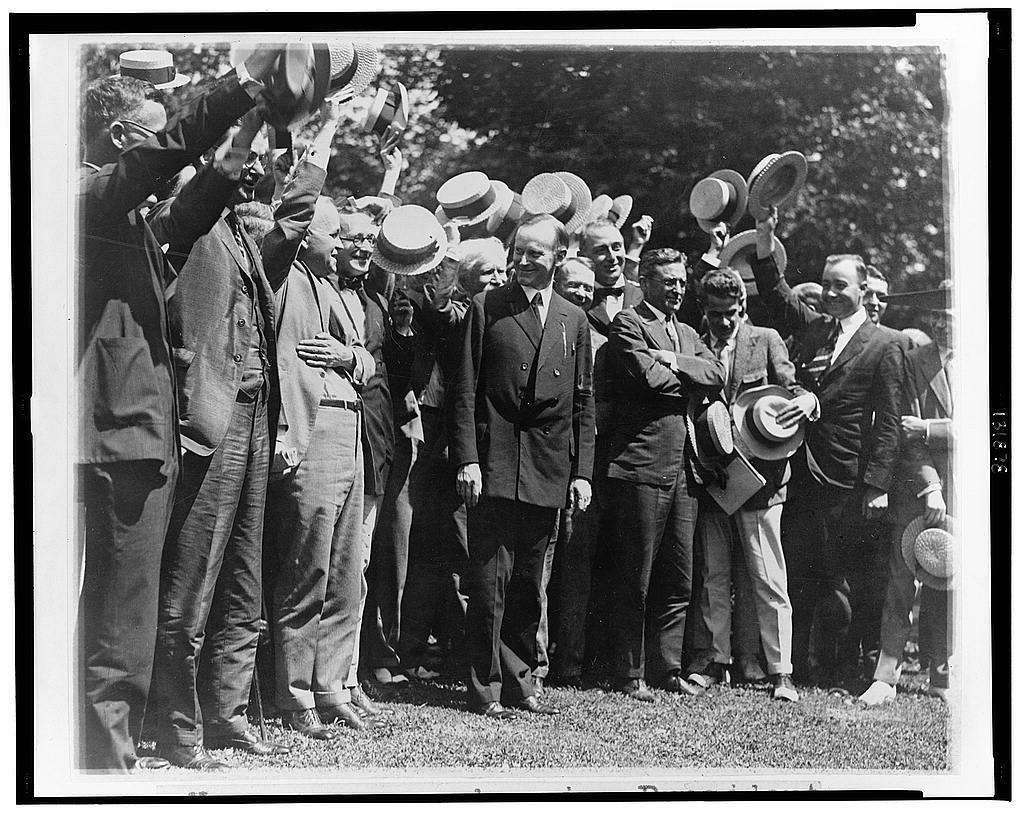
On the occasion of President Coolidge’s first press conference (August 1923), which met with spontaneous applause. The press knew with Coolidge things were changing for the better of all.
For further reading, see Blair, John L. “Coolidge and the Image-Maker: The President and the Press, 1923-1929,” The New England Quarterly XLVI (December 1973): 499-522; Brayman, Harold. “The President Speaks Off the Record: Historic Evenings with America’s Leaders, the Press, and Other Men of Power at Washington’s Most Exclusive Club–the Gridiron.” Princeton: Dow Jones Books, 1976; Quint, Howard H. and Robert H. Ferrell, eds. “The Talkative President: The Off-the-Record Press Conferences of Calvin Coolidge.” Amherst: University of Massachusetts, 1964.
On a Living Lord
It was not the observance of the day itself that met the religious requirement for Mr. Coolidge, but recognizing the profounder essentials, the truth behind the outward practice that mattered most. On April 3, 1931, the former President wrote:
“Tomorrow will be Easter Sunday. In every quarter of the globe it will be observed in memory of a risen Saviour. So far reaching has been this event, so wide has become the realm of Christendom, that it would be difficult to find anywhere on earth a human being whose life has not been modified in some degree by the influence of the Christian religion.
“Outside the teachings of religion there is no answer to the problems of life. Our international and social relations cannot be solved by material forces. Armaments, wages, profits are not mere questions of quantity. They are questions of quality. Changing and fixing their amount will afford no final solution. What is needed is a change of mind, a change of attitude toward the use of these material things and toward each other. The real problems of the world are not material, but spiritual.
“Easter teaches us the reality of the things that are unseen and the power of the spirit. A risen Saviour established a new faith in the world that showed the reason and authority of service and sacrifice.”
Even with all our technological advancement, we have not nor will we progress beyond our spiritual natures. We may be feel society’s maturity has moved us beyond the spiritual, but we are never far from its enduring needs and the duty our souls owe to a living Lord. At the root of every cultural, social and political problem there is a need for spiritual resources. It is lampooned and ridiculed today no less than critics laughed it off in Coolidge’s time. However, it is the highest vanity to run from the reality of what a living Christ has done for the world and offers to all who come to Him.
 The Importance of the Obvious