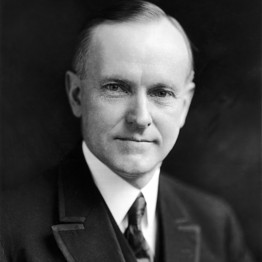
“It is rising above a calling, above a profession, into the realm of art. It must be dignified by technical training, ennobled by character, and sanctified by faith. It is not too much to say that the need of civilization is the need of teachers. The contribution which they make to human welfare is beyond estimation…The earnest conscientious men and women, running from the head of the great university down to the kindergarten, represent a force for good which is immeasurable. The influence which they create for better things, the inspiration which they give for higher ideals, are the chief contributing force to the stability of society and the march of progress. They point the way the dawn, they lead toward the morning, toward light, toward truth” — Calvin Coolidge, speaking before the County Teachers’ Institute and School Directors’ Convention, Reynoldsville, Pennsylvania, December 21, 1922.
When, however, teaching descends to mere self-service that rewards mediocrity, tenures incompetence and protects immoral character, it has violated the sanctity of this charge. When a system of education debases moral conduct, condones failure and punishes the individual for practicing standards that do not comport with the lowest member of the collective, it makes a mockery of education’s purpose. When the goal is not to pursue truth but to deny it exists with requirements that praise misspelling and reward wrong answers for their good intentions, education is sending its students wholesale to slaughter.
The ideals Coolidge reminds us of are necessary if society is to progress with the principles that equip it for what the future holds. Many should not be teaching at all because they do not have the moral character it deserves. Morals, relegated for far too long as the antiquated trappings of religious fanatics, are the basis that makes life whole, nourishes the soul, and prepares the mind for all the challenges of life. When classical education is abandoned, virtue is but the first of many standards to be jettisoned. When that happens, when education consists of teacher’s tenure and multimillion dollar facilities, instead of on the souls and minds of people, it is not surprising that shootings, sexual crimes and assembly-line indoctrination become the norm.
self-government
On the Purpose of Education
Amherst College, with teachers like Charles E. Garman and Anson D. Morse, stood preeminent in the country during the period in which Calvin Coolidge studied there. This was not merely due to the caliber of the men who taught here or its classical curriculum but it was due to the fact that Amherst remained true to the goal of education. It was distinguished in a time when a high number of excellent educational institutions proliferated the country. In our time, it is a serious lack of stewardship that good schools are increasingly difficult to find. Hillsdale College founded twenty-three years after Amherst remains one such haven of classical education. Delivering the commencement address at Amherst on June 18, 1919, Governor Coolidge outlined the purpose of education as it is to be faithfully passed on: “Civilization depends not only upon the knowledge of the people, but upon the use they make of it. If knowledge be wrongfully used, civilization commits suicide. Broadly speaking, the college is not to educate the individual, but to educate society. The individual may be ignorant and vicious. If society have learning and virtue, that will sustain him. If society lacks learning and virtue, if perishes. Education must give not only power but direction. It must minister to the whole man or it fails. Such an education considered from the position of society does not come from science. That provides power alone, but not direction. Give a savage tribe firearms and a distillery, and their members will exterminate each other. They have science all right, but misuse it. They lack ideals.”
Living with the spectre of the Great War, which had not yet formally ended, all those listening to Coolidge speak knew well the horrors of what man, equipped with science severed from morals, could mete out on the world. Over 37 million lay dead around the globe with millions more missing and grieving over the lives forever changed as a result.
As Vice President, Coolidge would continue to explain what education was meant to accomplish, “Unless we are to be content with the superficial, the cynical, and the immature, something more substantial than this is needed to bring out the best that there is in life. The real constructive power of the mind must be sought. It is necessary to provide a training which will enable the student to assemble facts, draw conclusions, and weigh evidence. Education must bring out these higher powers of the mind, if the result is to be real manhood and real character. The goal is not to be the lower reaches of mere animal existence but the higher reaches of beings endowed with reason. Such result can only be secured by long and tireless discipline.”
Of what would this curriculum consist? “Gender” and “minority studies” disguised as history courses? Sexual-education seminars cloaked behind philosophy classes? Narrow subjects at the expense of understanding the whole picture? No, Coolidge answers, “[c]ourses of study must be pursued which require close application, accurate observation, precise comparison, and logical conclusion.” All things foreign to far too many modern schools. Coolidge continues, “I know of no courses which have supplied these requirements better than the study of mathematics, Latin, and Greek when they are supplemented by contemplation of the great truths of philosophy and a generous knowledge of history. The ideal of education must be not a special training leading to a one-sided development but a broad and liberal culture which will bring into operation the whole power of the individual. We have witnessed a falling away from this ideal…Unless education can be based on a belief in mankind and in the power of the race as a whole to develop by response to the teachings of the truth, education might as well be abandoned.”
Coolidge kept going to make the point even plainer, “In education the whole being must be taken into consideration. It is not enough to train the hand, the eye, to quicken the perception of the senses, develop the quickness of the intellect, and leave out of consideration the building up of character, the aspirations of the soul.” A solid training in historical perspective, more than just peripheral, is essential. “There is the most urgent necessity for a broader understanding of the teachings of history and the comprehension of the height and breadth of human nature, if we are to maintain society, if we are to support civilization. Much of the unrest of the present day, many of the unwise proposals for change in the way of laws, and the large amount of criticism of our government would be completely answered if there were a better general knowledge of history.” It is because history is not actually taught any longer than schools are turning out ignorant and impressionable students. Departing from the aim of education, control over what people are allowed to think has taken its place. Thereby sweeping social and political transformation can be achieved without, or in spite of, an informed citizenry.
As a result, the proper understanding of our form of government is lost. The goal of education becomes no longer building mature men and women who become responsible citizens but instead is the deliberate perpetuation of childish expectations, outlooks and attitudes. The literacy rate in this country is even to demonstrate education is no longer the goal of too many modern schools. In the end, though, “[t]here is no such thing as liberty without responsibility. My rights are always represented by the duties of others. My freedom is always represented by the obedience of others. Their rights and their freedom are represented by my duties and my obedience…Any attempt to maintain rights, to secure freedom and liberty for ourselves without the observance of duties and the rendering of obedience toward others, is a contradiction of terms. It defeats itself.” It is that suicidal legacy that confronts us now.
“But the chief end of it all, the teaching of how to think and how to live, must never be forgotten. All of this points to the same conclusion, the necessity of a foundation of liberal culture, and the requirement for broadening and increasing the amount of moral intellectual training to meet the increasing needs of a complicated civilization.” As President, Coolidge would adhere to that same conclusion, “All of our learning and science, our culture and our arts, will be of little avail, unless they are supported by high character, unless there be honor, truth, and justice. Unless our material resources are supported by moral and spiritual resources, there is no foundation for progress. A trained intelligence can do much, but there is no substitute for morality, character, and religious convictions. Unless these abide, American citizenship will be found unequal to the task.” Such is both the challenge and the opportunity to restore genuine education, rearing children into mature adults, encouraging teachers of character, preparing responsible citizens and morally equipping the nation for the future.
On Responsibilities
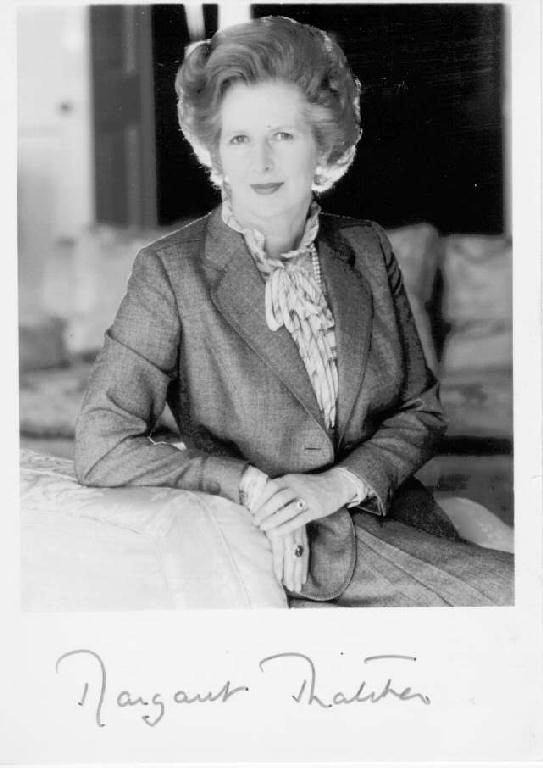
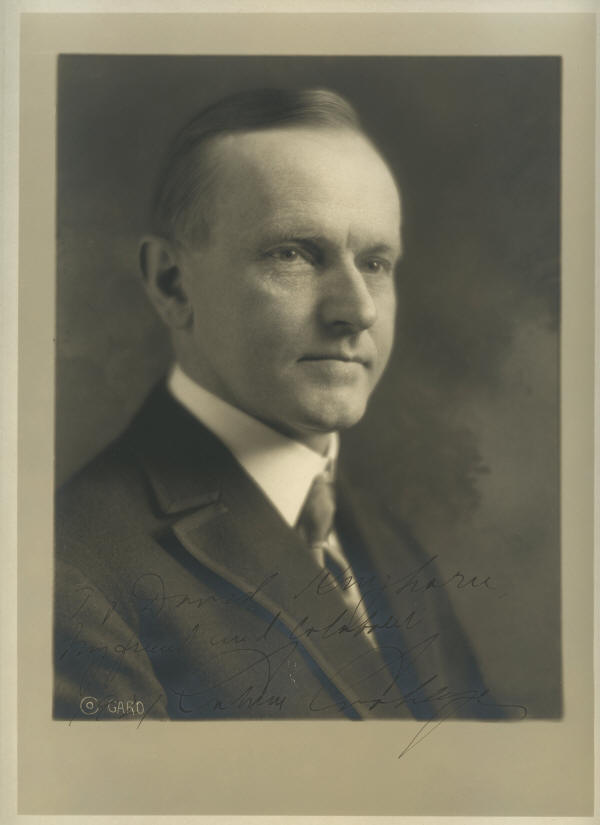
As today marks the passing of Baroness Margaret Thatcher, the “Iron Lady,” who served as Britain’s Prime Minister from 1979 to 1990, it is necessary to remember that her convictions were not new. They were shared by none other than Americans like President Coolidge. Thatcher was born in a relatively small market town called Grantham in England, in the second year of Coolidge’s presidency, during the same fall that his secretary, C. Bascom Slemp, was preparing a collection of his speeches, which would be published the next year as “The Mind of the President.” In that collection, Coolidge would express an unshakable optimism in the ability of Americans to govern themselves, saying, “The institutions of our country rest upon faith in the people. No decision that the people have made in any great crisis has ever shown that faith in them has been misplaced. It is impossible to divorce that faith which we have in others from the faith which we have in ourselves.”
Perhaps entirely unaware of these words, Prime Minister Thatcher would echo that same confidence in her people to retain their self-sufficiency, “If our people feel that they are part of a great nation and they are prepared to will the means to keep it great, a great nation we shall be, and shall remain.” She would affirm in the same 1980 speech, “[I]t is not the State that creates a healthy society. When the State grows too powerful people feel that they count for less and less. The State drains society, not only of its wealth but of initiative, of energy, the will to improve and innovate as well as to preserve what is best. Our aim is to let people feel that they count for more and more. If we cannot trust the deepest instincts of our people we should not be in politics at all. Some aspects of our present society really do offend those instincts. Decent people do want to do a proper job at work, not to be restrained or intimidated from giving value for money. They believe that honesty should be respected, not derided. They see crime and violence as a threat not just to society but to their own orderly way of life. They want to be allowed to bring up their children in these beliefs, without the fear that their efforts will be daily frustrated in the name of progress or free expression.”
Coolidge in 1914, as Thatcher’s father was going to war, would praise self-sufficiency and warn against the destructive actions of government activity, “The people cannot look to legislation generally for success. Industry, thrift, character, are not conferred by act or resolve. Government cannot relieve from toil. It can provide no substitute for the rewards of service. It can, of course, care for the defective and recognize distinguished merit. The normal must care for themselves. Self-government means self-support.”
Thatcher would again sound familiarly Coolidge-like in a 1987 interview, when she observed, “I think we have gone through a period when too many children and people have been given to understand ‘I have a problem, it is the government’s job to cope with it!’ or ‘I have a problem, I will go and get a grant to cope with it!’; ‘I am homeless, the government must house me!’ and so they are casting their problems on society and who is society?
“There is no such thing! There are individual men and women and there are families, and no government can do anything except through people and people look to themselves first.
“It is our duty to look after ourselves and then also to help look after our neighbour and life is a reciprocal business and people have got the entitlements too much in mind without the obligations.”
Coolidge, in retirement, would presage the danger of the entitlement mindset and its parent, unrestrained government spending, “This country was not made on the theory that we should ‘eat, drink, and be merry, for tomorrow we die’…Instead of falling back and falling down on the claim that the world owed them a living, they moved forward and moved up on the principle that they owed the world the duty of providing for themselves…One of the most astounding spectacles is the complacency with which people permit themselves to be plundered by extravagant governmental expenditure under the pretense of taxing the rich to help the poor. The poor are not helped but hurt…A higher tax means real wages are lower. The cost of living is higher. The chance to work is less. Every home is burdened. Its value is decreased. The Congress and the legislatures know these results of extravagance…Those who demand appropriations inspire all the fear. Aggregate state and town debt, national and local taxes are increasing enormously. Unless the people resist vigorously and immediately they will be overwhelmed.”
Speaking again, forty-nine years later, Thatcher explained the same harmful mentality underway in Britain, namely, “to add to public spending takes away the very money and resources that industry needs to stay in business let alone to expand. Higher public spending, far from curing unemployment, can be the very vehicle that loses jobs and causes bankruptcies in trade and commerce. That is why we warned local authorities that since rates are frequently the biggest tax that industry now faces, increases in them can cripple local businesses. Councils must, therefore, learn to cut costs in the same way that companies have to.”
Baroness Thatcher is no longer with us but her principles endure. They remain necessary no less now than in 1980 or in 1925. They are necessary because they truly understand human nature and are grounded in the moral responsibilities of people both to themselves and to each other. For Coolidge, in the same year Thatcher was born, declared, “I favor the policy of economy, not because I wish to save money, but because I wish to save people. The men and women of this country who toil are the ones who bear the cost of the Government. Every dollar that we carelessly waste means that their life will be so much the more meager. Every dollar that we prudently save means that their life will be so much the more abundant…If extravagance were not reflected in taxation, and through taxation both directly and indirectly injuriously affecting the people, it would not be of so much consequence. The wisest and soundest method of solving our tax problem is through economy…Whenever taxes become burdensome a remedy can be applied by the people; but if they do not act for themselves, no one can be very successful in acting for them.”
Such is the benefit coupled with the responsibility of self-government taught by British Prime Minister Thatcher and the American who preceded her, President Calvin Coolidge.
 The Importance of the Obvious