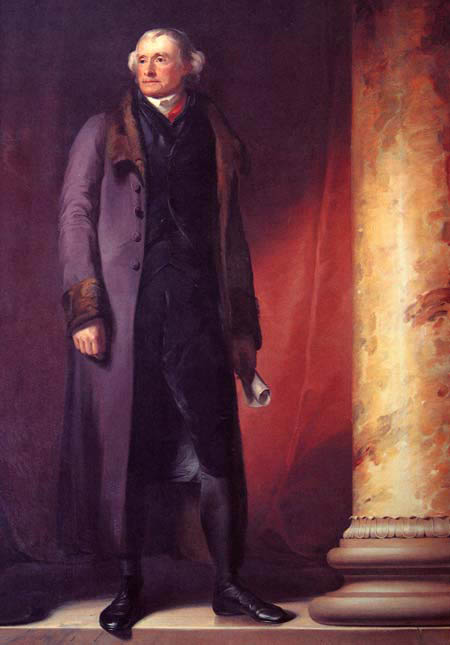
Jefferson by Thomas Sully, 1821-22
“In spite of all his greatness, anyone who had as many ideas a Jefferson was bound to find some of them would not work. But this does not detract from the wisdom of his faith in the people and his constant insistence that they be left to manage their own affairs. His opposition to bureaucracy will bear careful analysis, and the country could stand a great deal more of its application. The trouble with us is that we talk about Jefferson but do not follow him. In his theory that the people should manage their government, and not be managed by it, he was everlastingly right” — Calvin Coolidge on the third President, 1929, The Autobiography, p.215.
“About the time of the adoption of the Constitution, Jefferson wrote of his disapproval of parties, and somewhat later John Marshall expressed the same opinion. Yet when Jefferson undertook the practical administration of the Government and had a conscientious desire to promote the rule of the people, he became such a thorough party organizer that he has ever since stood as the patron saint of that method of expressing the will of the people. He realized that there was no choice between that system and turning over the administration of public affairs to an oligarchy or an aristocracy. The great place which he holds in our political history is due to his thorough comprehension of that fundamental principle” (Coolidge in one of the last essays he would write, entitled “Political Parties,” published posthumously in the Saturday Evening Post, 1934).
Today marks the 271st anniversary of Jefferson’s birth. A thought-provoking piece by Dr. Clyde Wilson reminds us in “Looking for Thomas Jefferson” to dig past the layers of academic veneer that obscure who he was, how he thought and why he is great…taken, like Coolidge, on his terms not through the lens of modern political prejudices. Historical study, to remain sound and honest however, must resist the urge to replace one set of biases with another. Any scholar must be approached with careful perspective to let the subject lead and inform not conform to the observer’s views.
 The Importance of the Obvious