On Mistaken Identity

Circulated around Washington through the 1920s, this apocryphal story of mistaken identity, is recounted by one of Chief Justice Taft’s earliest biographers:

“One day during the administration of President Coolidge, the Chief Justice happened to drop his cane just as a small boy of about seven came by. The boy picked up the cane and handed it politely to Taft, who thanked him with the radiant warmth which was so characteristic.

     ‘I met the nicest old gentleman on the bridge today,’ said the youngster to his mother when he reached home. ‘He dropped his cane and I picked it up. He was very, very fat!’

     “The mother recognized Taft in the description. ‘That was a very famous man,’ she told her son. ‘He used to be president of the United States.’

     “A day or two later they met again.

      ‘I know who you are!’ said the boy. ‘You used to be President Coolidge!’ “ (Pringle 964).

While the amiable Chief Justice was a frequent visitor to the Coolidge White House, he shared in the impression of even those closest to Coolidge who felt the chill from time to time that resulted from giving the President unsolicited advice. Taft, who knew the weight and obligations of the Presidency better than anyone close to Coolidge, never let incidentals like this get in the way of his friendship with Calvin and Grace.

Having met in 1914, Coolidge and Taft always kept the highest respect for one another, as the exchange below illustrates. Writing to his father, Coolidge said of Taft, “what he said was so much like what I had said that I sent him a copy of my address he sent me the enclosed letter which you may return to me, also an autograph copy of his book on Popular Government…” In that enclosed letter, Taft, characteristically self-effacing, told Coolidge, “I have read what you said to the Senate upon your taking the Chair [Coolidge’s famous January 7, 1914 speech], and it is so fine that I thank you for sending it to me and for giving me an opportunity to read it. It strikes a chord in my heart that responds to every word. I have pleasure in sending you a little volume that has been published of ten lectures which I have delivered on Popular Government and also three addresses that I have made which are not included in the book, to file away, with the certainty that there is nothing in them which says as well as you have said it the truth with respect to government, but that there is also nothing in them which differs in spirit from that which you have said” (“Your Son, Calvin Coolidge,” Edward C. Lathem, Montpelier: Vermont Historical Society, 1968, pp.126-7).
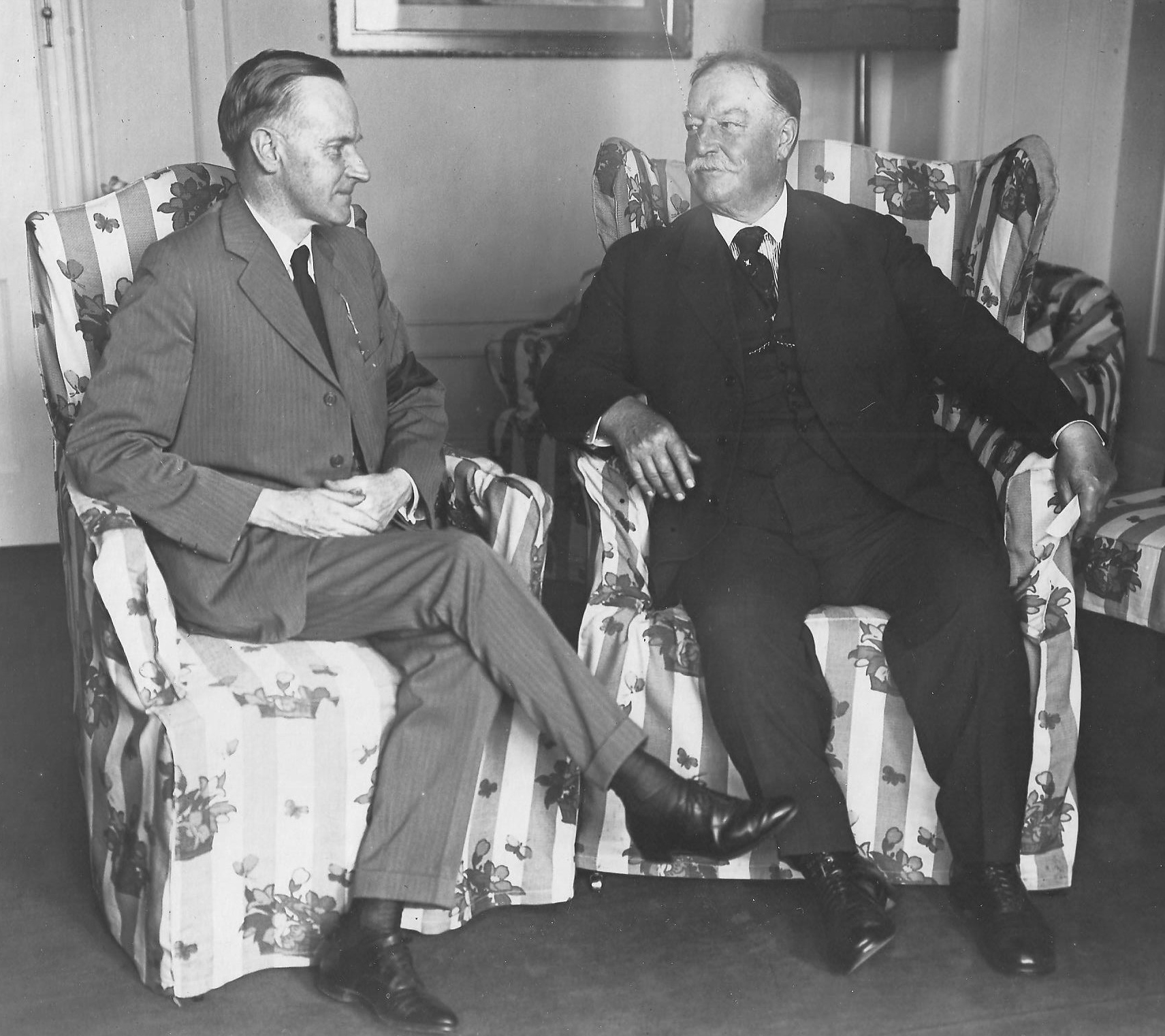
President Coolidge meeting with Chief Justice Taft at the New Willard Hotel within the first week of succeeding to the Presidency, August 1923.
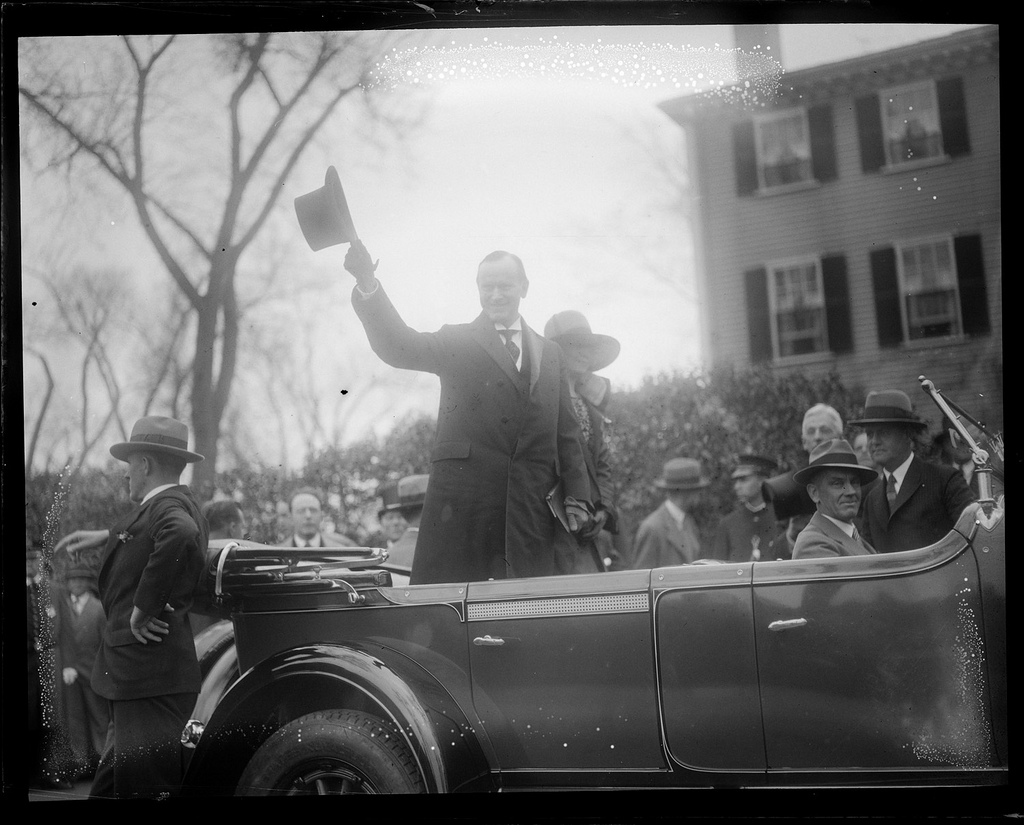
President Coolidge meeting with Chief Justice Taft at the New Willard Hotel within the first week of succeeding to the Presidency, August 1923.

On the Oath

Section 1 of Article II of the Constitution prescribes the oath each President is to promise and observe as he carries out the responsibilities of his office, ‘I do solemnly swear (or affirm) that I will faithfully execute the Office of President of the United States, and will to the best of my Ability, preserve, protect and defend the Constitution of the United States.’

When the occasion arose to succeed the President in the early hours of the morning on August 3, 1923, Coolidge did not have to consult a team of legal experts or “brainstorm” with Cabinet members over the telephone about what comes next. He simply consulted the Constitution which sat on his father’s bookshelf and found the oath to be taken by the President, the same he had affirmed over two years before. The answer, to anyone able to read and understand, was accessible simply by looking at the Constitution, our blueprint and road-map.

“Having found this form in the Constitution I had it set up on the typewriter and the oath was administered by my father in his capacity as a notary public, an office he had held for a great many years.”

When it came to the Constitution, Coolidge’s grasp of its power and clarity is no less essential a message for the current President than it has been for the previous forty-three,

…[T]he President exercises his authority in accordance with the Constitution and the law. He is truly the agent of the people, performing such functions as they have entrusted to him. The Constitution specifically vests him with the executive power. Some presidents have seemed to interpret that as an authorization to take any action which the Constitution, or perhaps the law, does not specifically prohibit. Others have considered that their powers extended only to such acts as were specifically authorized by the Constitution and the statutes…This has always seemed to me to be a hypothetical question, which it would be idle to attempt to determine in advance. It would appear to be the better practice to wait to decide each question on its merits as it arises…

Coolidge is not sanctioning an improvisational Presidency employing situational compliance with the Constitution and our laws as it suits the individual. He makes that plain with what he says in the very next paragraph.

For all ordinary occasions the specific powers assigned to the President will be found sufficient to provide for the welfare of the country. That is all he needs. All situations that arise are likely to be simplified, and many of them completely solved, by an application of the Constitution and the law. If what they require to be done, is done, there is no opportunity for criticism, and it would be seldom that anything better could be devised…by simply finding out what the law required (The Autobiography, pp.200-202, emphasis added).

Office holders today, whatever level of importance, would do well to take their oath with the same seriousness of mind and reverence for duty that Coolidge held for it.

6192828053_50c0a1fa2a_b CC in Andover

On the Move

On the Move

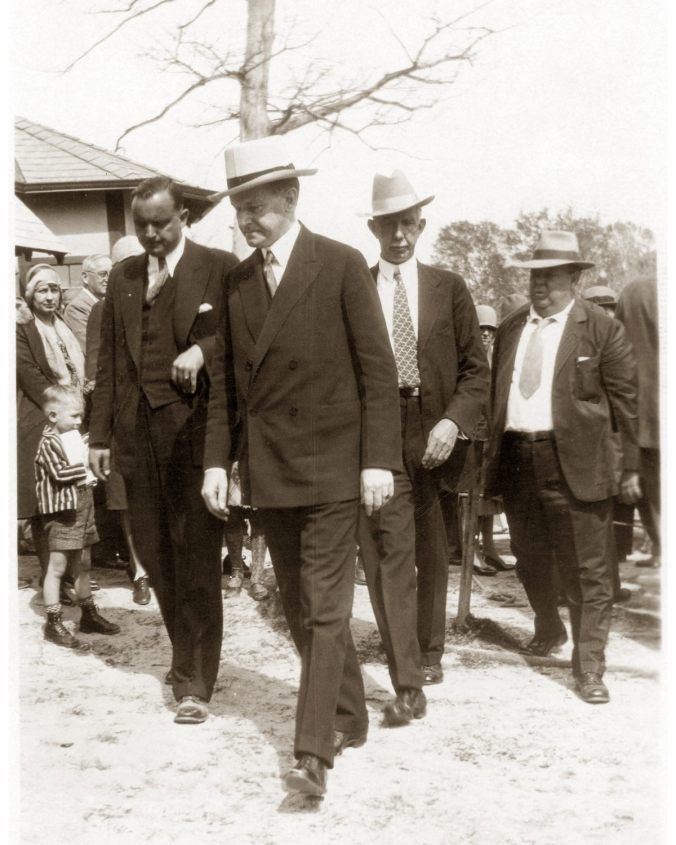
Here former President Coolidge, staying at the Lakeside Inn, Mount Dora, Florida, is walking along with Archie Hurlburt (behind Coolidge), Cal’s friend and also the manager of the Inn at that time, Carl Ray (to his right), and “Shorty” Davidson (behind Hurlburt).

Ray and Davidson, both Ocala-area entrepreneurs, teamed up in 1924 to revitalize Silver Springs into a successful attraction. They made it work and it drew folks for decades afterward as a result of their efforts.

On this Sunday afternoon, February 9, 1930, Coolidge accompanied them on the hour-long glass-bottom boat tour, seeing the various underwater springs including the area near the dock which, even then, was becoming a favorite for underwater filming.

The Coolidges stayed at Lakeside for a month on their way to California. Trying to travel as private citizens again, the Coolidges could not escape the crowds drawn to their every stop. Finally concluding unobtrusive travel was no longer possible, Coolidge never saw all he wanted to of the country. He sacrificed his curiosity to see and do to the solitude and separation from public life he wished still more after having walked away from the most powerful office in the world.