On Pancakes

President Coolidge’s pancake breakfasts were a trademark of his five and a half years in the White House.  As a frequent visitor of the kitchen, he expected much from the housekeeper, Miss Riley. Her papers, kept by the Vermont Historical Society, are well worth renewed interest and study. The President, long the conscientious manager of household expenses, approached the White House no differently. He understood that the best results did not come from costly purchases or elaborate meals. Yet, as long-time Washington journalist Frances Parkinson Keyes notes, “the general atmosphere of state receptions was never more brilliant than when the Coolidges were in the White House” (Capital Kaleidoscope, p.132-3).

He never forgot he was just the man who lived temporarily on the third floor. Regarding himself no better than any of his fellow White House tenants, he once went to the housekeeper’s office to have a word with Miss Riley about the pancakes. Holding the dainty cake carefully between his thumb and index finger he wanted to know, “Why can’t I have big ones like they have down downstairs?” Ishbel Ross, in her book Grace Coolidge and Her Era, notes how the kitchen staff saved time by making their cakes as large as dinner plates (p.104). The President saw no reason why any exception should be made for him. He expected thrift not only in public money but also in the use of time.
Image

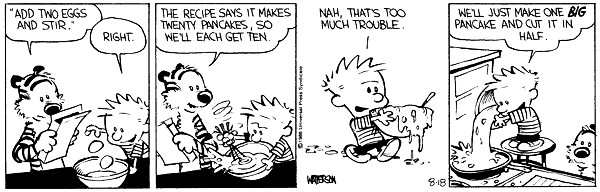
This Calvin and Hobbes strip by Bill Watterson printed August 1986 humorously illustrates the attitude of economy when it comes to pancakes. It may have amused President Coolidge to see this duo’s attempt at thrift when it came to making breakfast.

“But I like it!”

Edna M. Colman recounts an instance that took place just before President Coolidge’s inauguration ceremony in March of 1925, when much discussion ensued among the staff regarding Presidential handshaking. Colman writes, “The fact that, although in the White House but about twenty months, President Coolidge had shaken hands with ninety thousand people brought forth argument against the practice on the part of some of his close friends. A committee was appointed to attempt to relieve him of some of his routine duties. When the solicitous group had expounded to him their views upon the matter and expressed their desires and intentions, expecting him to acquiesce with pleasure and possibly with praise for their thoughtfulness of him, he electrified them and disposed of the entire matter in his characteristic fashion–‘But I like it!’

So much for the mistaken notion that a cold and unfeeling Coolidge lazily slept through the 1920s!

ImageNew Year’s Reception by the Coolidges at the White House, 1927

On the Power of the President

Image

“While it is wise for the President to get all the competent advice possible, final judgments are necessarily his own. No one can share with him the responsibility for them. No one can make his decisions for him. He stands at the center of things where no one else can stand. If others make mistakes, they can be relieved, and oftentimes a remedy can be provided. But he can not retire. His decisions are final and usually irreparable. This constitutes the appalling burden of his office. Not only the welfare of…his countrymen, but oftentimes the peaceful relations of the world are entrusted to his keeping. At the turn of his hand the guns of an enormous fleet would go into action anywhere in the world, carrying the iron might of death and destruction. His appointment confers the power to administer justice, inflict criminal penalties, declare acts of state legislatures and of the Congress void, and sit in judgment over the very life of the nation. Practically all the civil and military authorities of the government, except the Congress and the courts, hold their office at his discretion. He appoints, and he can remove. The billions of dollars of government revenue are collected and expended under his direction. The Congress makes the laws, but it is the President who causes them to be executed. A power so vast in its implications has never been conferred upon any ruling sovereign” — Calvin Coolidge, The Autobiography, pp.199-200 [1929]