On Getting Back to First Principles

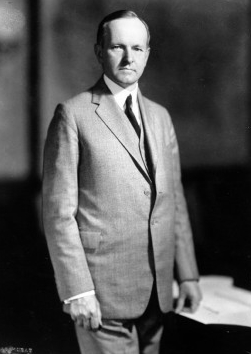
Calvin Coolidge standing the old Cabinet Room of the West Wing.

Calvin Coolidge standing in the old Cabinet Room, established by President Taft, on the West Wing of the White House.

“We always have the defeatists with us. Washington had them…Lincoln had them…Wilson had them during the war to such an extent that he found it necessary to turn over the conduct of important legislation to Republican leadership. We have them at the present time doing their best to capitalize distress and preaching the overthrow of our system of economics and government. It is these forces more than depression which render our condition critical.

“If we have the courage and vision to maintain our governmental and social structure we can meet all other problems. The forces of discord always work in an insidious way. They often attempt to conceal the peril of their unsound proposals under the claim that they are liberal. When that is analyzed it usually means that they intend to give away the money which someone else has earned. Such a process, once started, is bound to increase until it lands the country in universal bankruptcy and general disintegration. It is a time when the great body of our people of common sense should not be stampeded, but should stand firm. In spite of all declarations to the contrary, of the professions of platforms and candidates, the record of two generations discloses that the safety of the country lies in the success of the principles of the Republican Party” — former President Calvin Coolidge, September 10, 1932.

“Silent Cal: A Public Role Model”

“Silent Cal: A Public Role Model”

This excellent piece by College Conservative Alex Uzarowicz defines in cogent terms why overlooking Coolidge and his accomplishments deprives us of the immense benefit of Coolidge’s humble example of service. It was a model Americans expected in 1928 and which is glaringly absent now. Coolidge’s platform resonates not only because it succeeded so well but because it demonstrated how our Founding principles work. The governing principles of “Silent Cal” remain a winning message going into 2016.

mapt06

“Born on the Fourth of July” by Sidney M. Milkis

“Born on the Fourth of July” by Sidney M. Milkis

The latest review of both Amity Shlaes’ Coolidge and Charles C. Johnson’s Why Coolidge Matters adds a welcome take to a renewed conversation of Calvin Coolidge. Mr. Milkis, well-known author and professor with the Miller Center of Public Affairs at the University of Virginia, has much to offer when it comes to the Progressive Era, the period generally classified from 1900 to 1929. In his critique of both books, Mr. Milkis presents the Coolidge neither author may envision but one that resembles the man described by David Greenberg, whose Calvin Coolidge, published in 2006, accepted too many of the assumptions handed down by Art Schlesinger and the New Deal gang. Greenberg unfortunately dug himself into a deeper hole with his 2011 piece further ridiculing Coolidge’s “naive faith in the gospel of productivity” as if Big Government has proven once and for all to be a reliable and permanent fixture of American life.

Mr. Milkis contributes a worthy opinion in the ongoing and overdue discussion about our thirtieth president. However, it is equally as important not to reinforce the same, old misrepresentations of what has, for far too long, been the accepted narrative regarding “Silenced Cal.” The fact that Ms. Shlaes and Mr. Johnson are questioning that narrative with meticulous research is not “revisionist” as much as it is a return to the rigorous standards of scholarship restored by Thomas Silver, popularized by Ronald Reagan, and now being revitalized by, among others, the authors Mr. Milkis has reviewed.

Mr. Greenberg and those who preceded him in defense of the New Deal have more to lose by seeing Coolidge’s principles reintroduced and expounded through the heavy lifting done by those he perceives to be on “the Right,” than they do repeating the tired shibboleth of his naivete and failure. Americans all can appreciate Coolidge not because he identified with this or that “political side” but because the principles he embodied were thoroughly and unabashedly true to the foundations of our exceptional system, declared, constituted and reaffirmed by our ancestors. As Coolidge expressed it on another occasion, “Whether one traces his Americanism back three centuries…or three years…is not half so important as whether his Americanism of to-day is real and genuine. No matter by what various crafts we came here, we are all now in the same boat.” His appeal to eternal truths of human nature and political experience should form ground on which we can all Americans can again be a united and prosperous people.