“Calvin Coolidge and civility”

“Calvin Coolidge and civility”

Here is a worthy piece by Rick Sincere, Jr., illustrating Coolidge’s graciousness and civility, even toward those who ran against him for office. A mutual respect existed not merely because of Coolidge’s heartfelt kindness for others but also because his opponents still cherished the virtue of forbearance. It is that self-restrained tolerance, that allowance for disagreement without plummeting to personal vilification that exemplified the ideal that we are Americans first. The Kennedy who defeated Coolidge would not have recognized his Party today. Were Coolidge, or Kennedy for that matter, able to witness politicians today exchange the vitriol we hear for this or that fellow Representative or Senator they would find it a reprehensible and disgusting perversion of the noble duty of public service. The mentality that impugns and mocks our common foundation as Americans is why politics, no less lively and spirited in Coolidge’s day, now shamelessly mislabels opponents “terrorists,” “legislative arsonists,” “hostage-takers” and as virtual “enemies of the human race,” the last label being virtually ascribed by the Supreme Court majority in United States v. Windsor this last summer against those who support the Federal Defense of Marriage Act.

While the case can be clearly made that one side is predominantly given to such childish name-calling, the personal attacks against those who are simply trying to do what is right, represent the people and work faithfully come from opponents in both parties. These conscientious public servants among us deserve no less the civility Coolidge displayed.

Americans have never entirely agreed on every point. What made peaceful co-existence possible in the past came down to a healthy respect for those who believe and think differently. We may disagree but we are still Americans who love our country, our institutions and our liberties. The tone has changed not because opposition to Administration policy is new, unjustified or “all opposition is uncivil” but because that respect for others and commitment to America first is no longer paramount in the actions and words of certain politicians.

Civility never muzzled Coolidge from taking clear, controversial or principled stands. Each time he did so, he ran the risk of offending someone. He kept to ideas, not personalities. He campaigned for principles, not against people. He championed convictions that met with partisan opposition but demonstrated that civility did not mean surrendering the fight. He led the way back toward a kindly forbearance to be shared by all, Republican, Democrat or otherwise, made possible by an abiding sense of obligation to America’s people, institutions and morals.

On the Consequences of Compromise

Image

“The Congress threw away a great opportunity to help the people. If it has granted all necessary relief and then by a policy of rigid economy reduced governmental costs, avoided a deficit and more debt, the country would have looked on it as a savior. Politics is always present. Probably there were those who thought they would profit politically by being able to charge that business is bad and taxes and debt have been increased. Those making the charge in the future will have to explain what constructive measures they proposed to revive business, promote economy and reduce taxes and debt. Those voting for the largest peace-time expenditures any Congress ever authorized cannot escape responsibility” — Calvin Coolidge, March 4, 1931.

As talk of Congressional deals to reopen the government seem imminent, funding everything including Obamacare, what is not being discussed is how any of these proposals advance the interests of the people. On an unprecedented scale, we stand alone, without representation in Washington. The establishment of both parties, insulated from the impact of their own decisions, seem content to ensure surrender to the President and his agenda on every point of difference so long as they get to hold some measure of Congressional power over the money and committees.

Observing a Congress ready to embrace the largest peacetime tax increase up to that time, as proposed by President Hoover, Coolidge would live to see the first deficit in over a decade and its attempted remedy, the disastrous Revenue Act of 1932. The Republicans, flinching at the prospect of unpopularity, forgot the lessons of the 1921, 1923 and 1926 recessions. Instead of holding firm on reducing expenditures, cutting waste and following Coolidge’s recipe for success, fear prevailed over principles. The quick recoveries of past recessions due to strict economy by Harding and Coolidge were thrown overboard as passe and obsolete.

The election of 1930 was but a harbinger of F.D.R.’s sweep in 1932. The costs of abandoning the people in that crucial hour, refusing to stand in bold opposition to the expansion of government at the sacrifice of individual freedom, cannot be quantified. Had the 71st Congress demonstrated courageous and conservative leadership, like Senators Lee and Cruz have done, the losses both at the ballot box and to the people may have been curtailed, if not largely avoided. Whatever might have happened, this much can be known: it is compromise, not conservatism, that leads to defeat at the polls.

The timely warning Coolidge expressed in the spring of 1931 applies just as readily now as it did then. The consequences of compromising, when just a little more resolve and the pressure of time could win a huge victory for the people, will have enormous impact on every one of us. It will especially affect those currently in Washington who find themselves joining the unemployed after next year’s fast-approaching primaries and general election. Just as Coolidge put it, “Those voting for the largest peace-time expenditure any Congress ever authorized cannot escape responsibility.” The Washington establishment will not rule over and against the people with impunity. There will be electoral consequences for surrendering now to the radical and partisan wishes of this President.

On Honoring Our Veterans

As Senate Democrats continue to back the President’s cherry-picking approach on which public sites to shut down and who deserves funding, veterans simply do not contribute anything to their Party agenda that merits respect or support. In the midst of what is supposed to be a Government “shutdown,” we saw the reinforcement of the World War II Memorial fencing by seven Park Service employees. At the same time, the Normandy American Cemetery and Memorial in France has been chained shut “due to the U.S. Government shutdown.” So, we are spending money to reinforce gates and place guards at closed sites because we no longer have the money to keep them open?

Meanwhile, Camp David, the Presidential retreat, is kept open. The Blue Angels and NASA programs have long been shut down as visible symbols of American achievement and patriotism. Now Senator Harry Reid is refusing every effort to fund the National Guard, salaries for Reserve personnel, veterans’ services, and museums and parks. Taking all of these together, combined with the rabid attacks by Democrats against our military for serving in Iraq and Afghanistan during the previous administration, it forces the question: What do the Democrats have against our Armed Forces? Of course, they do not have value to the agenda.

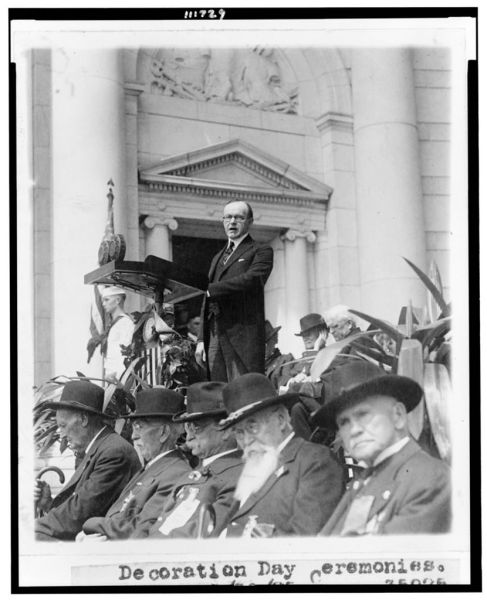
Calvin Coolidge, upon being officially informed of his nomination as Vice Presidential candidate, spoke at length on what the country needed. He saw America suffering under a militant White House, continuing to prosecute the powers of wartime in peace. When a return to respect for our laws and institutions was needed, President Wilson and his Party kept the hostility and obstruction going. Evading their responsibilities to govern, the Democrats had assumed control at the expense of the people’s sovereignty. Millions were now unemployed, many of them World War I veterans and their families. The economy was stagnating under high taxation rates extracted by the Internal Revenue Service. A culture of fear was being perpetuated by Wilson’s Justice Department. The Democrats were shirking the duty they held not only to all the people but to those who had served. The unrestrained waste of the people’s substance had to be stopped. It was time to change those in charge. What they were doing was wrong and the first opportunity for the people to correct the direction in which America was going came with the 1920 election. As we know the people took their country back decisively, sweeping the White House, the Congress and state governments across the land.
Image

When it came to veterans, while there could be no price quantified for what they had sacrificed, America had an obligation to them they could not pass off to anyone else. Coolidge said,

Whenever in the future this nation undertakes to assess its strength and resources, the largest item will be the roll of those who served her in every patriotic capacity in the world war. There are those who bore the civil tasks of that great undertaking, often at heavy sacrifices, always with the disinterested desire to serve their country. There are those who wore the uniform. The presence of the living, the example of the dead, will ever be a standing guaranty of the stability of our republic. From their rugged virtue springs a never-ending obligation to hold unimpaired the principles established by their victory. Honor is theirs forevermore.

The form this honor should take is what compelled Coolidge to stand on principle against cash payments to veterans, or any other special demographic. He knew what the perception of a Government giving money away does even to good and honest people. He knew that no amount could adequately recompense those who risked all, some giving life itself, for America’s ideals. When he vetoed measures to bestow cash bonuses to veterans, he acted with full awareness of what it might cost him politically. Principle mattered more to him. The principle of honoring sacrifice to Coolidge did not consist of merely appropriating money to show that “we care” but by embracing a deeper, more profound respect and reverence for what our veterans have done. The Congress of his day, overrode his veto.

Americans had made promises to veterans and those promises must be kept. Coolidge continued,

Duty compels that those promises, so freely made, that out of their sacrifices they should have a larger life, be speedily redeemed. Care of dependents, relief from distress, restoration from infirmity, provision for education, honorable preferment in the public service, a helping hand everywhere, are theirs not as a favor but by right. They have conquered the claim to suitable recognition in all things.

This recognition would be desecrated, however, if honoring our veterans became nothing more than a cash giveaway. More is required than simply to throw money at the problem and walk away. Unless we take up the service of those who served, no amount we give purchases the compassion and respect we owe. By helping the veteran who lives next door, providing for the assistance of his family, supporting the education and upward mobility of our defenders, wherever they are, ensuring the wounded are healed, the forsaken encouraged and the war-torn are built up, we are meeting that obligation. Responsible government appropriates the funds but it accomplishes nothing without the active participation of you and me serving those who served.

On numerous memorials across our nation, what Coolidge said next is fittingly preserved for posterity on the stones we have established in recognition of our veterans’ sacrifices. He reminds us still, “The nation which forgets its defenders will be itself forgotten.”

Image