On Respect for the Office

Image“Personally, I do not like all this attention, but it is for the President of the United States, and I have great respect for the office” — Calvin Coolidge to his Aunt Mrs. Pollard, after boarding the Mayflower to formal salutes, the National Anthem and the ceremonious presentation of his sailing cap (Paul Boller, Presidential Diversions. Orlando: Harcourt, 2007, p.217).

“Everything that the President does potentially at least is of such great importance that he must be constantly on guard. This applies not only to himself, but to everybody about him. Not only in all his official actions, but in all his social intercourse, and even in his recreation and repose, he is constantly watched by a multitude of eyes to determine if there is anything unusual, extraordinary, or irregular, which can be set down in praise or in blame…While such events finally sink into their proper place in history as too small for consideration, if they occur frequently they create an atmosphere of distraction that might seriously interfere with the conduct of public business which is really important” — Calvin Coolidge, The Autobiography, pp.216-7.

“When the President speaks it ought to be an event” — Calvin Coolidge, The Autobiography, p.219, when discussing the refusal to give speeches from the rear platforms of trains. To Coolidge, it was beneath the dignity due the Office. He had great esteem for the Presidency.

“This was I and yet not I, this was the wife of the President of the United States and she took precedence over me; my personal likes and dislikes must be subordinated to the consideration of those things which were required of her” — First Lady Grace Coolidge

“Even after passing through the presidential office, it still remains a great mystery. Why one person is selected for it and many others are rejected cannot be told. Why people respond as they do to its influence seems to be beyond inquiry. Any man who has been placed in the White House can not feel that it is the result of his own exertions or his own merit. Some power outside and beyond him becomes manifest through him. As he contemplates the workings of his office, he comes to realize with an increasing sense of humility that he is but an instrument in the hands of God” —  Calvin Coolidge, The Autobiography, pp.234-5.

“Young man, you are having dinner tonight with the President of the United States. You will dress properly. Go to your room and change” — President Calvin Coolidge to his son, John, after the boy had come back to the White House in casual clothes and wanted to know why, since no guests were expected outside the family, he had to dress formally and appear punctually for 7PM dinner (Robert Gilbert, The Tormented President, p.51).

Father Coolidge was not thinking of how it reflected upon him personally, he was regarding the respect due to the Presidency, an obligation equally as binding on him as upon his family. For Coolidge, the President was more than the man who occupied it at the time, it was the great and dignified responsibility of the Office. It would not be cheapened or sacrificed through any action on the part of himself or his family. This remained true all of his life, whatever office he held.

The secretary who worked in his law office, Ernestine Perry, once recounted the occasion that Lieutenant Governor Coolidge called from the train station. He was quite “disgruntled,” she remembered. It seems he had become separated from his hat and coat, arriving before them on a separate train to Northampton. As Mrs. Perry recounted, Coolidge “had only to walk the length of the platform and cross the street to his office, but he would not attempt it hatless.” To confuse this response with vanity is greatly mistaken, Coolidge held each office with the highest honor. He would not detract from it for the sake of his own convenience, sending the message that an informal appearance conveyed: flippant disregard for one’s duties. As Mrs. Perry observed, “He felt keenly that public officials should maintain the dignity of office. To him it represented the public trust. His dignity was not a pose. He was always orderly. I never saw him in need of a shave, and I never saw his hair untidy. I never saw his shoes in need of a shine” (Good Housekeeping, March 1935, p.214). It was not the appearances themselves but what the outward neglect said about the substance of the person that mattered to Coolidge.

Even his readiness to wear the gifts presented to him, despite how it made him personally appear, conformed to his high regard for the Presidential Office. Coolidge wore them not to denigrate official dignity for were he to refuse the headdress, the ten-gallon hat and chaps given to the President, it would have hurt the bond of mutual respect that must necessarily continue between the Office and the People. He could not injure so delicate a sentiment because it would impair the strength of that very legitimate connection the people rightly have to those they choose to serve as their leaders.

“It was my desire to maintain about the White House as far as possible an attitude of simplicity and not engage in anything that had an air of pretentious display. That was my conception of the great office. It carries sufficient power within itself, so that it does not require any of the outward trappings of pomp and splendor for the purpose of creating an impression. It has a dignity of its own which makes it self-sufficient. Of course, there should be proper formality, and personal relations should be conducted at all times with decorum and dignity, and in accordance with the best traditions of polite society. But there is no need of theatricals. But, however much he may deplore it, the President ceases to be an ordinary citizen” — Calvin Coolidge, The Autobiography, p.217.

Image

On Getting Back to First Principles

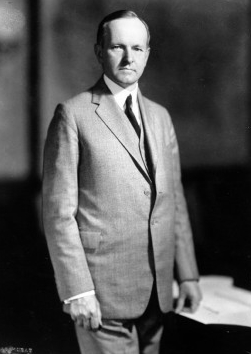
Calvin Coolidge standing the old Cabinet Room of the West Wing.

Calvin Coolidge standing in the old Cabinet Room, established by President Taft, on the West Wing of the White House.

“We always have the defeatists with us. Washington had them…Lincoln had them…Wilson had them during the war to such an extent that he found it necessary to turn over the conduct of important legislation to Republican leadership. We have them at the present time doing their best to capitalize distress and preaching the overthrow of our system of economics and government. It is these forces more than depression which render our condition critical.

“If we have the courage and vision to maintain our governmental and social structure we can meet all other problems. The forces of discord always work in an insidious way. They often attempt to conceal the peril of their unsound proposals under the claim that they are liberal. When that is analyzed it usually means that they intend to give away the money which someone else has earned. Such a process, once started, is bound to increase until it lands the country in universal bankruptcy and general disintegration. It is a time when the great body of our people of common sense should not be stampeded, but should stand firm. In spite of all declarations to the contrary, of the professions of platforms and candidates, the record of two generations discloses that the safety of the country lies in the success of the principles of the Republican Party” — former President Calvin Coolidge, September 10, 1932.

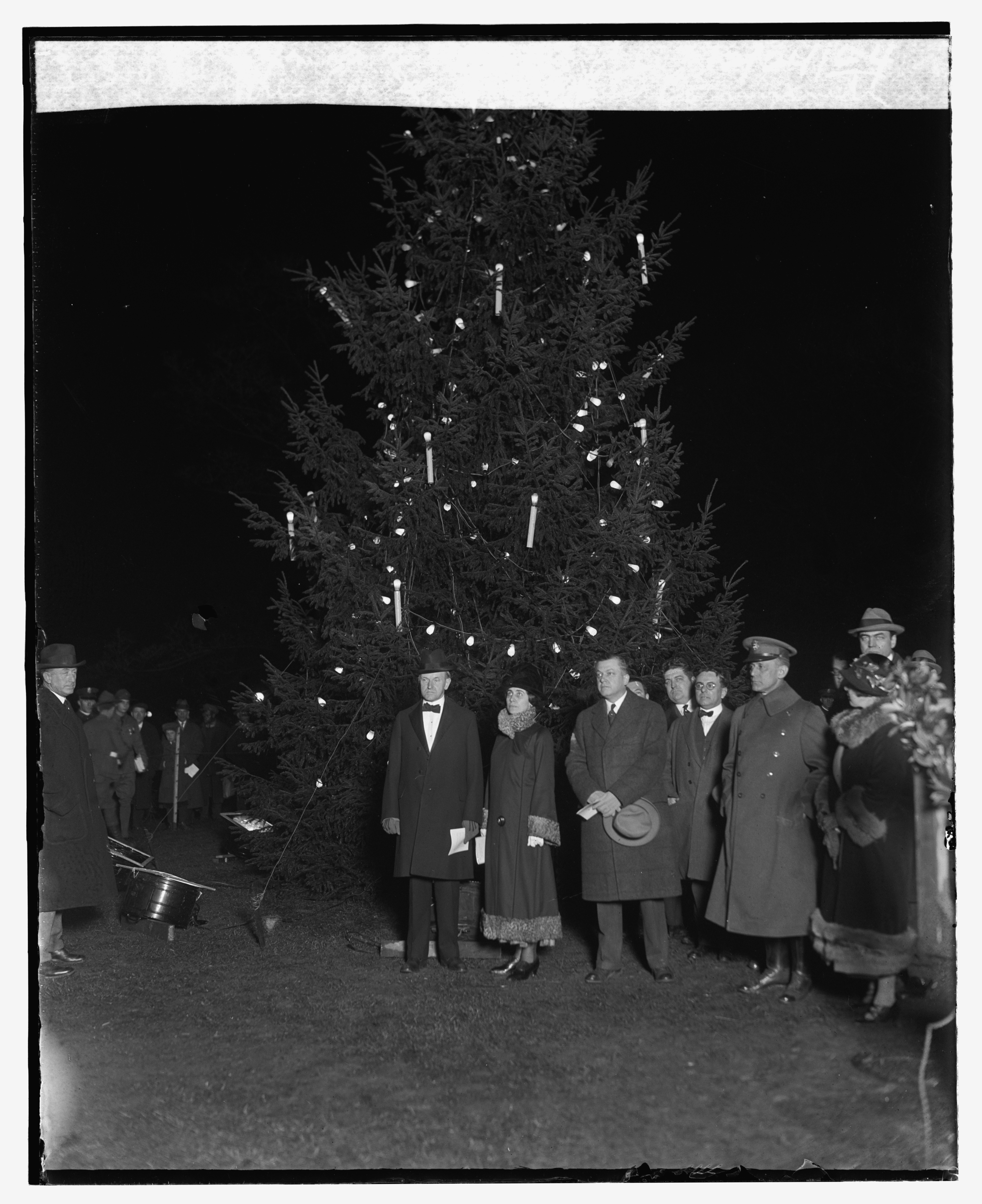
The “National Christmas Tree,” 1923

The National Christmas Tree, 1923

Long known as the “White Lot” for the whitewashed fencing which went along its undeveloped property lines, the Ellipse was laid out in 1791 by the District of Columbia’s designer, Pierre L’Enfant. The current home of what is dubbed, the “National Christmas Tree,” the Ellipse served as the location for this historic first: the original lighting of the Christmas Tree, a tradition begun by none other than President Calvin Coolidge on December 24, 1923.

This historic first was the result of a collaborative effort by the Washington area Community Center Department of the public schools who launched the event, the Society for Electrical Development and the Electric League of Washington who engineered the battery power source and button (at the end of the long cord in the President’s hand) which illuminated 2,500 red, white and green bulbs, Paul D. Moody of Middlebury College and Senator Greene of Vermont who donated the 48-foot balsam fir cut and transported all the way from Coolidge’s home state, the Office of Public Buildings and Grounds who coordinated with Grace Coolidge’s permission to hold this event here and the President’s acceptance of the gift and participation in its lighting.

The historic quality of what happened here is equally as significant as what did not happen. The push to place the Tree on the grounds of the White House itself was declined because the Coolidges insisted upon a deliberate removal from the Presidential residence so that it would serve as the neighborhood tree, rather than another fixture assuming Federal control. It was to benefit the people who lived in the District and as such, it was more properly renamed the “National Community Christmas Tree” in 1924.

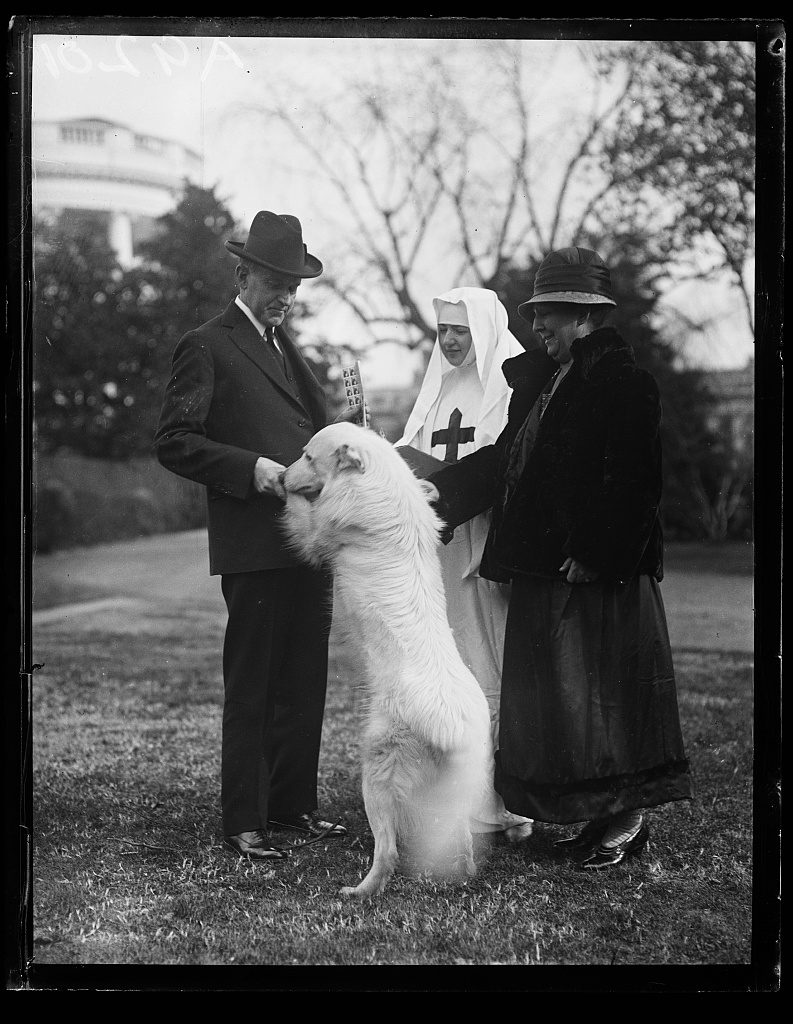
The 5 to 6,000 people present on this occasion in 1923 saw President Coolidge light the tree and leave with no words and no fanfare after but a few minutes. The real highlight of the evening was meant to be the singing of carols on the North Portico of the White House at 9PM. What mattered more to the Coolidges was not the pomp and ceremony but the spontaneity and gratitude of each American able to keep the occasion in one’s own way. The opportunity to serve was central to their observance of Christmas. The first year they would see 500 holiday baskets distributed through the Salvation Army, Grace would send more than 50 bouquets to the shops downtown who had helped her find presents, and as a family they visited the veterans recovering at Walter Reed Hospital in Washington, by Presidential authorization even entertaining the troops with the moving picture, “Abraham Lincoln.” The fight against tuberculosis was also a signature effort for the Coolidges, who not only raised funds for the Red Cross and National Tuberculosis Association through the purchase and sale of Christmas seals during the 1920s but continued to do so in retirement.

Rob Roy wants to buy some Christmas seals, 1924.

It seems Rob Roy wants to buy some Christmas seals, 1924.

The Christmas Seals of the Coolidge Years

(the Coolidges commenced the seal season for 1929 in Massachusetts as well)

1923 TB Christmas Seals1924 TB Christmas Seals

1925 TB Christmas Seals OLYMPUS DIGITAL CAMERA

1927 TB Christmas Seals1928 TB Christmas Seals 1929 TB Christmas Seals

Two crucial changes, in response to President Coolidge’s requests, would take place in 1924: 1. The American Forestry Association would replace the ailing balsam fir of the previous year with a new living 35-foot Norway spruce from New York; and 2. The lighting of the Tree would move to Sherman Plaza, so that, as Forestry Association officer G. H. Collingwood observed years later, the ceremony would be kept “spiritual in character, from reaching carnival proportions.” Coolidge had advocated the use of living trees as neighborhood landmarks that spring and it consequently helped define again an historic observance of Christmas in 1924.

The lighting of the Community Christmas Tree, December 24, 1924.

The lighting of the Community Christmas Tree, December 24, 1924.

In 1925, radio would broadcast the program for the first time. Three days before, however, President Coolidge, speaking to the children of 4-H and the Scouts, recalled that while he never had the opportunity to take part in their great organizations, “There is a time for play as well as a time for work. But even in play it is possible to cultivate the art of well-doing. Games are useful to train the eye, the hand and the muscles, and bring the body more completely under the control of the mind. When this is done, instead of being a waste of time, play becomes a means of education. It is in all these ways that boys and girls are learning to be men and women, to be respectful to their parents, to be patriotic to their country and to be reverent to God. It is because of the great chance that American boys and girls have in all these directions that to them, more than to the youth of any other country, there should be a merry Christmas.” 

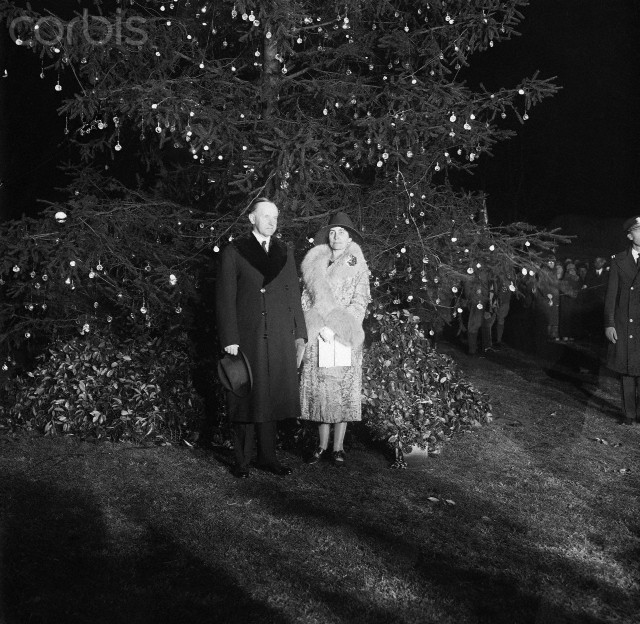
The Coolidges after the Christmas Tree has been lit, December 24, 1927.

The Coolidges after the Christmas Tree has been lit, December 24, 1927.

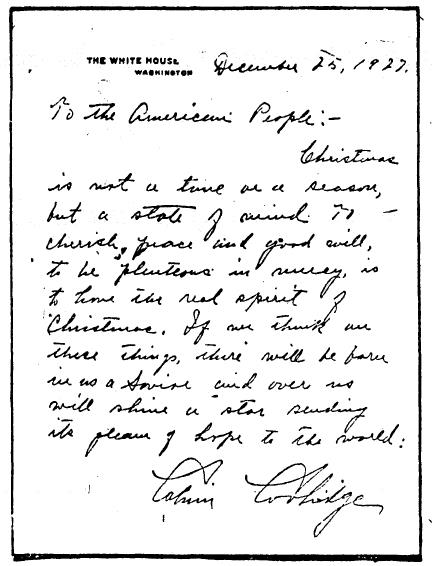
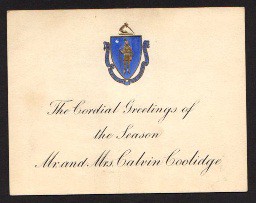
By April 1926, President Coolidge had designated the massive sequoia “General Grant” as the “Nation’s Christmas Tree,” not the Norway spruce he would light up without a word (for the third straight year) that December. By December 1927, the Christmas program included more music from the U.S. Marine Band, the Interstate Commerce Commission Glee Club and the traditional favorite, singing of carols on the North Portico. It was historic yet again for another reason. President Coolidge would give his first Christmas Message. Published in newspapers across the country on Christmas Day, the President finally spoke to the American people. Even then, it was brief and in characteristic Coolidge style. It is said that 1927 also marked long-absent return of formal Christmas cards sent from the Coolidge White House.

Written on White House stationary, the President spoke to the American people, saying: "Christmas is not a time or a season, but a state of mind. To cherish peace and good will, to be plenteous in mercy, is to have the real spirit of Christmas. If we think on these things, there will be born in us a Savior and over us will shine a star sending its gleam of hope to the world:  Calvin Coolidge"

Written on White House stationary, the President spoke to the American people, saying: “Christmas is not a time or a season, but a state of mind. To cherish peace and good will, to be plenteous in mercy, is to have the real spirit of Christmas. If we think on these things, there will be born in us a Savior and over us will shine a star sending its gleam of hope to the world: Calvin Coolidge”

calvin-coolidge-christmas-card  coolidge-christmas-card

The Christmas of 1928, the Coolidges’ last in Washington, would establish another historic first. This time, the President would speak on the radio. Still insisting on the principle that Christmas remain a personal and local occasion, he would not wax eloquent, bluntly declaring, “In token of the good-will and happiness of the holiday season and as an expression of the best wishes of the people of the United States toward a Community Christmas Tree, in behalf of the city of Washington, I now turn on the current which will illuminate the tree.” With that, fifteen minutes after his arrival, he went back the White House. A Christmas card signed by 17 business organizations was given to Mrs. Coolidge and the First Couple went back to the Presidential residence for what was to be the primary highlight of Christmas on the grounds: singing carols on the North Portico. A celebration with refreshments for eighty guests concluded the evening and closed a chapter of simple, yet joyful Christmas traditions, both new and old, cherished during the Coolidge years.

The singing of carols at the North Portico of the White House, a main feature of the Coolidges years, is pictured as it looked that first Christmas of 1923.

The singing of carols at the North Portico of the White House, a main feature of the Coolidge years, is pictured as it looked that first Christmas of 1923.