On the Danger of Cynicism

It has always been easier to criticize and find fault than to contribute toward and respect the constructive ideal. Optimists, always the creators, have to work not only to realize what previously seemed impossible but they also have to overcome the destructive habits of the pessimists. Those pessimists are the first to surrender in the face of difficulty while they trumpet the message of hopelessness. “Nor is it worth trying,” these closet nihilists aver. Failure to measure up to certain expectations is enough for some to give up entirely on a project and declare defeat for the cause. America is no different. It has always had a healthy share of pessimists and other weak-willed “experts” who knew it would fail in this or that endeavor. The purpose of America, as Coolidge would reiterate, remains valid. It has raised for all the world to see a set of truths that preserve liberty with duty in a way that no set of principles has before, or can surpass. The failure to eradicate all the failings and frailties inherent in human nature is no more proof of failure than evidence of any grander success by empowering government now to accomplish it for us. For these “armchair” critics, it discredits the entire foundation and persuades them that progress means abandoning moral clarity, surrendering confidence in self-government entirely and trusting in our modernity to move past the “old” and “inadequate” concepts of an “ignorant” and “limited” eighteenth century existence. It would be one thing to adopt so foolhardy and naively defeatist outlook for oneself. These self-proclaimed skeptics are imparting this to the next generation, however, through “modern education.” To this issue of education, Coolidge turned in June of 1922, when he said,

“This is the civilization which intelligence has created and which sacrificed has redeemed. We did not make it. It is our duty to serve it. Education ought to assess it at its true worth. It ought not to despise it but reverence it. If there be in education a better estimation of true values, it must be on the side of a great optimism. Under its examination human relationship stands forth as justified and sanctified. There is no place for the cynic or the pessimist. Who is he that can take no part in business because he believes it is selfish? Who is he that can take no part in religion because he believes it is imperfect? These institutions are the instruments by which an eternal purpose is working out the salvation of the world. It is not for us to regard them with disdain; it is for us to work with them, to dedicate ourselves to them, to justify our faith in them…The great service which education must perform is to confirm our faith in the world, establish our settled convictions, and maintain an open mind.”

The annual American Educational Research Association meeting in April made evident that improved testing and eradicating poverty are but symptoms of an education missing its core. As schools all across the country let out for the summer, now is an ideal time to consider the service education is actually rendering for us and our children. Is it consigning our proven ideals to failure, proclaiming a gospel of hopelessness and permanent moral uncertainty? Is it rejecting the worth of Christian standards of behavior because America is forever trapped, they claim, in racism, hypocrisy, chauvinism, bigotry and oppression? Is it championing the control of a few who can finally achieve the perfection which is our right, if only we abandon this failed framework of eighteenth century slaveholders? Such goes the cynic’s mantra. What is not so readily apparent are the rocks waiting on the other side of those words. It has wrecked and will continue to wreck the lives of those who are taught to embrace pessimism, to rely on the force of government to compensate for all of America’s shortcomings. The cynic, ultimately, doubts liberty. America has never worked, he assumes, so why work at it as responsible and informed citizens? Just as Coolidge remarked, though, an open mind can co-exist with settled convictions. Forever holding out undecided on everything is the perfect soil for cynicism. Moral relativity, taught by too many schools in this country, is actually moral surrender in a more subtle form. On the contrary, knowing certain things are right and true broadens the mind to keep learning. It is the pessimist whose mind is closed, failing to accept that the people can be trusted with their liberty far more than government has or ever will. Education serves its purpose when it keeps that flame of optimism in our ideals alive. It is the more difficult task than the ease of cynicism but faith is vindicated in the end.
Image

On the Boy Scouts

                         Image

Reflecting on the purpose of this long-standing private organization, especially in light of the recent change in admission standards, it is important to recall what Calvin Coolidge had to say about them. Writing in his daily column on February 9, 1931, he said,

“Millions of our young men have had the benefit of the physical, mental and moral discipline that results from Scout training. When the evil reports of a few gangsters make us wonder if society and government are about to disintegrate and revert to the law of the jungle, we can turn with assurance to the humanizing and civilizing effect of the Boy Scouts. Under the old life in the country every boy was something of a Scout. But in the modern city many boys live on a narrow street or alley. The buildings make it impossible for them to see; in the constant roar they cannot hear. With the lack of healthful and life-giving impulses from without they are turned back on themselves. When they need action and companionship in order to secure a natural growth of body and mind, they are unable to find anything but an artificial, dwarfing substitute. The profitable and patriotic remedy for these conditions is the Boy Scout movement. Under the influence of a considerable body of citizens so trained our republic is fairly secure.”

Considering the Boy Scouts accomplished all of this for decades before the latest round of complaints against it, the policy change rings hollow. Volunteer and civic-minded organizations, like what the Scouts have been, represent certain moral standards and no force in the world can rightfully tell them to abandon that ennobling purpose in order to enact the amorphous values of someone else. The Boy Scouts are not about sexual orientation, but about instilling character and competence in our young men. That used to be an asexual blessing to society–not anymore. Sexual identity trumps all other values. Now, one by one, organizations like the Boy Scouts have to concede their purpose to an intolerant minority unwilling to grant the existence of any organization that chooses its own standards of membership. So much for the good old fashioned virtue of living and letting live. This latest coerced participant in reordering society to please a few is only the most recent effort to keep Pandora’s box open, whatever it will cost (in lives or public morals) down the road.

On Broadcasting and the Movies

While it is better known that President Coolidge proficiently used the medium of radio, it is far lesser known what he thought of other forms of broadcasting, such as film and television, the latter in its earliest stages of potential. He was the first among Chief Executives to effectively employ the potential of radio communication. Long before the “fireside chat,” the voice Americans knew and liked was that of Calvin Coolidge.

As for the potential of movies, Coolidge hosted “movie previews,” both as Vice President and President for both friends and family, ranging from documentaries to entertainment pieces (Leab, “Coolidge, Hays, and 1920s Movies,” in Haynes 103). It was here that Coolidge’s realism built on faith manifested itself strikingly. He would navigate between the forces calling for outright censorship and those marketing and enthusiastically promoting D. W. Griffith’s pro-Klan picture, “Birth of a Nation,” steering legislation to decide by majority vote through commission whether the film should stand alone or include counterbalancing footage of black progress, like that at Tuskegee and Hampton Institutes. The latter prevailed in Massachusetts and served as a clear repudiation to the Klan and a rebuke of President Wilson, who was in favor of the movie as it stood. Coolidge’s bold act won respect, helped push the Klan into the margins and upstaged Wilson. It would not be the last time.

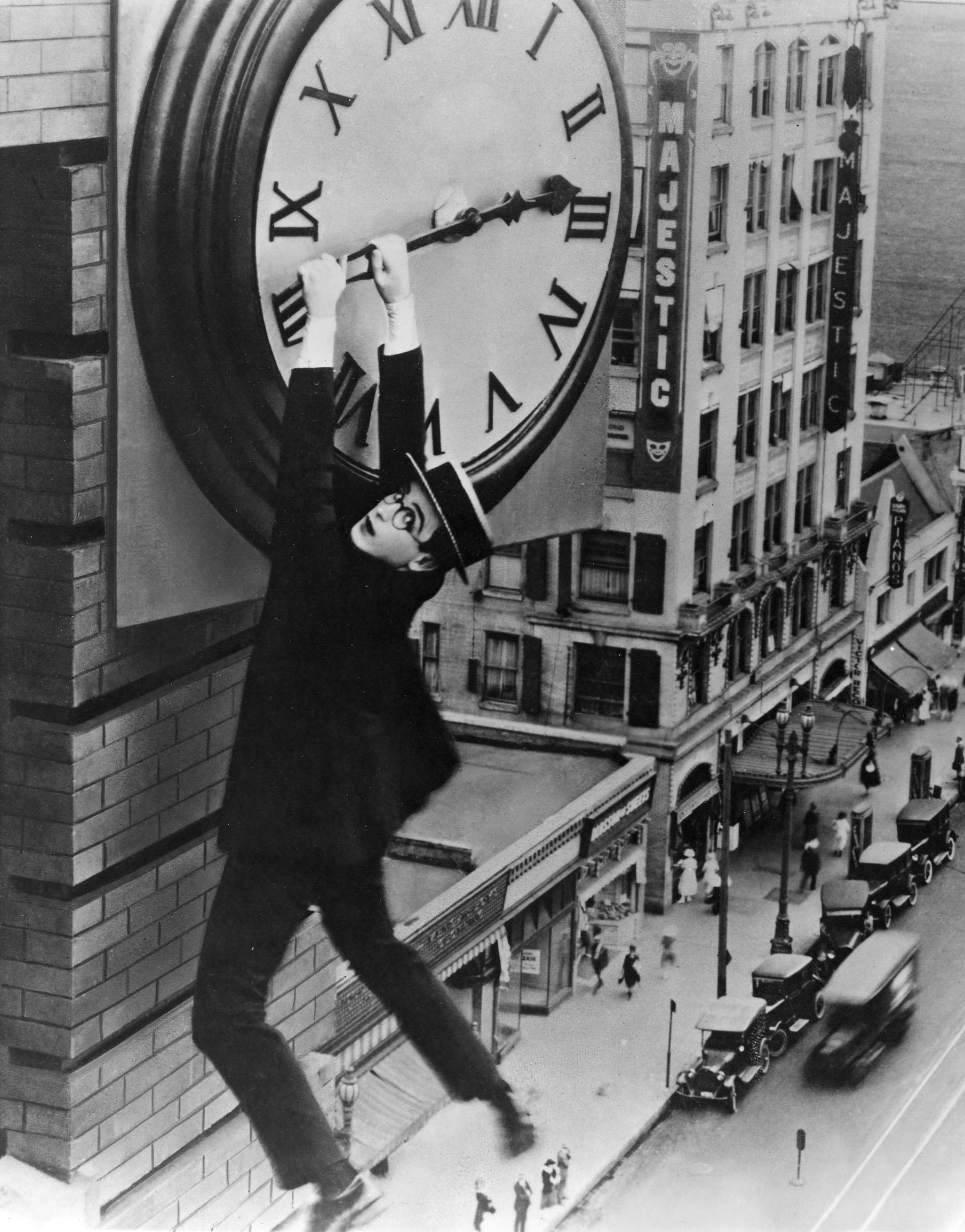
On the other hand, he recognized that moving pictures had great potential for good. The serious and educational served their purposes, of course, but so did comedy. Coolidge appreciated the need for balance between both. People need to be able to laugh, he would once remark. It is recalled by a regular guest to those “previews” that when a Harold Lloyd comedy was shown at the White House in 1925, he “never saw the President laugh more.” That potential for good was conditional, however, as he explains in his column on February 13, 1931, “The time may not be far away when it will be possible to have a receiving set in the home that will produce a sound motion picture. Central stations may be able to receive and broadcast to the eye and ear events taking place all over the world. It is difficult to comprehend what an enormous power this would be. New forces are constantly being created for good or for evil. When primitive people come in contact with civilization usually they use its powers for their own destruction. Unless the moral power of the world increases in proportion to its scientific power there is a real danger that the new inventions will prove instruments of our own destruction. If moral development keeps step, peace and good will have gained new allies.”

Given the general condition of modern film and television, can it be said that morality and goodness have kept pace with them? In small, isolated pockets broadcasting lives up to that noble alliance with morals, in praise of what is good and wholesome, and when it does, it exemplifies faithful stewardship and true progress. It is not coincidental that the best pictures appeal to timeless ideals.

                                    Image

                                    Image

                               Image

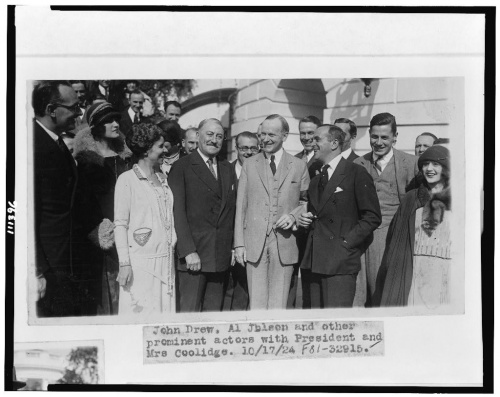
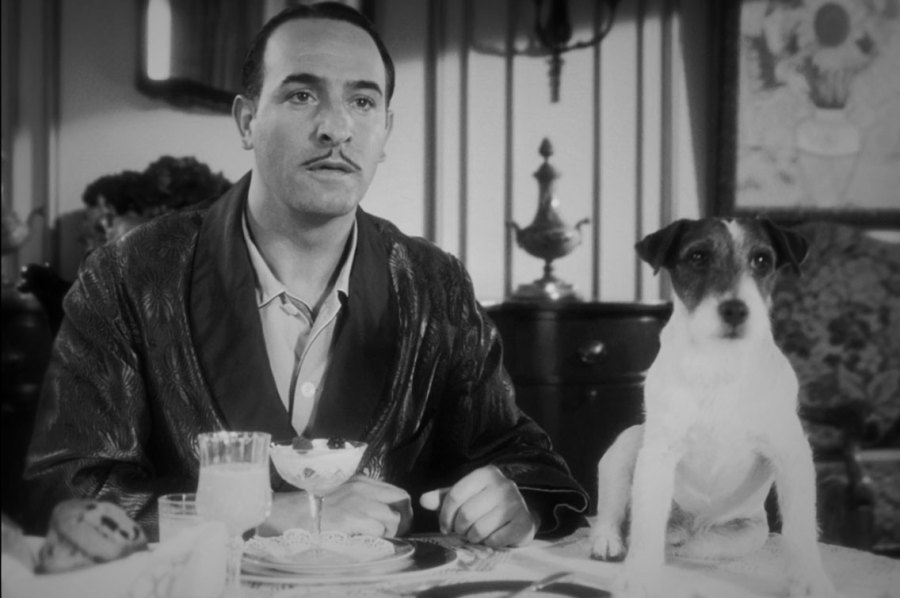
Top: Harold Lloyd in Safety Last! (1923); Middle: The Coolidges meeting Al Jolson and company, 1924; Bottom: Jean Dujardin and Uggie in The Artist (2011). Further Reading: chapter 4 “Coolidge, Hays, and 1920s Movies” by Daniel J. Leab in Calvin Coolidge and the Coolidge Era, Edited by John Earl Haynes. Washington, D.C.: Library of Congress, 1998.