On Reverence

Few individuals had as remote a likelihood of reaching the highest position of leadership in America as Calvin Coolidge. He enjoyed none of the privileged connections of Franklin D. Roosevelt. He had little of the physical charm of a John F. Kennedy or Ronald Reagan. He never led armies to battle like Washington or Eisenhower did. Yet he understood that leadership is more than these. Leadership is not held by birthright. Leadership is not being served, but serving, as Christ made clear. Coolidge looked back over his public life and recognized that it was not his own greatness on display, for “[a]ny man who has been placed in the White House can not feel that it is the result of his own exertions or his own merit. Some power outside and beyond him becomes manifest through him. As he contemplates the workings of his office, he comes to realize with an increasing sense of humility that he is but an instrument in the hands of God” (The Autobiography, p.235).

To acknowledge such a truth is not the indication of weakness. Weakness is the hubris of far too many of our sitting politicians who have come back to their states and districts with something more dangerous than deluded self-importance. Passionately voicing our will, be it in phone calls, emails, or now in town halls is a personal affront to their superior ability and judgment. Senator McCain’s recent town hall comments about “not needing to be lectured to” (be it by the very people he is supposed to represent) reiterates the arrogance of the Washington culture. What is missing in nearly every area of culture is reverence. It is mocked and assaulted, but it anchors us to the solid foundation of our first principles.

Coolidge’s abiding sense of humble perspective is more than a cynical political calculation, it was a genuine attitude of reverence for the source of our nation’s power, success and future — none other than God Himself. Speaking to the Holy Name Society gathered in Washington eighty-nine years ago this September, a grateful President recognized something greater than he or the almighty establishment was there. He said, “The foundation of our independence and our Government rests upon our basic religious convictions. Back of the authority of our laws is the authority of the Supreme Judge of the world, to whom we still appeal for their final justification…It seems to me perfectly plain that the authority of law, the right to equality, liberty and property, under American institutions, have for their foundation reverence for God. If we could imagine that to be swept away, these institutions of our American government could not long survive. But that reverence will not fail. It will abide…The institutions of our country stand justified both in reason and in experience. I am aware that they will continue to be assailed. But I know they will continue to stand. We may perish, but they will endure. They are founded on the Rock of Ages.” 
Image

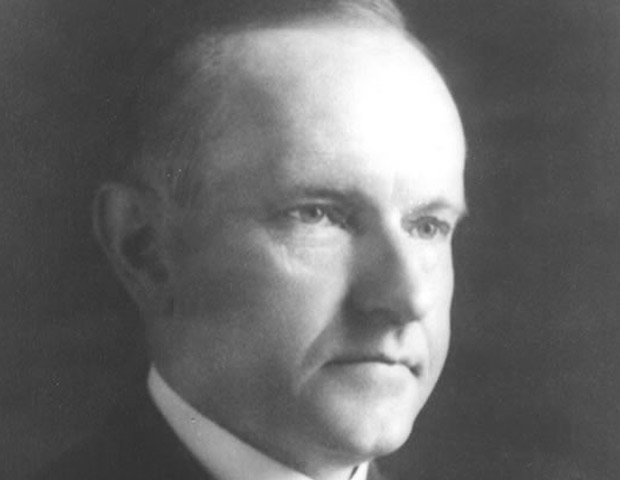
The Coolidges in Brule, 1928

The Coolidges in Brule, 1928

Depicted here is the President and First Lady leaving the small country church services one of the Sundays during the summer of 1928.

Deliberately avoiding the elaborate churches and ordained preachers of Superior, the Coolidges went to hear “lay-preacher” Mr. John Taylor, a blind man of 70 years. His sermons, on what newspapers have summarized “plain living and high thinking,” were reminders that the truth is often found in the simplest, humblest of circumstances.

If too enamored by the elaborate and sophisticated, the individual often misses the obviousness of truth entirely just as the apostle asked in 1 Corinthians 1:20 and 1:18: “Where is the wise? Where is the scribe? Where is the disputer of this world? Hath not God made foolish the wisdom of this world?” “For the message of the cross is foolishness to those who are perishing, but to us who are being saved it is the power of God.”

On Preemptive Involvement Abroad

Image

“Nations which are torn by dissension and discord, which are weak and inefficient at home, have little standing or influence abroad. Even the blind do not choose the blind to lead them. Foreign peoples are certainly going to seek assistance only from those who have demonstrated their capacity to maintain their own affairs efficiently. If we desire to be an influence in order and law, tranquility and good will in the world, we must be determined to make sufficient sacrifices to live by these precepts at home. We can be a moral force in the world only to the extent that we establish morality in our own country. — President Coolidge, May 30, 1927.

“I wish crime might be abolished; but I would not therefore abolish courts and police protection. I wish war might be made impossible but I would not leave my country unprotected…” — Coolidge in a Letter to the National Council for Prevention of War, July 23, 1924 (cited from ‘The Mind of the President,’ pp.235-6).

“America represents the greatest treasure that there is on earth, the greatest power that there is to minister to the welfare of mankind; to leave it unprepared and unprotected is not only to disregard the national welfare, but to be no less than guilty of a crime against civilization” — May 30, 1923

“America stands ready to bear its share of the burdens of the world, but it cannot live the life of other peoples, it cannot remove from them the necessity of working out their own destiny. It recognizes their independence and the right to establish their own form of government, but America will join no nation in destroying what it believes ought to be preserved or in profaning what it believes ought to be held sacred” — February 22, 1922

If we are sincere in our expressed determination to maintain tranquility at home and peace abroad, we must not neglect to lay our course in accordance with the ascertained acts of life. We know that we have come into possession of great wealth and high place in the world. There is scarcely a civilized nation which is not our debtor. We are sufficiently acquainted with human nature to realize that we are oftentimes the object of envy. Unless we maintain sufficient forces to be placed at points of peril when they arise, thereby avoiding for the most part serious attack, there would be grave danger that we should suffer from violent outbreaks, so destroying our rights and compromising our honor that war would become inevitable. It is to protect ourselves from such danger that we maintain our national defense. Under this policy it is perfectly apparent that our forces are dedicated solely to the preservation of peace…We have sufficient reserve resources so that we need not be hasty in asserting our rights. We can afford to let our patience be commensurate with our power” — May 30, 1927, emphasis added.