“America and the War,” 1920

“America and the War,” 1920

In this speech recorded for the campaign of 1920, Calvin Coolidge addresses the national transition that followed the conclusion of war the previous year and what makes a strong basis for peace. He reflects upon the high inheritance of American citizenship and our firm defense of liberty. He then calls us to remember that it is in the exercise of moral power, the selfless service we render to each other as fellow citizens, that constitutes progress.

The text of the message is as follows:

“Works which endure come from the soul of the people. The mighty in their pride walk alone to destruction. The humble walk hand in hand with providence to immortality. Their works survive.

“When the people of the colonies were defending their liberties against the might of kings, they chose their banner from the design set in the firmament through all eternity. The flags of great empires of that day have gone, but the stars and stripes remain. It pictures a vision of a people whose eyes are turned to the rising dawn. It represents of the hope of a father for his posterity. It was never flaunted for the glory of royalty, but to be born under it is to be the child of a king, and to establish a home under it is to be the founder of a royal house. Alone of all flags, it expresses the sovereignty of the people which endures when all else passes away. Speaking with their voice, it has the sanctity of revelations. He who lives under it and disloyal to it is a traitor to the human race everywhere. What could be saved if the flag of the American nation were to perish?

“America has many glories. The last one that she would wish to surrender is the glory of the men who have served her in war. While such devotion lives, the nation is secure. Whatever dangers may threaten from within or without, she can view them calmly. Turning to her veterans, she can say: ‘These are our defenders. They are invincible. In them is our safety.’ 

“After more than five years of the bitterest war in human experience, the last great stronghold of force surrendering to the demands of America and her allies agreed to cast aside the sword and live under the law. America decided that the path of the Mayflower should not be closed. She decided to sail the seas. She decided to sail not under an Edict of Potsdam, cramped in narrow lands, seeking safety in unarmed merchant men painted in fantastic hues as the badge of an infinite servitude; but she decided to sail under the ancient Declaration of Independence, choosing her own course, maintaining security by the guns of her ships of the LINE, flying at the mast the stars and stripes forever, the emblem of a militant liberty.

“With peace has come prosperity. Burdens have been great, but the strength to bear them has been greater. The condition of those who toil is higher, better, more secure than in all the ages past. Out of the darkness of a great conflict has appeared the vision of a nearer, clearer than ever before, the life on earth and less under the deadening restraint of course more and more under the vitalizing influence of reason. Moral power has been triumphing over physical power. Education will tend to bring reason and experience of the past into the solution of the problems of the future. We must look to service and not selfishness, for service is the foundation of progress. The greatest lesson that we have to learn is to seek ever the public welfare, to build up, to maintain our American heritage.” 
On Memorial Day

Addressing those gathered in his Northampton to observe Memorial Day, May 30, 1923, Vice President Coolidge delivered one of his most eloquent expositions of the day’s meaning and significance,

“Our country does not want war; it wants peace. It has not decreed this memorial season as an honor to war, with its terrible waste and attendant train of suffering and hardship which reaches onward into the years of peace. Yet war is not the worst of evils, and those days have been set apart to do honor to all those, now gone, who made the cause of America their supreme choice. Some fell with the word of Patrick Henry, ‘Give me liberty, or give me death,’ almost ringing in their ears. Some heard that word across the intervening generations and were still obedient to its call. It is to the spirit of those men, exhibited in all our wars, to the spirit that places the devotion to freedom and truth above the devotion to life, that the nation pays its ever-enduring mark of reverence and respect. It is not that principle that leads to conflict but to tranquility. It is not that principle which is the cause of war but the only foundation for an enduring peace. There can be no peace with the forces of evil. Peace comes only through the establishment of the supremacy of the forces of good. That way lies only through sacrifice. It was that the people of our country might live in a knowledge of the truth that these, our countrymen, are dead. ‘Greater love hath no man than this, that a man lay down his life for his friends.’

“This spirit is not dead, it is the most vital thing in America. It did not flow from any act of government. It is the spirit of the people themselves. It justifies faith in them and faith in their institutions…It is to that spirit again, with this returning year, we solemnly pledge the devotion of all that we have and are.”

Writing in recognition of this day eight years later, he would summarize the abiding import of this Day with these words, “No lapse or diminution should be permitted in the yearly devotion which the people pay to the memory of those who have served in our armed forces…The principle involved must not be obscured. The day is sacred to the memory of all the dead who wore our uniform, from the earliest Indian wars to the present hour. In honoring their memory we are not glorifying war. We are a peaceful nation…But we honor their memory that we may glorify citizenship. They were the antithesis of selfish individualism, merging freedom and even chance of life in the common welfare of country. In danger, choosing the course that really counts, they preserved their rights by discharging their duties. No nation can live which cannot command that kind of service. No people worthy of such service will fail to do it in reverence.”

Image

President Coolidge with Secretary of War, Dwight Davis (left), and Secretary of the Navy, Curtis Wilbur (right).

Image

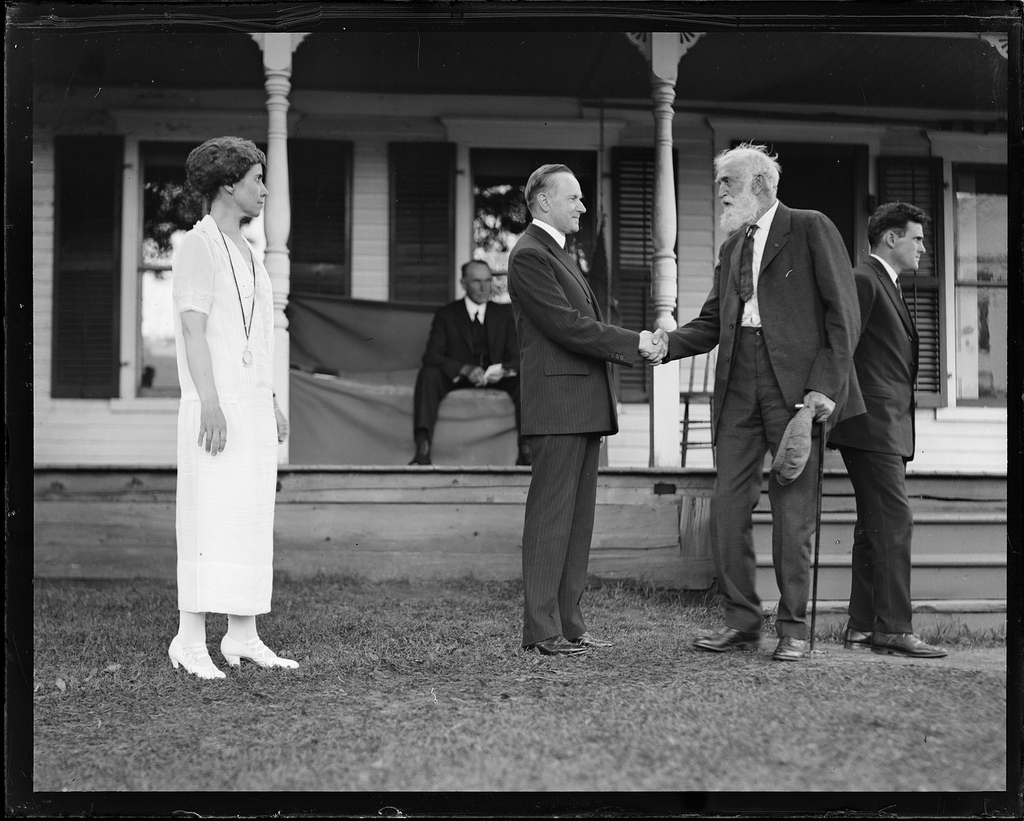
President and First Lady Coolidge meeting Civil War veterans, August 1924.

Image

Image

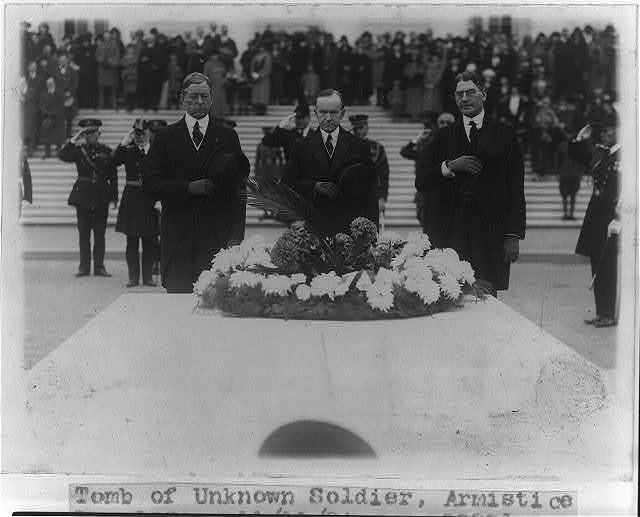
President Coolidge saluting the Unknown Soldier with Secretary of War, John Weeks; Assistant Secretary of Navy, Theodore Roosevelt, Jr., and Naval Aide to the President, Captain Wilson Brown, (1923?).

On Reuniting the States

On Reuniting the States

Return of the Confederate battle flags to Virginia, North Carolina and Texas on December 16, 1927. An earlier attempt by President Cleveland in 1887 met with successful opposition by the Grand Army of the Republic (Union veterans) as “trophies” of the War that should not be returned. It would be “treasonous” according to the large body of obstinate veterans.

President Theodore Roosevelt, through a careful coordination with Congress, restored a partial collection of battle flags to the Southern states in 1905, taking them from storage by the War Department in Washington.

Like so many old wounds, however, President Coolidge did not evade the controversy for fear that it would cost political support. Coolidge upheld just dealings toward all, whether it was the full citizenship for all tribes or fair honor due Southern Americans who fought just as valiantly as the Yankees did for principled reasons. It was overdue time to lay aside hostility, heal old grievances, and reestablish peace between Americans, North and South.

He recognized his duty included leadership by example to help reunite the country around the essentials we share as Americans. It would not be right to misuse a President’s influence by keeping us divided and at war with one another. He was as much an advocate of peace at home as he was abroad.