On the Strength of “Weakness”

While there is much in Michael J. Gerhardt’s new book, “The Forgotten Presidents: Their Untold Constitutional Legacy,” with which this author disagrees, he ably shows that Coolidge was anything but a pushover or “weak” president. Devoting chapter twelve of his book to the thirtieth president, Gerhardt demonstrates that Coolidge had unique strength when it came to his constitutional role and the exercise of presidential powers. Coolidge, perhaps more than any of his immediate contemporaries in the office, understood both the limits and the authority vested in the Presidency. His display of leadership was unprecedented in a number of ways.

As the previous administration’s scandals went public, it was Coolidge who took the incredible step of ensuring honorable and qualified investigators (not party hacks) took the helm after which he never intervened in the process to determine the facts. The investigation was allowed to find the guilty and acquit suspicion of the innocent. As a result of both their thorough competence and Coolidge setting a tone of full cooperation from the beginning, public trust in the law was preserved.

In the use of the pardon and the veto, Coolidge distinguishes himself as anything but a timid President. Of his twenty-nine predecessors, and his immediate successor, he ranks second only to Wilson in the number of pardons granted during his time. Of his 1,545, his most noteworthy were made at the beginning of his administration, on behalf of several who had been imprisoned for their public criticism of Wilson’s involvement in the War. Even more extraordinary was the fact that he issued these pardons not only over his Attorney General’s opposition but also before request for release had been made. His fifty vetoes stand also set Coolidge apart from his contemporaries. Only Teddy Roosevelt would issue more of them in the first thirty years of the twentieth century. Not until Teddy’s cousin would the record be broken. Standing in the company of Roosevelts, Coolidge can hardly be classified a passive President. Like Grover Cleveland before him, Coolidge would use the “pocket veto” with great effect as well. By allowing a bill to die after ten days unsigned during Congressional recess, Coolidge would leave a lasting impact on the potency of the veto. His firm dissent from McNary-Haugen — twice — ensured that the President’s role in preventing bad legislation remains intact.

Coolidge’s political courage is even lesser known but just as dominant in his protection of the constitutional power to appoint officers of the Executive Branch. The earliest tussles with Congress demonstrated Coolidge could retain his nerves, remain unmoved by “mob” demands for this or that resignation and eventually prevail despite intense political heat. His resolve was not merely stubbornness but rather an abiding sense of duty and integrity. He would not join the crowd in a political lynching, however badly they wanted it. He was fair even to those who proved unfit for responsibility. He would not give in to appearances nor would he condone wrongdoing. As pointed out by others, it actually takes more strength to refrain from acting until the right moment — especially in the heat of the moment — than it is to be seen doing something now to appease onlookers with appearances. It was Coolidge who exemplified the strength of character required for decisive action only when the fullness of time warranted it. Not before. His strength, considered “weakness” by many even today, is a necessary component of wise leadership. To discount this quality is to misunderstand and fail to appreciate what makes good leaders.
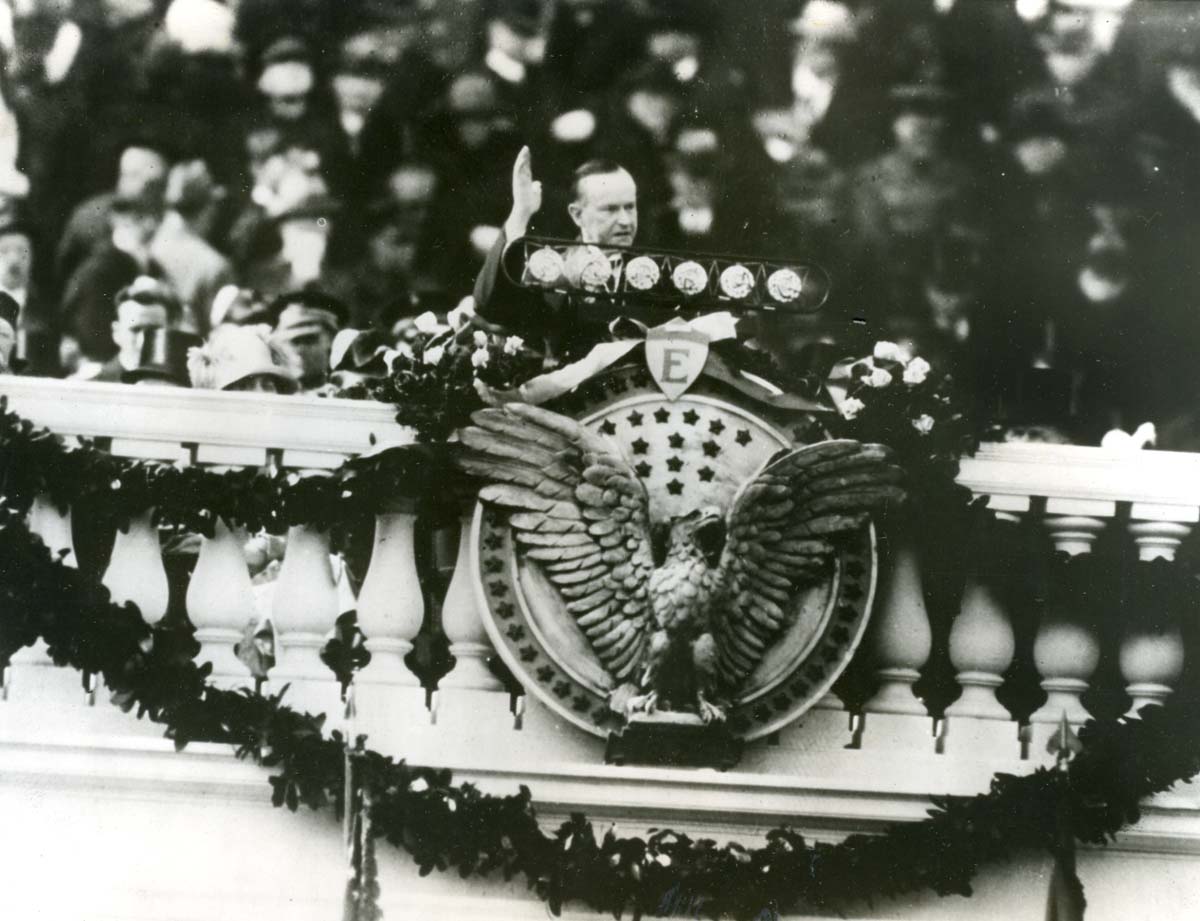
Remembering a President’s Inaugural

             Image

This morning while waiting in line, a news network reminded its viewers of the March 4, 1933 inaugural address of Franklin D. Roosevelt. To hear the reverence in the voices of those on the air, one would think any history worth remembering began with that infamously famous Presider over Depression, New Deal and World War. The thirty-six March 4th inaugurations before that time — 144 years of history — simply aren’t worth mentioning. One of those neglected thirty-six deserves mention here. In fact, it deserves our attention and study. It was March 4, 1925, the occasion of President Coolidge’s first formal inauguration after a resounding electoral victory in his own right the previous November. It is on this day, eighty-eight years ago, that he declared,

          If extravagance were not reflected in taxation, and through taxation both directly and indirectly injuriously affecting the people, it would not be of so much consequence. The wisest and soundest method of solving our tax problem is through economy. Fortunately, of all the great nations this country is best in a position to adopt that simple remedy. We do not any longer need war-time revenues. The collection of any taxes which are not absolutely required, which do not beyond reasonable doubt contribute to the public welfare, is only a species of legalized larceny. Under this Republic the rewards of industry belong to those who earn them. The only constitutional tax is the tax which ministers to public necessity. The property of the country belongs to the people of the country. Their title is absolute. They do not support any privileged class; they do not need to maintain great military forces; they ought not to be burdened with a great array of public employees. They are not required to make any contribution to Government expenditures except that which they voluntarily assess upon themselves through the action of their representatives. Whenever taxes become burdensome a remedy can be applied by the people; but if they do not act for themselves, no one can be very successful in acting for them.

Those are words worth remembering today. When self-government is responsibly exercised in this way, we have no reason to fear for the continuance of liberty under law.

On Law

A rigorous discussion of the purpose of law does not seem to engage Americans as it once did. That is not an indicator of either intellectual progress or societal maturity. It was once a pronounced characteristic observed not merely in the halls of higher education but in the daily interaction between Americans at work and at leisure. It is rarely asked, “Is this law necessary?” or “what does this law actually accomplish?” let alone “is this truly ‘law’ at all?” The thirtieth President’s thoughts on law came through this regular pursuit of first principles, to understand things in their essential nature and design. But he also learned through the practical experiences of watching his father at work in Plymouth as its law officer and representative and later, learning from his own work as a city councilman, city solicitor, mayor and state legislator, not to mention Governor of Massachusetts. This honest search to know the nature of law did not dissipate in his approach to problems as President. It was, in fact, common for Coolidge to meet legal conflicts with the simple, yet profound, question: “What does the law say?” To him, it was inconsequential to ask what political motives were involved, whose interests would be advanced, what this or that decision would mean for his reelection prospects or those of the Party. What mattered more than anything was the authority of law upon himself and those around him. It was not for him to reshape the law into what he preferred it to be or what made him more popular with a particular demographic. It was simply, “what is the law?” He explained its success in practice, writing in 1929,

          All situations that arise are likely to be simplified, and many of them completely solved, by an application of the Constitution and the law. If what they require to be done, is done, there is no opportunity for criticism, and it would be seldom that anything better could be devised. A Commission once came to me with a proposal for adopting rules to regulate the conduct of its members. As they were evenly divided, each side wished me to decide against the other. They did this because, while it is always the nature of the Commissioner to claim that he is entirely independent of the President, he would usually welcome presidential interference with any other Commissioner who does not agree with him. In this case it occurred to me that the Department of Justice should ascertain what the statute setting up this Commission required under the circumstances. A reference to the law disclosed that the Congress had specified the qualifications of the members of the Commission and that they could not by rule either enlarge or diminish the power of their individual members. So their problem was solved like many others by simply finding out what the law required (‘The Autobiography,’ pp.201-2).

Once again, the obvious is brought into focus by President Coolidge. When the calls were loudest for new rules and greater restrictions, Coolidge brought the matter back to its simplest form with that thoughtful admonition to find what the law says. As it turned out, rules already existed and the matter was resolved. All too often, the search for what the law says is missing today in the rush to legislate and regulate. In the process, not only is enforcement of existing laws neglected but the very authority of law upon all alike, including the President and his Cabinet, falls into disrepute. The question that echoes through the years is not “what do we want the law to be in this instance” or “which laws do we prefer to enforce” but “what is the law”? Once that question is answered, the next step is clear. The duty upon all, including the highest officers of the national government, is the same as it was for Coolidge, “Well, follow it.”

                      Image