On Presidential Knowledge

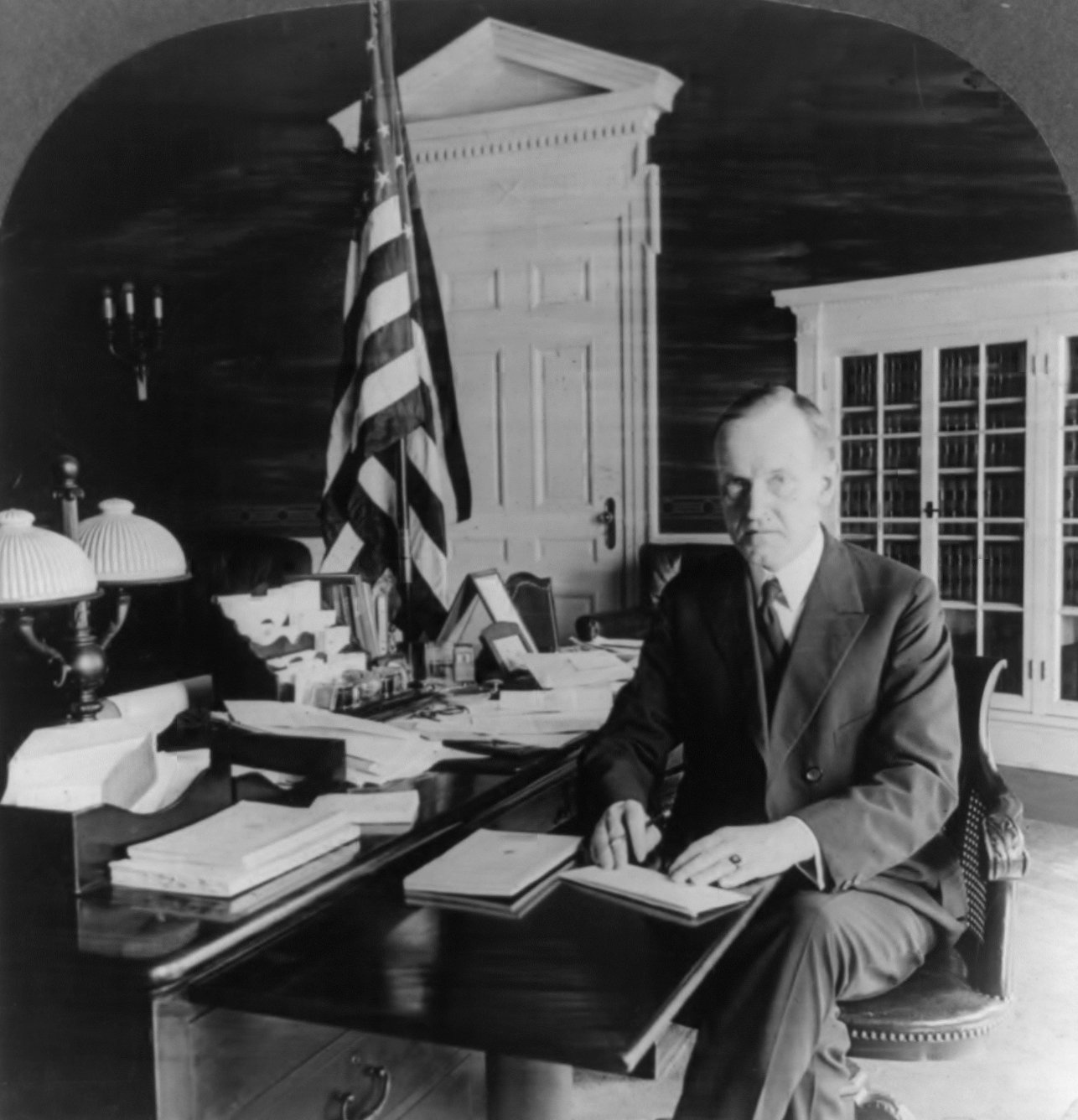
Former President Coolidge, looking back on his administration, once told Bruce Barton, “The President shouldn’t do too much. And he shouldn’t know too much.” When Barton’s curiosity was peaked, the former Chief Executive explained what he meant.

“The President can’t resign,” Mr. Coolidge answered, “If a member of the Cabinet makes a mistake and destroys his standing with the country, he can get out, or the President can ask him to get out. But if he has involved the President in the mistake, the President has to stay there to the end of his term, and to that extent the people’s faith in their Government has been diminished.”

Coolidge, never one to abide abuse of power or duty, would have seen a Presidential resignation as thwarting the people’s faith in their electoral choices and the confidence their representative system deserved. The price must be paid in a President finishing his term. The Constitution also provided for impeachment and removal but resignation was no viable “third solution” to Coolidge. The critical deficit of faith in our form of Government that followed Nixon’s resignation in 1974 is precisely what Coolidge forecast to Barton. The harm to the people, the country as a whole and the Presidential Office by Nixon’s decision, with all its attending results in subsequent years, is still being paid for in the present day. Even so, Coolidge was neither defending an absentee approach nor claiming it is okay to be an “empty suit,” oblivious to what is going on around him.

The problem, as Coolidge plainly summarized, was not in being completely unaware of what was transpiring on his watch but knowing too much. He elaborated, “I constantly said to my Cabinet: ‘There are many things you gentlemen must not tell me. If you blunder, you can leave, or I can invite you to leave. But if you draw me into all your department decisions and something goes wrong, I must stay here. And by involving me you have lowered the faith of the people in their Government.’ “

Coolidge, despite what “New Deal” writers claim, knew what was going on during his Administration, from the trivial to the consequential. He kept an ear to the ground while exercising the discipline of reserve, never volunteering that he did, in fact, know. When it became known among the ladies of Washington that Alice Roosevelt was expecting, Grace (having forgotten to ask when) was amazed to discover that Calvin already knew. When a confidential message regarding an American ambassador’s criminal conduct came across the wire, Chief Yardley, the head of that particular Bureau, learned of the document after it had already been found by Coolidge and forwarded on to the Justice Department for action outside of his office. When a letter from Lloyd George arrived addressed to Coolidge while he was staying in Plymouth for a few days in 1926, he responded to handle the situation right away without waiting to get back to Washington and reply, as he usually did, through his Secretary of State.

Coolidge remained entirely in charge of the Executive Branch. There was no doubt that he knew what was occurring in fulfillment of his responsibilities as its presiding officer. He did not do the work of his Cabinet officers or Bureau chiefs, never allowing himself to be involved in the decision-making of each department, but he knew what they were doing all the same.

When President Truman declared, “The Buck Stops Here,” he was striking upon the same principle in a different form. Whereas the President ought to know, and is ultimately responsible, it preserves the integrity of the people’s confidence in their republican system to expect that those whom the President chooses to serve as his Cabinet officers and leaders in his subordinate departments must do their work competently and faithfully. If the President has to get involved, it announces to the world that those under him are unfit and unqualified for the task. It was a sign of weakness and failure should the President have to assume the powers belonging to other officers. It brought down the high dignity of the Presidency and overturned the confidence people properly entrust to their representatives in Government to exercise efficiently and ably.

This is what Coolidge meant when he said “A President shouldn’t know too much.” President Obama, by contrast, is proudly hailed for not knowing anything about anything, as political expediency suits. It would be hard to imagine how much harm Obama could further inflict on the kind of faith Coolidge respected than he already has. It is shameful to see the destruction to our faith in America going as far as it has. Coolidge would doubtlessly look upon the current occupant in the White House with a mixture of grief and anger for the way it which the Office he strove so carefully to honor has been debased, its power to permit lawlessness excused and its responsibility on every front denied.
Image

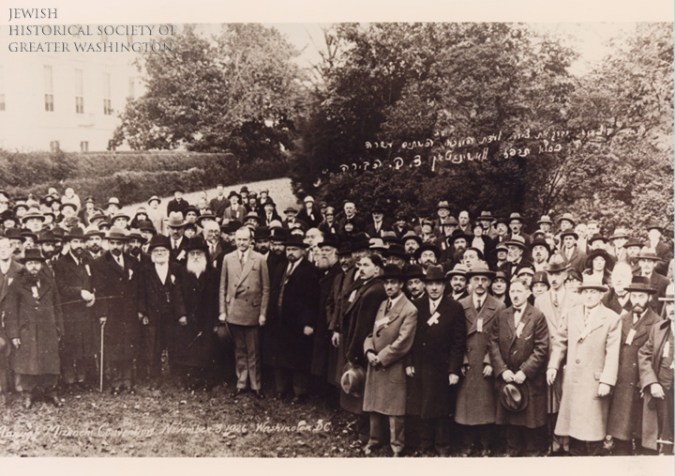
Meeting at the White House, 1926

Meeting at the White House, 1926

“I think — the best thing I can wish to the Jews in Palestine — is that they will get on — as well as they get on — over here” — Calvin Coolidge, 1926.


As a result of a mixture of hostility to Jewish settlement throughout Europe and the activities of the radical “Parushim,” of which Justice Brandeis was a leader, the move to establish homes in British Palestine gained momentum following the First World War. Most Americans, including Jewish Americans, had no interest in carving out a “Promised Land” in Palestine. Here President Coolidge is pictured with Orthodox Zionists. These men and women were working to establish a place where Jews from everywhere would live together as a nation. Rather than observe the principle: be at peace with all men so far as it depends on you, the movement sought to pull up roots and plant anew.  Coolidge’s statement, as the representative of America’s ideals, is a testament to this more excellent way here at home and in our relations abroad. The solution for the peace of the world was not in mandated Statehood but in exercising the obligations of citizenship here and wherever Jews already resided.

Photo part of a collection held by the Jewish Historical Society of Greater Washington.

On Promises

While self-serving and deceptive politicians are not new in our time, the past year has exposed many for who they are. The hypocrite is one who campaigns with soaring ideals but when circumstances demand principled courage and competent integrity, substance must be bluffed and ability feigned. The hypocrite is flush with lofty promises but when the time comes to deliver, the facade is revealed for all its emptiness. Coolidge identified it well, when he said, “When you substitute patronage for patriotism, administration breaks down. We need more of the Office Desk and less of the Show Window in politics. Let men in office substitute the midnight oil for [in place of] the limelight.”

Let’s review some of the promises made over the past five years. Obama, during the 2008 campaign, rejected NSA wiretapping to uphold national security. Turns out President Obama has not only approved domestic wiretapping of political opponents and government officials but also 35 foreign heads of state.

Obama promised not to govern by executive orders, signing “statements to nullify or undermine duly enacted law.” Turns out that only applies to the laws he agrees with enforcing, failing to uphold Federal law regarding border enforcement, marriage and even waiving provision after provision of Obamacare, except the individual mandate, just to name a few.

Obama promised his $787 billion stimulus would ensure 5.4% unemployment if passed. Turns out it went on to unleash 43 consecutive months above 8%, not reporting total numbers.

President Obama promised “My Administration is committed to creating an unprecedented level of openness in Government. We will work together to ensure the public trust and establish a system of transparency, public participation, and collaboration. Openness will strengthen our democracy and promote efficiency and effectiveness in Government.” Turns out Obama’s administration has been one covert decision after another, from “Fast and Furious” to Benghazi to passing Obamacare to “see what is in it” then engaging in a contrived government “shutdown” to coerce full funding for its implementation.

President Obama said we could keep our current insurance plans. Turns out that will not be the case for millions of families being dropped by their providers, faced with multiplying premiums, forced to pay fees or fall into a single-payer system, as was the intention all along.

President Obama said this bill was not a tax. Turns out costs are already skyrocketing for both the insured and uninsured as the Supreme Court majority agreed last summer was a legitimate part of the law.

President Obama drew a red line August of last year on Syrian chemical weapons. Turns out the red line was not a unilateral declaration of war, as he conveyed, but was a meandering debacle of indecision and moral surrender.

Obama promised to end budget deficits and restore surpluses. Turns out, after incurring over $6 trillion in debt without a single budget passed in five years, he alone is responsible for over one third of what has taken two hundred and thirty years to accumulate.

Finally, President Obama promised leading up to October 1, the new health care website would “make shopping for health insurance as easy as ‘buying a plane ticket on Kayak or TV on Amazon.’ ” Turns out the “glitches” of a site that took three years and $93.7 million to build are not going to be worked out until the end of November and perhaps later. Yet, when they cannot even properly execute something so simple as a webpage, are the people to be trusted with providing our medical well-being?

When it came to promises, Coolidge held to a practice diametrically opposed to this repeated inconsistency between word and deed. In stark contrast, Coolidge under-promised but over-delivered. As he made clear, “The conduct of public affairs is not a game.” It is the sober execution of responsibilities humbly and competently. “Governments are not founded upon an association for public plunder,” Coolidge would continue, “but on the cooperation of men wherein each is seeking to do his duty.” That duty meant telling the truth, a practice missing altogether vacant in this current administration. Coolidge would declare his duty to truth inherent to sound government, “I am not one of those who believe votes are to be won by misrepresentations, skilful presentations of half truths, and plausible deductions from false premises. Good government cannot be found on the bargain-counter.” Coolidge knew that promises, to be of any value, were not mere words uttered in the heat of a campaign, they were actions. What was done about a problem meant something far more than what was said or felt about it.

In Roland D. Sawyer’s excellent book “Cal Coolidge, President,” the author devotes space exploring how Coolidge worked when it came to political favors and promise-making. In short, he never made promises. Yet, he stands in an exclusive few among politicians, in general, and Presidents, in particular, for his ability to produce results far beyond what others expected. Sawyer writes,

“Coolidge…had the faculty of doing, in a quiet and unostentatious way, a lot of favors for people. We representatives and senators have may appeals for this and that from constituents. Governors are always affable, they give us the glad hand and–promises. Coolidge would hear us with little comment–and if favorably impressed would merely say, ‘I will see, Representative, if I can do anything on that,’ and generally the matter would be attended to at once. It was his habit to make the next visitor wait while his secretary was called and the wheels were set in motion on the thing wanted. Such treatment was so unusual in an office-holder that Mr. Coolidge soon had a lot of smaller ‘Frank Stearnses’ rooting for him. In my own case, for instance, I entered the House the same day Mr. Coolidge was sworn in as president of the senate. The next week we rode into Boston together. I had been introduced to Mr. Coolidge the week before, and had not been favorably impressed by his cold exterior. This Monday morning I was walking down the car, and merely nodding to Mr. Coolidge, when he said, ‘Representative, I see you have a road bill in; sit in here a minute, perhaps I can help you a little on it.’ Gladly I sat in. And in a few words Mr. Coolidge explained to me, a green legislator and member of the opposition party, the methods of legislation, and the way of getting favorable consideration. The brief and well chosen sentences finished, Mr. Coolidge turned his head to look from the car window, and to smoke his stogie. My estimate of the man was at once changed,–I saw at once he was a man of kindly nature, interested in his fellow men, but unable to make trivial conversation, and not caring to try. Such was the method of the man, and such his temper.”

Such was the Coolidge way. By refusing to multiply promises, guarantees and assurances, he prevented the disappointment of failure before those to whom he was accountable. As he would say, “I don’t recall any…that ever injured himself very much by not talking.” By taking up each matter promptly, acting decisively without fanfare or empty rhetoric, Coolidge accomplished far more with fewer words than most do with mountains of promises.

3a22398u