“Too often the world turns its eyes to the high places, thinking that from them will come its revelations and its great events, forgetful that a greater wisdom is in those who ‘mind not high things, but condescend to men of high estate.’ The greatest epoch in all human history began in a manger. This great American [speaking of Abraham Lincoln], the foremost world figure of the nineteenth century, came out of a frontier clearing and spent his early manhood in a village of a few hundred souls.
“In the memory of these facts there lies a solid basis for our faith. There is in the people themselves the power to put forth great men. There is in the soul of the nation a reserve for responding to the call to high ideals, to nobility of action, which has never yet been put forth. There is no problem so great but that somewhere a man is being raised up to meet it. There is no moral standard so high that the people cannot be raised up to it. God rules, and from the Bethlehems and Springfields He sends them forth, His own, to do His work. In them we catch a larger gleam of the Infinite” — Calvin Coolidge, February 12, 1922, at the Lincoln Birthplace, Springfield, Illinois.
While frequently on the speaker’s circuit as Vice President, Mr. Coolidge is here articulating an assurance that under God’s rule solutions to our problems do not come by Washington’s decree but, being spiritual in their essence, it takes righteous standards to address them. It is God, not people, who elevate individuals for the times through moral character. God even now prepares men and women of integrity who are being prepared for the problems confronting us. By looking to heavenly principles rather than the material accumulations of affluence, security and progress, a nation turns back to the foundations that stand. Ultimately, all problems are spiritual ones.
As Coolidge knew, like the Founders before him, a “nation that is morally dead will soon be financially dead.” Sound economics mean nothing without a firm grasp of moral principles. In the haste to cut away all reliance upon God and His moral order for society, we are simply hastening our own destruction. We are denying the eternal means of redemption when we live in defiance of our nature’s spiritual needs. The redefinition of marriage into something it has never been, the systematic denial of rights belonging to the smallest and weakest of society, and the refusal to acknowledge our Creator, our Lord and our Savior, will not spare us from reaping what we now sow. The fruits of our optimism will forever elude us if they do not rest in the clear moral standards originating from our Lawgiver and Lord.
leadership
On Thoughtfulness
One of the best insights into a person comes from the honest assessments of those with whom one works. President Coolidge had many such witnesses. Not everyone accurately understood him nor did they all respect what they did not “get” about him. Still, there remain many whose firsthand experience with the man emphatically contradict the popular image of Coolidge as a cold, unfeeling and callous individual. On the contrary, Ira Smith, the director of the White House mailroom for fifty-one years (including the entire Coolidge era), has one of many such examples of Coolidge’s spontaneously given kindness. His thoughtfulness was not unexpected because it was rare but because it manifested a degree of attention and regard the recipient never thought a President would deign to feel let alone show. Underestimated all his life, Mr. Coolidge enjoyed doing the unexpected. More than this, though, he was a kind man. He noticed the small things and took care to express concern, be it little Anne Morrow’s hurt finger, “old man” Mellon’s morale in the midst of the tax cut fights or a complete stranger as in the case recounted here:
“He had a temper that could make itself felt in high places, but he always felt a strong sympathy for the ordinary citizen and frequently went out of his way to perform some little act of thoughtfulness for a stranger. One Sunday morning when I was at the office trying to catch up with a heavy flood of mail he came over from the White House and stood beside my desk while I opened a large pile of letters. One of them was a special delivery letter from a woman who wanted to know what church the President would attend that day and at what time he would be there. She explained that she was in Washington only for a few days and that she wanted her small son to get a glimpse of the President while he was in the capital because it would be something he would remember always and could tell his friends about. She asked whether it would be possible to telephone her at her hotel and tell her which church Mr. Coolidge would attend. I handed him the letter and he read it carefully. Without saying anything, he picked up a pencil and wrote: ‘Phone 10:30 A.M. Monday.’ He handed the notation to me and went abruptly away. Such notes were typical of Mr. Coolidge, and I understood that he meant for me to telephone the woman and tell her to bring her son to the White House on Monday at 10:30 A.M. for a visit with the President. This I did, and the delighted mother and son were received by Mr. Coolidge.”
Some may cynically dismiss this as mere political calculation but to those who knew and understood him well, he was simply thinking of others. Conscious of his limitations as President, he exercised the power he held as a moral example that should inspire with humble service, not arrogant disdain for people. When he declined to use the powers he could have wielded as President, he did so with respect for his Constitutional oath and the rightful exercise of state and local governance. To blame Coolidge for the silence toward Charles D. Levy, a Jew facing boycott and expired leases in Ohio from the Klan, overlooks that the President was acting — to both preserve local self-government from federal good intentions and to set the moral example of presiding. The President presides, he does not take all powers into his hands to intervene on behalf of select citizens. To do so, would have undermined the freedoms of others and compromised the purpose of the Office. It would have been unjust, a variation of “picking winners and losers.” It would only help legitimize the Klan for a President to treat them seriously with a public statement. Ignored as insignificant, the lack of attention would defeat them. It had nothing to do with a lack of compassion and everything to do with an overriding concern for what was fair to all and respectful of liberty. He knew the disaster of good intentions and so the situation Mr. Levy faced was referred to the Bureau of Investigation, under the Justice Department led by Attorney General Stone. This was the Coolidge way: to take care of issues if they are his to handle; If not, to delegate to the proper person what is their responsibility. To explain to Mr. Levy, or anyone else what he was doing, would have undermined his actions and undone the effectiveness of addressing the problem versus discussing what one intends to do about it. In this way, Mr. Coolidge imparts even greater thoughtfulness for Mr. Levy (safeguarding his lawful liberties and the freedoms of all concerned) than his sharpest critics understand or will admit.
On ‘Freedom and Its Obligations’
Addressing those assembled at Arlington National Cemetery, May 30, 1924, President Coolidge spoke,
“American citizenship is a high estate. He who holds it is the peer of kings. It has been secured only by untold toil and effort. It will be maintained by no other method. It demands the best that men and women have to give. But it likewise awards to its partakers the best that there is on earth. To attempt to turn it into a thing of ease and inaction would be only to debase it. To cease to struggle and toil and sacrifice for it is not only to cease to be worthy of it but is to start a retreat toward barbarism. No matter what others may say, no matter what others may do, this is the stand that those must maintain who are worthy to be called Americans.”
During the Coolidge presidency, there were nine individuals whose actions merited the Medal of Honor, the highest recognition to those who distinguish themselves while wearing the uniform. Their actions were not all combat-related, as the years between 1923 and 1929 was a time of peace. Their courage and selfless service, however, be it in behalf of their brothers-in-arms, those around the world in need, or in the cause of greater possibilities (with nothing but uncertain flying crafts and their navigational skills) were testaments to what President Coolidge referred — those “worthy to be called Americans.” That tradition of selfless service will continue unbroken and it remains, rightly so, a reason to honor and aspire to those worthy of the name “American” to this day.

President Coolidge awarding the Medal of Honor to Machinist Floyd Bennett, USN (in front of him) and Commander Richard E. Byrd, Jr., USN (behind Coolidge), for their courageous risk of life in the first “heavier than air flight” to and from the North Pole in a tri-motor Fokker F-VII called the Josephine Ford.

The awarding of the Medal of Honor to Torpedoman Second Class Henry Breault, USN, for his quick actions to rescue a shipmate in their submarine 0-5, which sank within one minute. Confined by the hatch that closed after him, he kept himself and his mate alive for thirty-one hours below the surface until rescued.

Chief Gunner’s Mate Thomas Eadie, USN, received the Medal of Honor for an extraordinary rescue of his shipmate, Chief Torpedoman Michels, whose line fouled 102 feet below while trying to connect an airline to the sub USS S-4. CGM Eadie (as his citation states) “knowingly took his life in his hands,” diving down to skillfully extract Michels, bringing them both back to the surface after two hours of heroic effort.
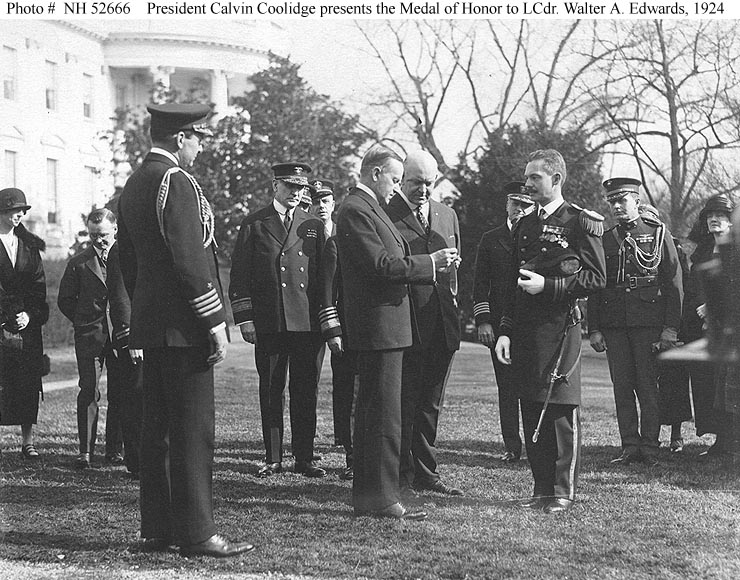
Lieutenant Commander Walter Atlee Edwards, USN, was awarded the Medal of Honor for his rescue of 482 men, women and children from the sinking French transport Vinh-Long, while aflame in the Sea of Marmora, off the coast of Turkey. While commanding the USS Bainbridge, he placed and kept his ship alongside the burning wreck until all alive were safely transferred to the American vessel.

Machinist’s Mate William Russell Huber, USN, was recognized here with the Medal of Honor for his exceptional heroism after a boiler exploded aboard the USS Bruce in Norfolk Navy Yard, 11 June 1928, he went into the “steam-filled fireroom and at grave risk to his life” successfully carried shipmate, Charles H. Bryan, to safety. Machinist’s Mate Huber went below again to aid in removing others from the room despite suffering severe burns to his arms and neck.

Captain Charles A. Lindbergh, Army Air Corps Reserve, was recognized with the Medal of Honor for both courage and skill despite the risk in navigating by nonstop flight from New York City to Paris, France, in the Spirit of St. Louis, a custom-built single-engine monoplane, achieving (as his citation, held here by President Coolidge, states) “not only…the greatest individual triumph of any American citizen but demonstrated that travel across the ocean by aircraft was possible.”

Ensign Thomas John Ryan, USN, was presented with the Medal of Honor for heroism in rescue of a woman trapped when fire broke out at the Grand Hotel in Yokohama, Japan, September 1, 1923, as the result of an earthquake that hit the city. Ensign Ryan disregarded his own safety to help another, as unexpected events demanded decisive action.
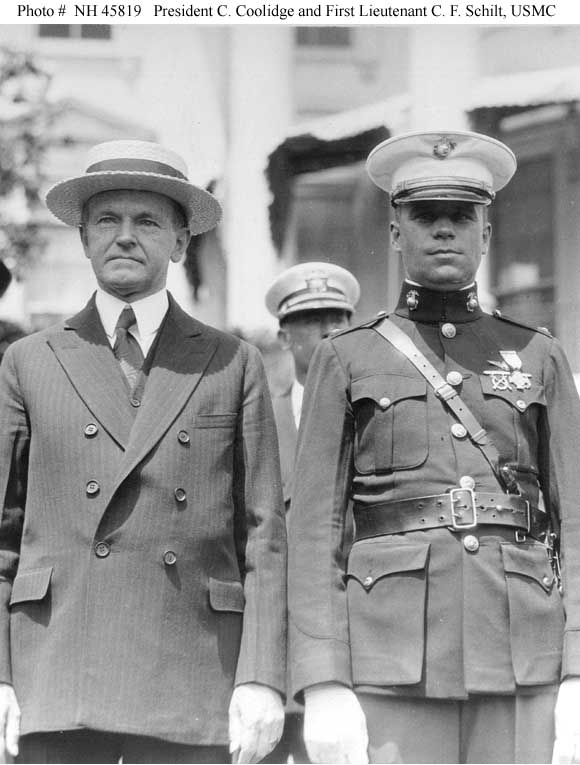
Here is First Lieutenant Christian Frank Schilt, USMC, to whom the President has just given the Medal of Honor for his superb actions in Quilali, Nicaragua, over the course of three grueling days in January 1928. First Lieutenant Schilt, following an intense fight to restore peace to the area, volunteered to evacuate all of the wounded by air and bring in a new commanding officer as relief. Taking off a total of ten times while under steady enemy fire from rough urban terrain, he removed all the wounded, saved three lives and brought back the necessary supplies to those in dire need on the ground.
 The Importance of the Obvious