When one approaches the literature that has accumulated over the years about the 1920s, it is found that narrow templates and hostile stereotypes have been allowed to define the decade. This is not honest scholarship, especially when those definitions are passed down as the final word on the matter. Repeating approved doctrines deprive us and future generations of the wealth of insight taught by the Coolidge era. By skipping over Coolidge far too many refuse to acknowledge that a profound and successful political philosophy exists outside the limits and failures of the “New Deal” and all of its legislative offspring. The 1920s are simply not worth studying, it is asserted, because they were an era of greed, hyper-capitalism, “underconsumption,” American isolationism and worship of “big business” (as if none of those conditions ever existed in the administration that swept to office in 1932). Any attempt to return to the primary sources and reappraise the time period is simply “reactionary” or “revisionist,” as if Schlesinger and the long train of “historians” after him were merely reporting the facts without a shred of bias for the policies of F. D. R.
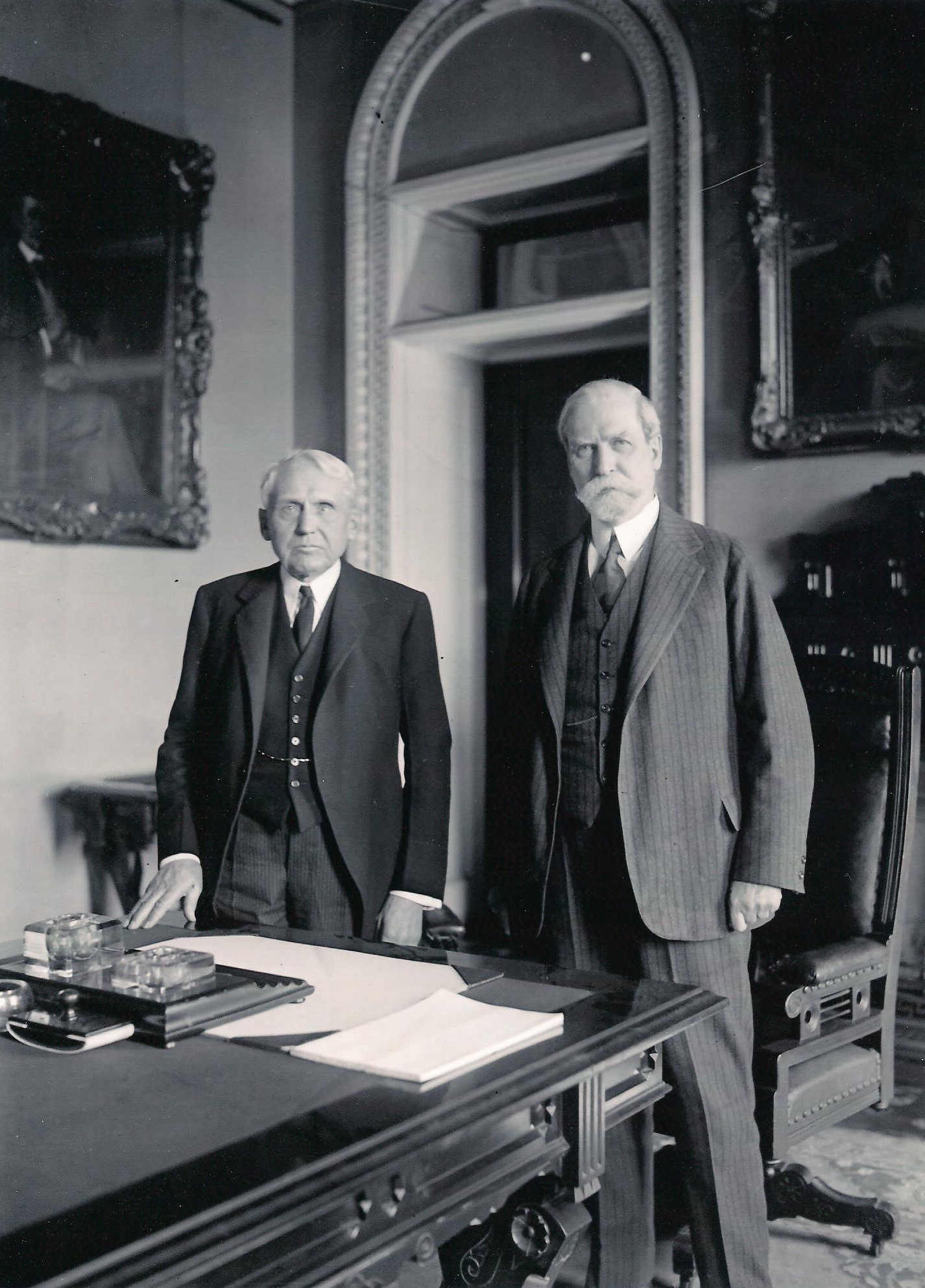
Chief among those accepted templates forced onto the 1920s are: (1) Isolationism and (2) Alliance with “Big Business.” A return to the original sources written by those who developed policy and implemented it during the Harding and Coolidge years, such simplistic frames of reference do not hold. A fascinating letter written to President Coolidge by none other than Secretary of State Charles Evans Hughes, on November 8, 1923, illustrates a far different policy underway at the time. Secretary Hughes is explaining the distinct difference of America’s “Open Door Policy” regarding America businesses abroad. The President’s approach, expressed in giving complete confidence to his Secretary to direct the Department, makes clear that Hughes was acting entirely with Coolidge’s authority.
Secretary Hughes writes, “From time to time there has been some dissatisfaction expressed in business circles because this Department’s attitude toward American business interests in the foreign field differs somewhat from the attitude in similar matters of the British, French and other European governments. The latter are not loath to interfere politically in support of the business interests of their nationals to a degree which is not followed by this Department.” Hughes was articulating an avowed refusal to thrust American businesses on other countries to the chagrin of several of our own businessmen, despite the potential fallout at the polls. He goes on, “Our position is that we are always ready to give appropriate support to our nationals in seeking opportunities for business enterprise abroad, but we do not undertake to make the government a party to the business negotiations or use political pressure for the benefit of private interests in order to obtain particular concessions, or intervene in favor of one American interest as against another. We are persistent in our efforts to maintain the open door policy, or equality of commercial opportunity, but we do not attempt to assume obligations for the government, expressed or implied, which under our system we could not undertake to discharge.” The open door was not for forcing American business on the world, it was for other nations to maximize opportunity for commerce without government favoritism, ours or theirs.
The Turkish government’s patronage of national petroleum companies was closing that open door for opportunity and hindering a free market. Instead of deploying the pressure of politics, however, the Coolidge administration strove to keep that door open to any and all, without negotiating favoritism for American businesses. It was the exact opposite of what Burton Folsom calls “political entrepreneurship.” Under this policy, “big business” had no special advantages to get established overseas. There were no “secret deals” between government and business with Hughes at the helm. Businesses were to approach one another and negotiate as equals with the strength of their own resources and if they failed to persuade foreign investors, the door remained open for someone else to succeed without government there to “strong-arm” a deal.
Disappointing as it was for some in business, Hughes commended the advantages of keeping the door open. “American companies which might prefer a policy of more direct interference on their behalf by the government are inclined, in my opinion, to overlook the fact that American prestige and reputation for fairness has been enhanced, and consequently business opportunities of our nationals have been increased, by the correct policy which this government has followed. I find that in many parts of the world, American business is welcomed largely because foreign countries realize that they can deal with American interests on a business basis without fearing political complications.” The “political intrigues” and “difficulties” that would ensue through closing the door to opportunity, whether by rewarding favored companies or by punishing undesirable industries, vindicates the wisdom of this policy.
The conferences that pervaded the decade on a host of foreign relations problems combined with the direct lines of friendship rebuilt by men like Dwight Morrow in Mexico, Charles Dawes and Frank B. Kellogg in Europe, Henry Stimson in Nicaragua and the Philippines, Sumner Welles and Secretary Hughes toward the Latin American states and many others help to correct the grossly mistaken belief that America retreated from the world under Coolidge. It was as involved as ever. Instead of embracing aggression and propaganda as its weaponry, however, these leaders of the Coolidge era demonstrated what patience, impartiality, service and understanding, with the resolve to protect America’s ideals, can accomplish.



 The Importance of the Obvious