On the Gettysburg Address

To express our devotion we have come to the field of Gettysburg. It ranks as one of the great historic battle grounds of this continent. In the magnitude of its importance it compares with the Plains of Abraham, with Saratoga, and with Yorktown. It is associated with a great battle between the Union and Confederate forces and with one of the greatest addresses ever delivered by one of the greatest men ever in the world, Abraham Lincoln. – See more at: http://www.calvin-coolidge.org/address-at-gettysburg-battle-field.html#sthash.LvYMuGW1.dpuf
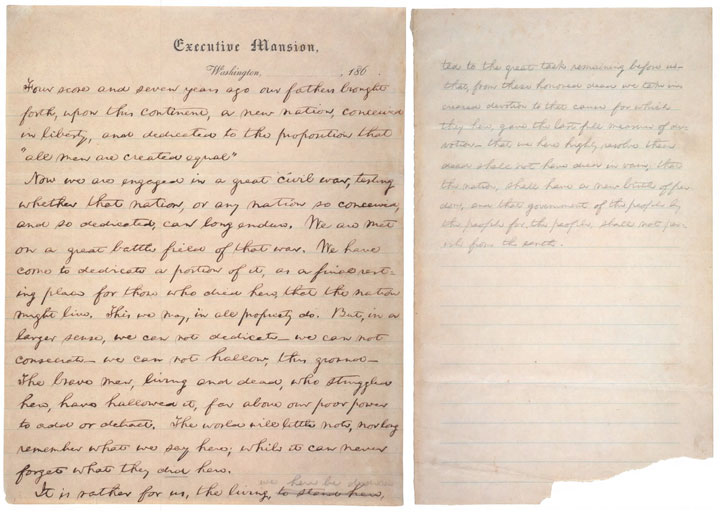
The "Nicolay Copy," earliest known handwritten version of the Gettysburg Address.

The “Nicolay Copy,” earliest known handwritten version of the Gettysburg Address.

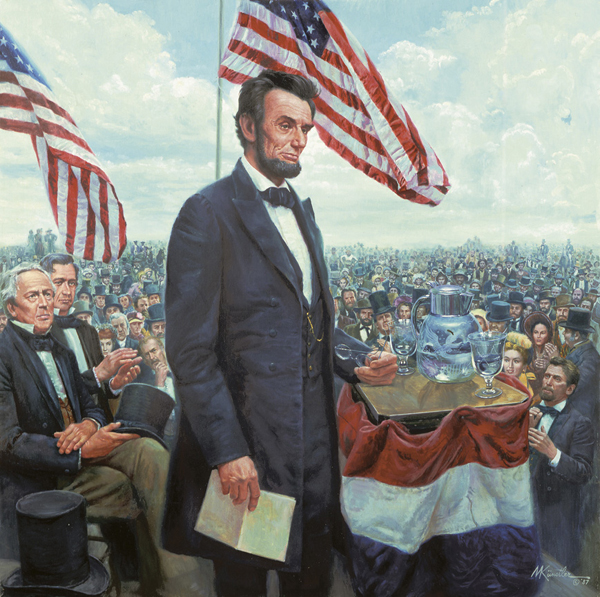
One hundred and fifty years ago, President Lincoln ascended the speaker’s platform to give over the course of two, short minutes one of the most eloquent speeches ever uttered. His words stand in timeless tribute to those, on both sides of those vast fields and hills of Gettysburg, who gave all they had to preserve freedom and government by consent.

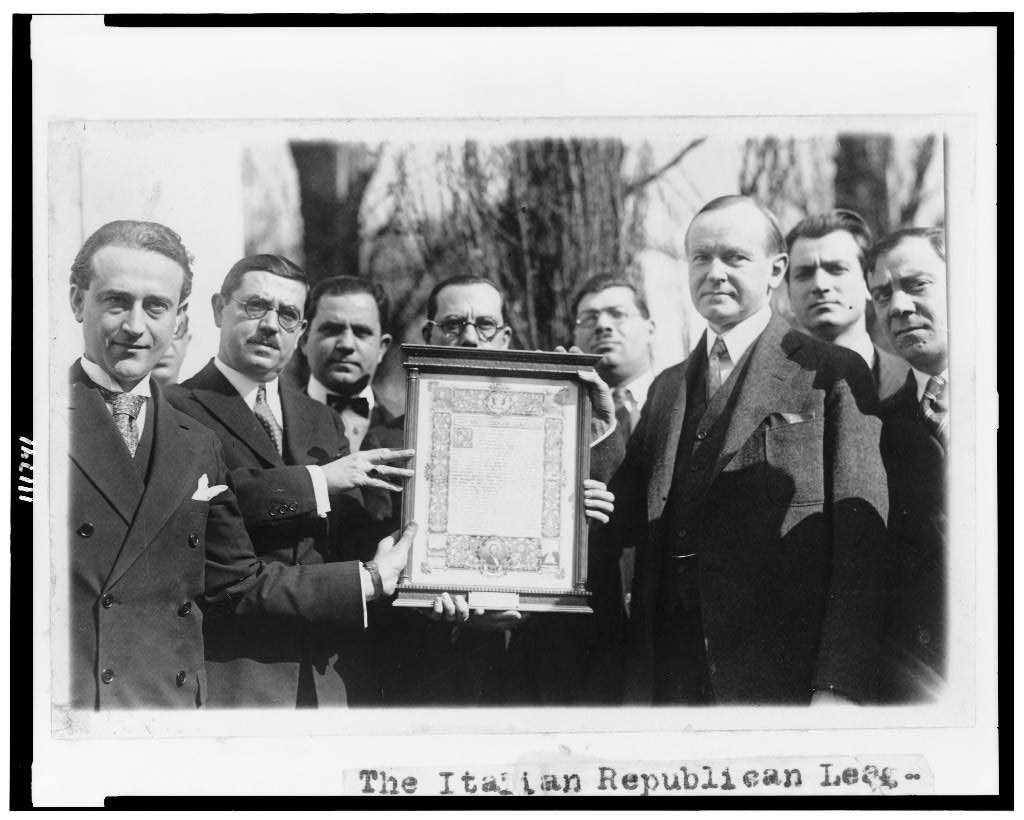
President Coolidge being presented an original parchment of the Gettysburg Address by the Italian Republican League of New York, February 12, 1927.

President Coolidge being presented an original parchment of Lincoln’s Gettysburg Address by the Italian Republican League of New York, February 12, 1927.

One of six Presidents to visit the battlefield at Gettysburg up to that time, Calvin Coolidge came here in 1928, honoring not only what brave men did there but what one man said there,

“We do not come to lament, but to give thanks. With one acclaim the people bestow upon them all that divine salutation, ‘Well done, thou good and faithful servant.’ To express our devotion we have come to the field of Gettysburg. It ranks as one of the great historic battle grounds of this continent. In the magnitude of its importance it compares with the Plains of Abraham, with Saratoga, and with Yorktown. It is associated with a great battle between the Union and Confederate forces and with one of the greatest addresses ever delivered by one of the greatest men ever in the world, Abraham Lincoln.”

Image

To express our devotion we have come to the field of Gettysburg. It ranks as one of the great historic battle grounds of this continent. In the magnitude of its importance it compares with the Plains of Abraham, with Saratoga, and with Yorktown. It is associated with a great battle between the Union and Confederate forces and with one of the greatest addresses ever delivered by one of the greatest men ever in the world, Abraham Lincoln. – See more at: http://www.calvin-coolidge.org/address-at-gettysburg-battle-field.html#sthash.LvYMuGW1.dpuf

“Calvin Coolidge: A Silver Lining”

Coolidge+smile

“Calvin Coolidge: A Silver Lining”

Brittany Baldwin of The Imaginative Conservative has produced a superb review of Dr. Thomas Silver’s enduring work, Coolidge and the Historians. While Dr. Silver is regrettably no longer with us, Ms. Baldwin has done well not only in assessing the value of recent studies on the thirtieth president (as in Coolidge by Amity Shlaes and Why Coolidge Matters by Charles Johnson), she looks back to the prime mover of restoration for Coolidge’s record and legacy.

It was Dr. Thomas Silver who returned honest standards of scholarship to the most underrated president of modern time. It was Dr. Silver’s work who laid the foundation for a renewed appreciation of Coolidge now. Ms. Baldwin has done a commendable job in reminding us of the indebtedness we all hold to this good and faithful scholar, Thomas B. Silver, the man who “started it all.” As Dr. Silver continues to exemplify the best of Claremont Institute so Ms. Baldwin is a great credit to Hillsdale College.

tomsilver

On Where “the Buck Stops”

Municipal law had been flagrantly disregarded. Upwards of one hundred thousand people were seriously inconvenienced by the city of Salem ignoring the law that prohibited the running of jitneys, the old term for bus taxis, on the streets. Driving street cars (which ran on rails) from usage, jitney operators were in violation of the law. Both the city and rail trustees were allowing the law to be fudged, bent and manipulated provision by provision as circumstances allowed.

The Governor, duly authorized by prior law to intervene in such circumstances, did so decisively. He instructed the directors of street car companies that the law was not ambiguous at all. Nor would he alter it to fit ever-changing circumstances. The law placed street cars in Salem, and forbade jitneys. To disobey the law, even by city officials, was wrong and needed to stop. The city of Salem would have to to amend city code by legislative council, not executive alteration. The Governor boldly told them so, adding that he would exercise his lawful authority to deploy State police to enforce the law if city officers failed to do their duty.

One man stood up, “If you do that,” he threatened, “the labor people will go into ever town of the State and crucify you politically.” The man went on, becoming even more explicit in what would happen to the Governor if he followed through with his words. Was the Governor cowed by the prospect of losing everything politically? Hennessy recounts what happened next. “The Governor patiently listened for a while, and then broke in, with a drawl that convulsed the listeners and embarrassed the speaker…” (Calvin Coolidge, pp.112-113).

He said, “Don’t let me deter you. Go right ahead.” The threat died in its tracks.

As the meeting dragged on longer and longer, another official complained, “well, about all we have done so far is pass the buck.” 

To that the Governor looked straight at the speaker and declared, “Try it on me. I won’t pass the buck.”

The Governor would not be intimidated by either electoral consequences or attempts to sidestep the law to get instant results. Nor would he concoct a fictional third person to whom he could pin all political liabilities and deficiencies if something went wrong. “I won’t pass the buck,” he announced. Not “we” or “my team” but “I won’t pass the back.” It was he alone who would uphold the law, even if no one else did. The responsibility of governing meant more than the outcome of any election. It was to be executed faithfully in obedience to the law, as that law is the duly enacted will of the people through their representatives.

The Governor had no more right to create new laws than did the city of Salem to rewrite by arbitrary action what the law allowed today, changing it to fit what may happen tomorrow. Our system, to remain free, must have continuity and reliability. If it is constantly transforming at the whim of executive power, it is no longer the law but lawlessness, a mockery of constitutional government. “The law,” as the Governor would say, “changed and changeable on slight provocation, loses its sanctity and authority.”

The Governor, Calvin Coolidge, could not be more right.
Image

Â