On Mistaken Identity

Circulated around Washington through the 1920s, this apocryphal story of mistaken identity, is recounted by one of Chief Justice Taft’s earliest biographers:

“One day during the administration of President Coolidge, the Chief Justice happened to drop his cane just as a small boy of about seven came by. The boy picked up the cane and handed it politely to Taft, who thanked him with the radiant warmth which was so characteristic.

     ‘I met the nicest old gentleman on the bridge today,’ said the youngster to his mother when he reached home. ‘He dropped his cane and I picked it up. He was very, very fat!’

     “The mother recognized Taft in the description. ‘That was a very famous man,’ she told her son. ‘He used to be president of the United States.’

     “A day or two later they met again.

      ‘I know who you are!’ said the boy. ‘You used to be President Coolidge!’ “ (Pringle 964).

While the amiable Chief Justice was a frequent visitor to the Coolidge White House, he shared in the impression of even those closest to Coolidge who felt the chill from time to time that resulted from giving the President unsolicited advice. Taft, who knew the weight and obligations of the Presidency better than anyone close to Coolidge, never let incidentals like this get in the way of his friendship with Calvin and Grace.

Having met in 1914, Coolidge and Taft always kept the highest respect for one another, as the exchange below illustrates. Writing to his father, Coolidge said of Taft, “what he said was so much like what I had said that I sent him a copy of my address he sent me the enclosed letter which you may return to me, also an autograph copy of his book on Popular Government…” In that enclosed letter, Taft, characteristically self-effacing, told Coolidge, “I have read what you said to the Senate upon your taking the Chair [Coolidge’s famous January 7, 1914 speech], and it is so fine that I thank you for sending it to me and for giving me an opportunity to read it. It strikes a chord in my heart that responds to every word. I have pleasure in sending you a little volume that has been published of ten lectures which I have delivered on Popular Government and also three addresses that I have made which are not included in the book, to file away, with the certainty that there is nothing in them which says as well as you have said it the truth with respect to government, but that there is also nothing in them which differs in spirit from that which you have said” (“Your Son, Calvin Coolidge,” Edward C. Lathem, Montpelier: Vermont Historical Society, 1968, pp.126-7).

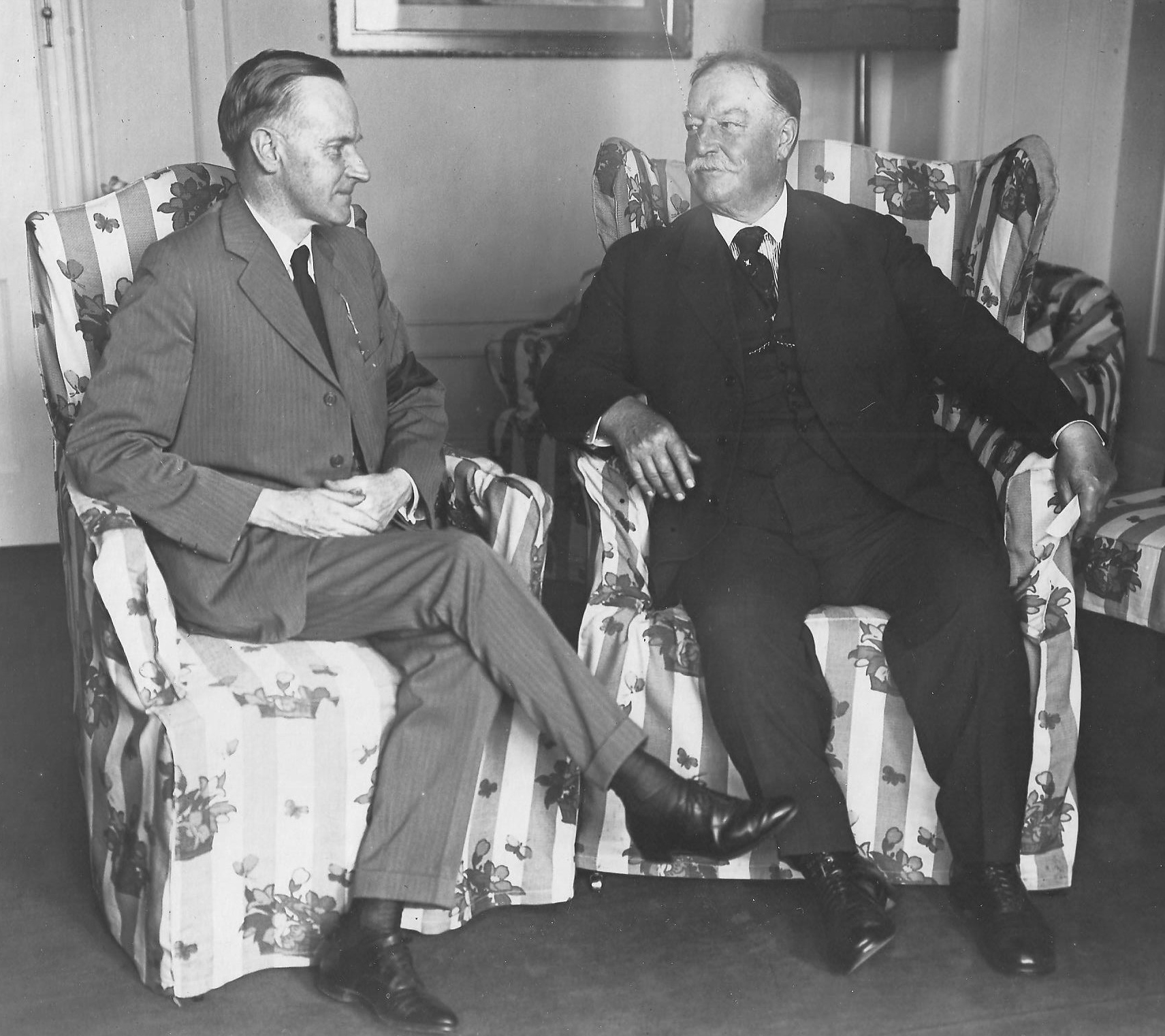
President Coolidge meeting with Chief Justice Taft at the New Willard Hotel within the first week of succeeding to the Presidency, August 1923.

President Coolidge meeting with Chief Justice Taft at the New Willard Hotel within the first week of succeeding to the Presidency, August 1923.

On What is Missing in Education

In all the discussion over the years concerning the deficiencies of modern education, from the improvement of testing standards, the adoption of new curricula, or even the construction of expansive facilities, the most fundamental component is missing. The purpose of education, for most of America’s existence, has been encouraging the student’s grasp of morality and sense of service to others. So it was for the last classically educated President in our history, Calvin Coolidge.

For all the concern over school shootings, sexual misconduct, drugs, violent outbursts, and other self-destructive behavior, the basics continue to be neglected as incapable of addressing the “complexity” of the issues. This is a refusal to live in reality. It is a decided effort to run from the hard decisions of maturity, allowing immature and unhealthy impulses to dictate both the lives of individuals and the governance of schools.

No one is born with perfect behavior, impeccable manners, or maturity. These qualities must be taught, for students absorb both the good and the bad. Cut out the moral core and there is no compass to help the individual discern good from evil values. Moreover, the young are no longer taught the most basic virtues of character:  self-control, temperance, kindness, forbearance, patience, charity, and diligence. Instead, moral instruction is ridiculed as an attempt to impose extreme codes of behavior or to establish a state religion. Animalistic behavior is regarded as normal, and any attempt to reaffirm essential standards of conduct is met with organized ostracism from accepted society by politically correct elites. In truth, character has nothing to do with a “separation of church and state” and everything to do with a good and healthy civilization.

We are failing our children egregiously.  The individual is treated as mere biological matter or, at best, mind without conscience, free to respond to any and every stimuli while simultaneously being devoid of a spiritual nature or the needs of the soul. Mere relay of information is not education. Transmitting data, shorn of any idea that truth exists and can be known objectively, does not fulfill a teacher’s obligation.

Coolidge said it best,

“Man is far more than intelligence. It is not only what men know but what they are disposed to do with that which they know that will determine the rise and fall of civilization…The realization of progress that has marked the history of the race, the overwhelming and irresistible power which human nature possesses to resist that which is evil and respond to that which is good, are a sufficient warrant for optimism. If this were not so, teaching would be a vain and useless thing, an ornament to be secured by a few, but useless to the multitude.”

Coolidge thought such a narrow base of informed and truly educated people was not right. Proper education reached as many as it could. Proper education did not abandon certain communities, specific demographics, or particular economic strata. It seems some today have surrendered the standards because too few live up to them. Hence, literacy continues to fall, historical awareness evaporates, and nothing is required of the inmates running the asylum.

Coolidge appealed to higher standards proven by decades of historical experience. People were not richer, wiser, better, or purer than they are now, but they knew the effort to aspire to standards was worth it. Aspiring to the ideal — a character formed and maintained through constant effort — was worthy not because perfection could be realized, but because good character is found in its pursuit.

Coolidge continues,

“Our country…has founded its institutions not on the weakness but on the strength of mankind. It undertakes to educate the individual because it knows his worth. It relies on him for support because it realizes his power…[T]he chief end of it all, the teaching of how to think and how to live, must never be forgotten.

     All this points to the same conclusion, the necessity of a foundation of liberal culture, and the requirement for broadening and increasing the amount of moral intellectual training to meet the increasing needs of a complicated civilization. Free schools and compulsory attendance are a new experience. No power of government can bring them to success. If they succeed, it will be through the genuine effort and support that can come only from the heart of the people themselves. It is this condition that makes the position of the teacher rise to such high importance.”

Without the moral and the spiritual to support and sustain the individual, all the “facts” and material stimuli of modernity will leave the student empty, ill-equipped for the potential life holds. It will squander the great inheritance due the next generation: the wisdom of those who thought great thoughts and did great deeds before us.

Image

On Political Satire

Image

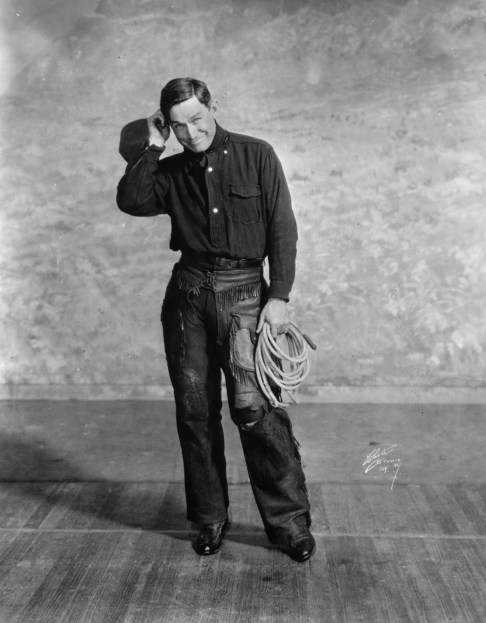
On January 4, 1928, Will Rogers, the era’s renowned cowboy comedian-columnist, led a radio hookup that featured participants all across the country, including the famous Al Jolson and the influential Paul Whiteman and his orchestra. It is interesting that both Jolson and Whiteman profoundly inspired many Americans (from Duke Ellington and Billie Holiday to Dick Clark and Bing Crosby) to launch their talents on the public stage. Whiteman was known as the “King of Jazz” while Jolson provided a sense of common identity and respect between minorities, immigrants and “Anglo-Saxons” through his black-face performances. Derided now, Jolson was loved across the demographics then. Will Rogers led this colorful gathering of talent to advertise Dodge automobiles.

As he continued the broadcast, in his characteristic drawl, he said, “Radio fans, I have a friend in Washington who on account of what the Automobiles have done for his Economy wants to speak to you, Mr. Coolidge, all right Mr. Coolidge go ahead…”

Rogers then employed a clever impersonation of the President’s “Vermont twang” and style of expression, ribbing Coolidge with this nonsensical series of comments:

     Ladies and Gentlemen, I am supposed to deliver a message every year on the condition of the country, I find the County as a WHOLE prosperous. I don’t mean by that, that the WHOLE country is prosperous, But as a WHOLE, its prosperous, That is its prosperous as a WHOLE. A WHOLE is not supposed to be prosperous, There is not a WHOLE lot of doubt about that…

Rogers, continuing to replicate Coolidge’s voice went on to political events in succinct and casual snippets, mentioning Mellon at Treasury, the Congress, “Smart Boy” Dwight Morrow and “Lindberg.” Rogers wrapped it up with a reference to Coolidge’s “I do not choose to run” statement from the previous year and how Prohibition was going.

All seemed fine until a few days later when Rogers dined at the home of Speaker Nicholas and his wife, Alice Roosevelt Longworth. To Rogers’ shock he learned of a New York Times piece chastising the comedian for “going too far” when it came to Presidential satire. He had even confused and angered some listeners who took issue with a President endorsing Dodge vehicles. Immediately, he sent a profuse letter of apology to both Mr. and Mrs. Coolidge, ending with the line with characteristic lack of punctuation, “If there ever was a sad Comedian, I am one, and I do ask all the forgiveness that its in your and Mrs. Coolidges power to give, Yours most respectfully, Will Rogers.”

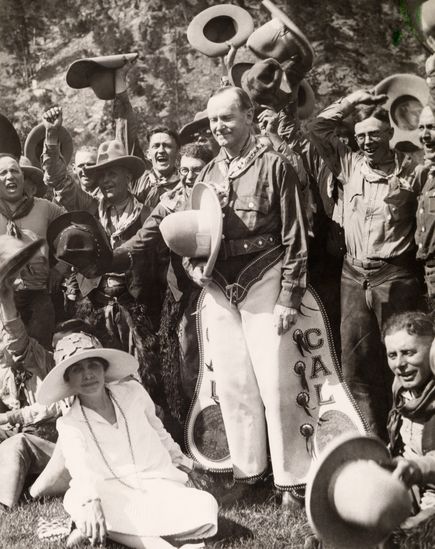
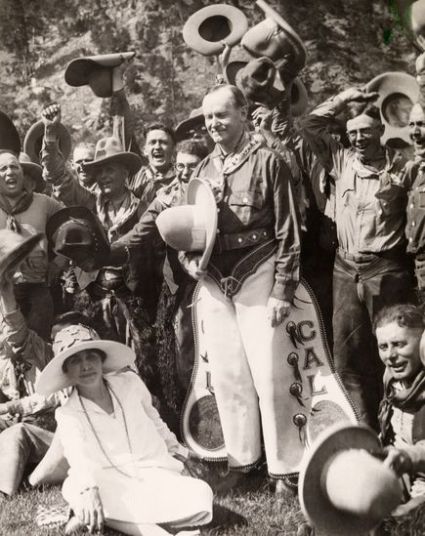
The President, who responded to criticism directed at him the previous year for wearing that silly cowboy outfit including customized chaps with, “It is good for people to laugh,” wrote this kind and sensible reply to the ashamed comedian:

     THE WHITE HOUSE

     Washington

                                                                                                      January 11, 1928

     My dear Mr. Rogers:-

     Your letter has just come to me. I hope it will cheer you up to know that I thought the matter of rather small consequence myself though the office was informed from several sources that I had been on the air. I wish to assure you that your note makes it all plain that you had no intention save harmless amusement.

     I hope you will not give the affair another troubled thought. I am well aware how nicely you have referred to me so many times.

                                                                                                      Cordially yours,

                                                                                                      Calvin Coolidge

As Lawrence E. Wikander, former Curator of the Coolidge Room at Forbes Library, has noted in his article, “Will Rogers and Calvin Coolidge” in The Real Calvin Coolidge, volume 13, “Even a slight acquaintance with the President would convince one that would not send such a warm letter if he were offended” (p.14). Yet that is exactly what biographers have done since 1939! Each seems oblivious to this letter and Coolidge’s explicit dismissal of any offense taken. Such is one of the many persistent Coolidge myths to continue in spite of the facts.

As Mr. Wikander points out, Rogers not only considered the matter closed…he would impersonate Coolidge again and in the coming years after the White House regularly chided Coolidge with public satire. They would meet in March of 1930 at the dedication of Coolidge Dam in Arizona and remain clearly on the warmest of terms.

This obscure incident of political satire from eighty-five years ago illustrates how far the culture has gone. Instead of continuing the progress evident in Coolidge’s day, the culture has become more restrictive, seemingly incapable of laughing at itself, “choosing” to take offense rather than embracing the healthy sense of proportion that events warrant.

It is forgotten what a long road of passionate political expression has been traversed in our country. When President Washington received Chief Justice Jay back from Great Britain following the negotiation of an unpopular treaty with the recently vanquished “Mother Country,” Jay observed he could travel back to the capital by the lights of likenesses of him burned in effigy. Everything from death threats to obscene acts were directed against President Bush, an experience shared by numerous Presidents before him.

Infinitely less has been done by the rodeo clown at the Missouri State Fair. Yet, in spite of the enthusiastic reaction from those who were in the audience…it is “racist,” “hateful” and “intolerant” to lampoon the President. Apparently he is to be held above criticism, however comedic. It is a grave loss to our liberty when political correctness is awarded the power to silence the most harmless of satirical performances while destroying the individual who utters anything not approved by government authorities. What is left of our freedom to express political opinion when satire is no longer allowed?
Image