The “National Christmas Tree,” 1923

The National Christmas Tree, 1923

Long known as the “White Lot” for the whitewashed fencing which went along its undeveloped property lines, the Ellipse was laid out in 1791 by the District of Columbia’s designer, Pierre L’Enfant. The current home of what is dubbed, the “National Christmas Tree,” the Ellipse served as the location for this historic first: the original lighting of the Christmas Tree, a tradition begun by none other than President Calvin Coolidge on December 24, 1923.

This historic first was the result of a collaborative effort by the Washington area Community Center Department of the public schools who launched the event, the Society for Electrical Development and the Electric League of Washington who engineered the battery power source and button (at the end of the long cord in the President’s hand) which illuminated 2,500 red, white and green bulbs, Paul D. Moody of Middlebury College and Senator Greene of Vermont who donated the 48-foot balsam fir cut and transported all the way from Coolidge’s home state, the Office of Public Buildings and Grounds who coordinated with Grace Coolidge’s permission to hold this event here and the President’s acceptance of the gift and participation in its lighting.

The historic quality of what happened here is equally as significant as what did not happen. The push to place the Tree on the grounds of the White House itself was declined because the Coolidges insisted upon a deliberate removal from the Presidential residence so that it would serve as the neighborhood tree, rather than another fixture assuming Federal control. It was to benefit the people who lived in the District and as such, it was more properly renamed the “National Community Christmas Tree” in 1924.

The 5 to 6,000 people present on this occasion in 1923 saw President Coolidge light the tree and leave with no words and no fanfare after but a few minutes. The real highlight of the evening was meant to be the singing of carols on the North Portico of the White House at 9PM. What mattered more to the Coolidges was not the pomp and ceremony but the spontaneity and gratitude of each American able to keep the occasion in one’s own way. The opportunity to serve was central to their observance of Christmas. The first year they would see 500 holiday baskets distributed through the Salvation Army, Grace would send more than 50 bouquets to the shops downtown who had helped her find presents, and as a family they visited the veterans recovering at Walter Reed Hospital in Washington, by Presidential authorization even entertaining the troops with the moving picture, “Abraham Lincoln.” The fight against tuberculosis was also a signature effort for the Coolidges, who not only raised funds for the Red Cross and National Tuberculosis Association through the purchase and sale of Christmas seals during the 1920s but continued to do so in retirement.
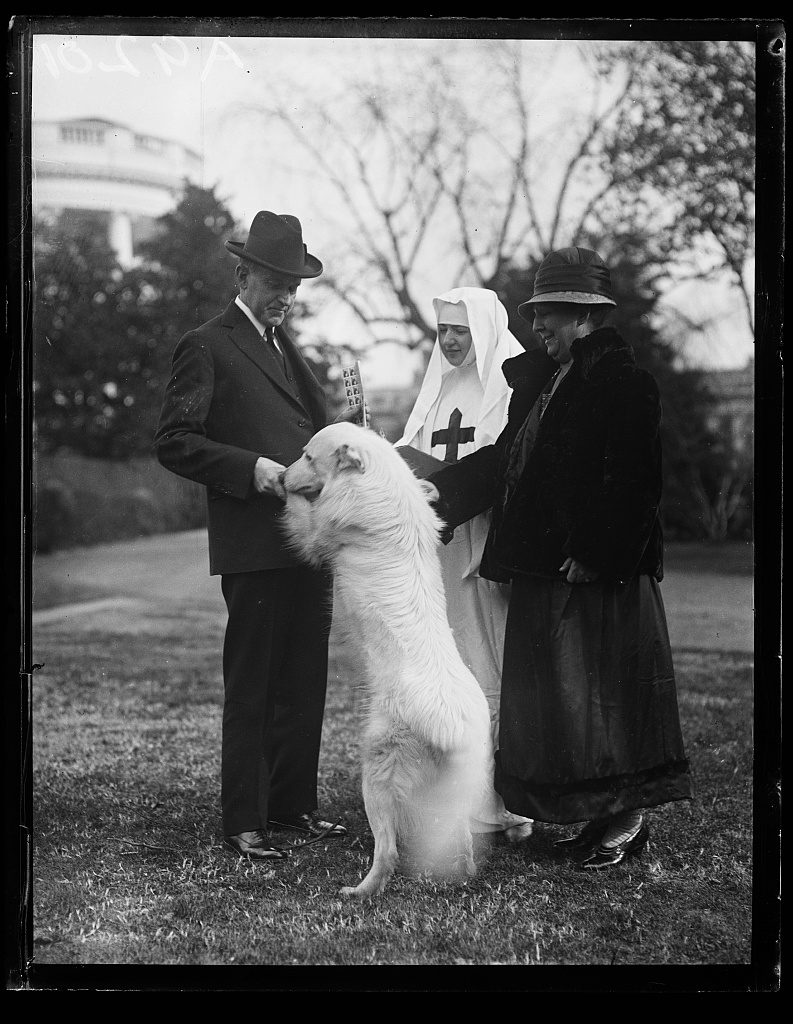
Rob Roy wants to buy some Christmas seals, 1924.

It seems Rob Roy wants to buy some Christmas seals, 1924.

The Christmas Seals of the Coolidge Years

(the Coolidges commenced the seal season for 1929 in Massachusetts as well)

1923 TB Christmas Seals1924 TB Christmas Seals

1925 TB Christmas Seals OLYMPUS DIGITAL CAMERA

1927 TB Christmas Seals1928 TB Christmas Seals 1929 TB Christmas Seals

Two crucial changes, in response to President Coolidge’s requests, would take place in 1924: 1. The American Forestry Association would replace the ailing balsam fir of the previous year with a new living 35-foot Norway spruce from New York; and 2. The lighting of the Tree would move to Sherman Plaza, so that, as Forestry Association officer G. H. Collingwood observed years later, the ceremony would be kept “spiritual in character, from reaching carnival proportions.” Coolidge had advocated the use of living trees as neighborhood landmarks that spring and it consequently helped define again an historic observance of Christmas in 1924.
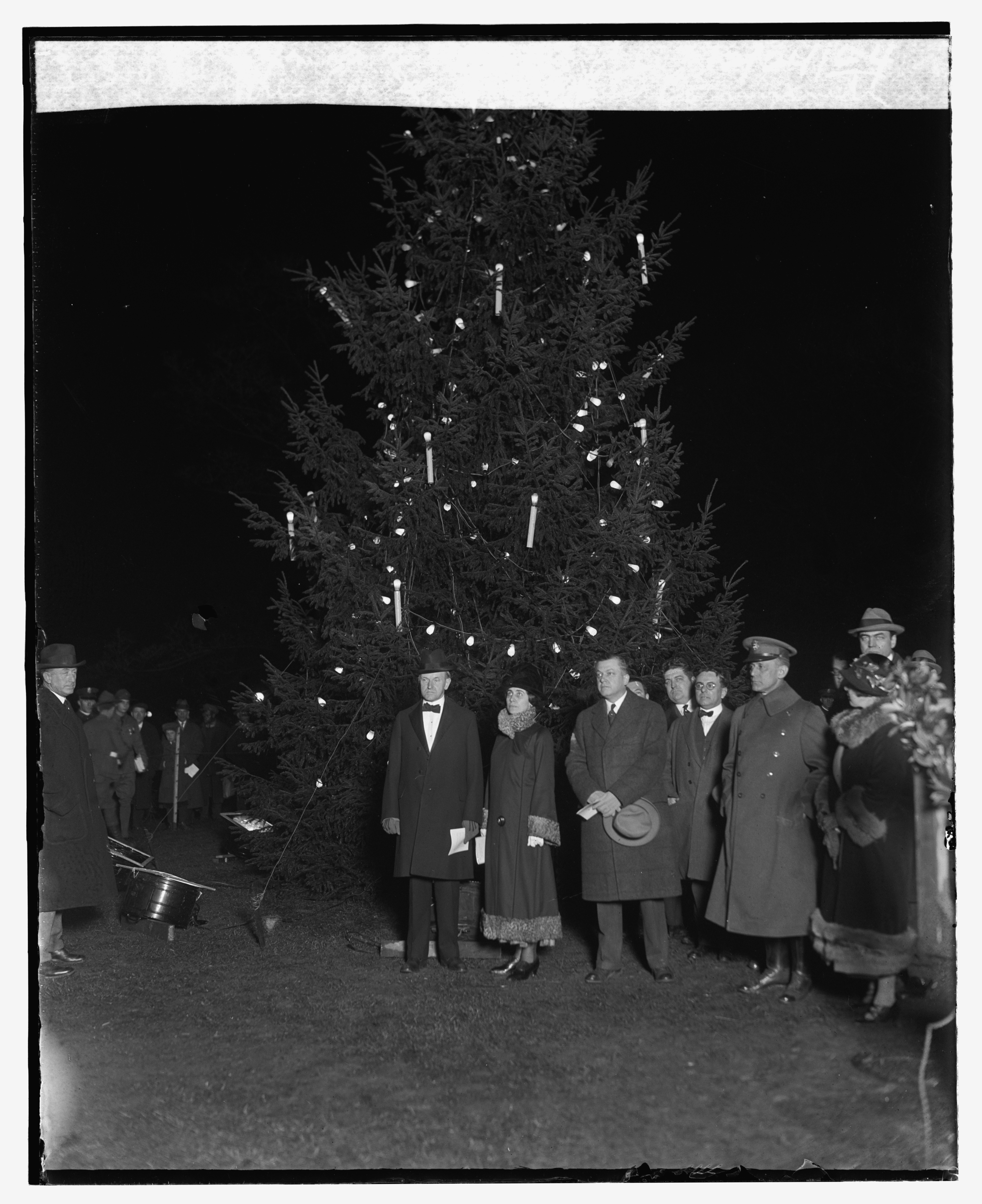
The lighting of the Community Christmas Tree, December 24, 1924.

The lighting of the Community Christmas Tree, December 24, 1924.

In 1925, radio would broadcast the program for the first time. Three days before, however, President Coolidge, speaking to the children of 4-H and the Scouts, recalled that while he never had the opportunity to take part in their great organizations, “There is a time for play as well as a time for work. But even in play it is possible to cultivate the art of well-doing. Games are useful to train the eye, the hand and the muscles, and bring the body more completely under the control of the mind. When this is done, instead of being a waste of time, play becomes a means of education. It is in all these ways that boys and girls are learning to be men and women, to be respectful to their parents, to be patriotic to their country and to be reverent to God. It is because of the great chance that American boys and girls have in all these directions that to them, more than to the youth of any other country, there should be a merry Christmas.” 
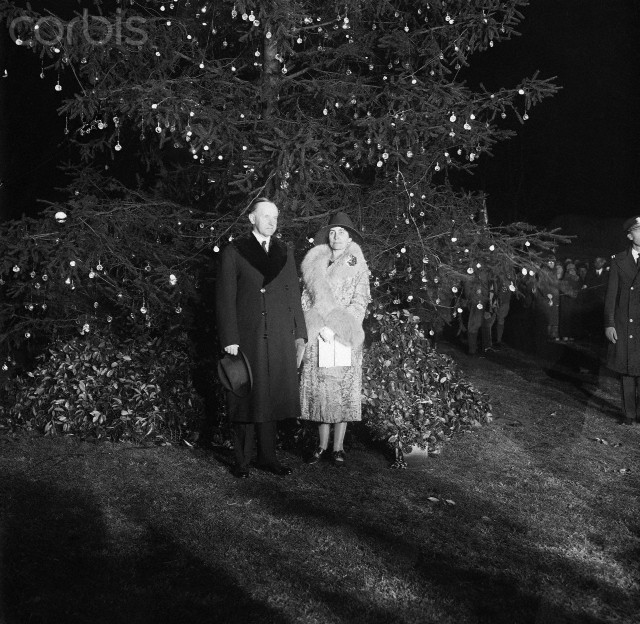
The Coolidges after the Christmas Tree has been lit, December 24, 1927.

The Coolidges after the Christmas Tree has been lit, December 24, 1927.

By April 1926, President Coolidge had designated the massive sequoia “General Grant” as the “Nation’s Christmas Tree,” not the Norway spruce he would light up without a word (for the third straight year) that December. By December 1927, the Christmas program included more music from the U.S. Marine Band, the Interstate Commerce Commission Glee Club and the traditional favorite, singing of carols on the North Portico. It was historic yet again for another reason. President Coolidge would give his first Christmas Message. Published in newspapers across the country on Christmas Day, the President finally spoke to the American people. Even then, it was brief and in characteristic Coolidge style. It is said that 1927 also marked long-absent return of formal Christmas cards sent from the Coolidge White House.
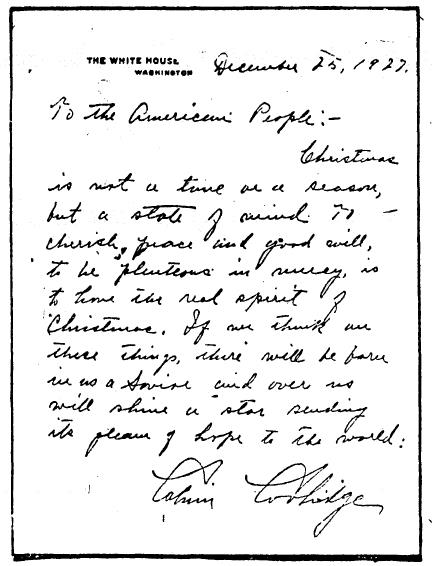
Written on White House stationary, the President spoke to the American people, saying: "Christmas is not a time or a season, but a state of mind. To cherish peace and good will, to be plenteous in mercy, is to have the real spirit of Christmas. If we think on these things, there will be born in us a Savior and over us will shine a star sending its gleam of hope to the world:  Calvin Coolidge"

Written on White House stationary, the President spoke to the American people, saying: “Christmas is not a time or a season, but a state of mind. To cherish peace and good will, to be plenteous in mercy, is to have the real spirit of Christmas. If we think on these things, there will be born in us a Savior and over us will shine a star sending its gleam of hope to the world: Calvin Coolidge”
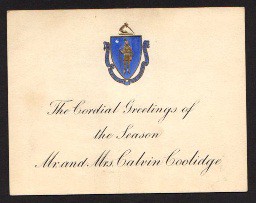
calvin-coolidge-christmas-card  coolidge-christmas-card

The Christmas of 1928, the Coolidges’ last in Washington, would establish another historic first. This time, the President would speak on the radio. Still insisting on the principle that Christmas remain a personal and local occasion, he would not wax eloquent, bluntly declaring, “In token of the good-will and happiness of the holiday season and as an expression of the best wishes of the people of the United States toward a Community Christmas Tree, in behalf of the city of Washington, I now turn on the current which will illuminate the tree.” With that, fifteen minutes after his arrival, he went back the White House. A Christmas card signed by 17 business organizations was given to Mrs. Coolidge and the First Couple went back to the Presidential residence for what was to be the primary highlight of Christmas on the grounds: singing carols on the North Portico. A celebration with refreshments for eighty guests concluded the evening and closed a chapter of simple, yet joyful Christmas traditions, both new and old, cherished during the Coolidge years.

The singing of carols at the North Portico of the White House, a main feature of the Coolidges years, is pictured as it looked that first Christmas of 1923.

The singing of carols at the North Portico of the White House, a main feature of the Coolidge years, is pictured as it looked that first Christmas of 1923.
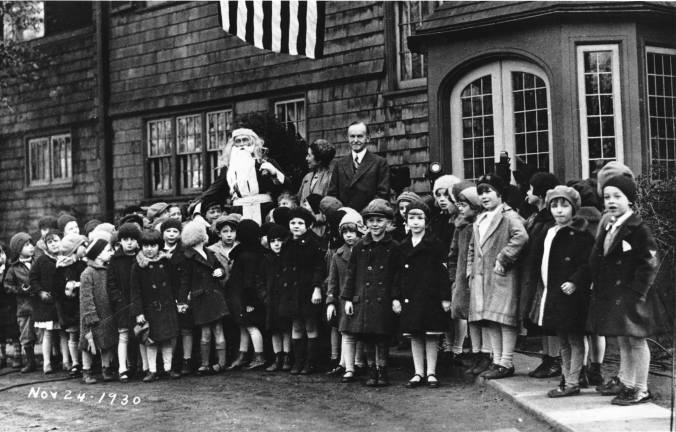
“There’s your answer”

It was a rare occasion that Calvin Coolidge made a good first impression. The first time his future wife saw him may be the greatest exception to the rule. On that occasion, he was seen shaving in front of a mirror with hat precisely fixed atop his head, in order, as he later explained, to keep an unruly strand of hair out of his way. It is interesting to recall that Mrs. Coolidge would find him with sleeves rolled and accoutrements in order for shaving on the day he passed away. He went as she had first met him.

Yet, not even those among his closest friends could honestly deny the disappointment each one felt upon first meeting the man. Being soundly recommended to them, Coolidge seemed to be neither engaged in their cause nor concerned with creating the perception that he was. Coolidge conveyed the diametric opposite of what is supposed to work in politics. The mentality is so prevalent that even the person sincerely and selflessly making request of an elected official expects the perception of concern as much, if not more, than actual results. Mr. Stearns was one such sincere petitioner who began what became an immovable friendship angry at the young Senator Coolidge for appearing indifferent to Amherst and his request. When the opportunity presented to take up the matter again the following year, Mr. Stearns was stunned to discover that Coolidge had not only passed the bill but added carefully crafted provisions for which the older man had not thought to ask! Such began Mr. Stearns’ quest to see Coolidge raised to national leadership.

Frank Waterman Stearns, A Real Friend (1856-1939), as Horace Green features him in The Life of Calvin Coolidge, 1924.

Frank Waterman Stearns, A Real Friend (1856-1939), as Horace Green features him in The Life of Calvin Coolidge, 1924.

Others, like his Amherst classmate Dwight Morrow, saw what was not so obvious to most about Coolidge. While a majority of their class voted for Morrow as the one most likely to succeed, he gave his first (and the lone vote of the class of 1895) for Coolidge. His wife and college sweetheart, Elizabeth, did not share his insightful impression of the man from Vermont. Meeting the Coolidges at an Amherst reunion, Mrs. Morrow simply could not see what Dwight (and Grace even more so) saw in “that sulky, red-headed little man.” Her husband countered, “Don’t be too hasty, Betty. We’ll hear from that man Coolidge some day.” “Yes,” she quickly retorted, “we’ll hear from him–but we’ll hear from him through his wife.”

As Mrs. Morrow would write in 1935, “I couldn’t have known then that my husband and I would both be right.”

The power of Coolidge’s personality and character left an imprint not readily visible or appreciated, especially from the first visit. As is often the case, the perceptive abilities of children to weigh what was important from inconsequential, to discern kindness and compassion in others, even in the smallest and usually underestimated ways, presents a truer grasp of the man as he genuinely was. Children tend to be the first to detect the fake and fraudulent. Three occasions of Coolidge’s impression on children illustrate not simply a political ploy but emphasize who he actually was, a good and thoughtful man who cared for people. To Coolidge, even the smallest and youngest individuals had great worth and significance.

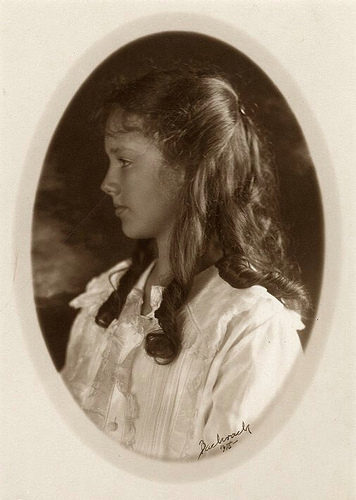
First, the Morrows having been to see the Coolidges before the police strike boarded the train home to New York. On the way they got into a discussion with those in their drawing room about the political future of Governor Coolidge. While Mr. Morrow saw Presidential potential in the man, nearly everyone else simply did not see it. He was “too quiet” lacking the “cordiality and personality” to go anywhere beyond Boston. “No one would like him!” someone announced. Mrs. Morrow writes, “At this point little Anne [their second eldest, age six at the time] broke into the serious discussion. She held up a finger that had a bit of adhesive tape on it over a little cut. ‘I like Mr. Coolidge,’ she said. ‘He was the only one who asked about my sore finger!’ My husband, quite pleased, of course, looked at his friends and said, ‘There’s your answer.’ ”

Anne Morrow, age 12.

Anne Morrow, age 12.

Second, Ernestine Cady Perry had worked for the law office of Coolidge and Hemenway in Northampton for some time. As Mr. Coolidge rose from local to national responsibility, he never forgot who he was or the people he knew and missed back home. Once in the White House, he took the time to send signed photographs to Mrs. Perry’s two little daughters. In fact, they would overhear so many good qualities attributed to kind Mr. Coolidge that one of them, Jane, at age five, took her mother by surprise upon asking, “Would it be better if I had Calvin Coolidge for a daddy instead of my own daddy?” Such a question, asked in the innocence of her age, still carries an insight into the endearing character of Calvin Coolidge and the wholesome regard even the youngest held for him.

Third, Edward K. Hall worked for many years as a vice president of the American Telephone and Telegraph Company in personnel relations. A graduate of Darmouth, Mr. Hall came to be recognized for his superior qualities of leadership in labor disputes. In 1924, his eldest son, Richard, died suddenly after illness struck just a few hours earlier. It was President Coolidge, having just lost his youngest son, Calvin Jr., after only a few short days of sickness, who sent a book with this inscription to comfort the similarly grieving father:

“To Edward K. Hall: In recollection of his son and my son, who had the privilege by the grace of God to be boys through all eternity. Calvin Coolidge.”

Memorial tablet for Richard Neville Hall, the son of Edward K. and Sally D. Hall. It rests in the foyer of Baker Library at Dartmouth College.

Memorial tablet for Dartmouth sophomore Richard Hall, the son of Edward K. and Sally D. Hall.

The President's son, Calvin Jr. (1908-1924)

The President’s son, Calvin Jr. (1908-1924)

It was that same Mr. Coolidge who, upon receiving a small boy Colonel Starling had found waiting to see him outside the White House gates, having come to console him after Calvin Jr.’s death, told Starling, barely able to contain his emotions: “Colonel, whenever a boy wants to see me always bring him in. Never turn one away or make him wait” (Starling of the White House p.224).

Clarence S. Brigham of the American Antiquarian Society noted Coolidge’s love for people, particularly cherishing the innocent goodness of our children. He valued the least among us and took joy in the presence of the happy and appreciated lives of little ones. It was he who once said, “I should not want to think of heaven without children there.” In offering a few final words in memory of his friend, the thirtieth president, Mr. Brigham wrote:

“I think that Mr. Coolidge’s outstanding trait was his kindness and his sympathy. He never forgot a friend and had a surprising habit of remembering trivial happenings, if they concerned those whom he liked and trusted. He had the faculty of inspiring a really fond affection from those with whom he was closely brought into contact. His character was so strongly made up of honesty, fairness, adherence to ideals, and courage, that they stood out above other qualities throughout his whole life. Truly, a man with a soul which looked inwards and tried to interpret the mysteries of life, whose own life was given to serve his fellow men, must live forever in the hearts of the people.”