
Elaborate state funerals, even for former Presidents, have become familiar events to many of us. These afford a formal and dignified occasion to honor the office and the man who once exercised such great responsibility, once at the head of the most powerful nation in the world. The deaths of Presidents Nixon in 1994, Reagan in 2004 and Ford in 2006 remind us of what modern Presidential funerals consist, combining the wishes of the family with the ceremonial observances expected for those who were once Chief Executives. The Air Force One used by President Nixon during his terms of office was deployed to bring the body from New York to California, to rest at the Nixon Library after an elaborate funeral including every Presidents Ford through Clinton, numerous foreign heads of state and other dignitaries. The Capitol Rotunda, on the other hand, has seen the bodies of former Presidents Reagan and Ford lie in state for multiple days preceding formal services at Washington’s National Cathedral attended by countless officials, presented with numerous eulogies and interred from there in their respective homes, the former in California and the latter in Michigan.
These ornate affairs underscore the prestige and glory of the Presidency but they also disclose something more profound about the character and outlook of the person being honored. As Todd W. Van Beck observes, “Death and funerals are mirrors of life styles and life attitudes. The death and funeral of Calvin Coolidge is no exception.” Van Beck elaborates, “For Calvin Coolidge life was being competent, dependable, and devoted. His was a unique life, and in his death and funeral we observe a ritual which reflects Coolidge’s modesty and simplicity. In the funeral of Calvin Coolidge, one sees balance between fame and dignity. ‘Do something, but don’t overdo it,’ is the Coolidge philosophy which is finally and forever played out at his funeral. Calvin Coolidge was a quiet man, and his departure from this life was consistent with the quiet manner in which he lived” (“The Death and Funeral of Calvin Coolidge,” The Real Calvin Coolidge, Plymouth, VT: Coolidge Memorial Foundation, 1988, pp.12ff).
The day after Coolidge’s passing, three very distinct decisions were made clear to a nation ready to express its sympathies to the family of a beloved President:
1. The place of the service would remain close to home. There would be no service in either Washington or Boston, no overdone pomp and ceremony subjecting the family to the national scene once again. To the last, no expensive or ostentatious affair would be charged to the country by Calvin Coolidge, even in death. He would be remembered not in the grand halls of government buildings but in a very personal house of worship, the sanctuary of the Edwards Congregational Church. He had returned to life as a private citizen and it was a wholesome thing that he remain such now in death.

Crowds gathered outside Edwards Congregational Church to remember Calvin Coolidge, January 7, 1933 (Courtesy of the Northampton Historical Society)
2. The timetable of the service would remain short. From beginning to end, the schedule of events was very limited. This is incredible considering the number of dignitaries, including President and Mrs. Hoover, Chief Justice Hughes, Mrs. Eleanor Roosevelt, Vice President Curtis, Cabinet members, Governors, diplomats and many others. The weather and the crowds were also present in abundance that day. The outpouring of support extended out the door, into the streets as hundreds of sympathetic Americans stood in the rain. The crowds were so large that the Northampton police department soon lost control and traffic stood still. Nonetheless, the entire funeral service would be over in twenty minutes. It would not be a drawn-out ordeal but adhered to Coolidge’s brevity and sense of proportion.

Viewing of Calvin Coolidge, Edwards Congregational Church, Northampton, MA, morning of January 7, 1933 (Courtesy of Corbis).
3. The manner of the service would remain simple yet dignified. The body had lain in state but only for a short time on Friday evening and for one hour on Saturday morning, the morning of the funeral. The doors opened for the hundreds gathered to see Mr. Coolidge for the last time would be promptly closed after sixty minutes by 9:30AM. Dressed impeccably as in life, Coolidge’s body had been placed in a solid bronze casket handsomely crafted by the Boston Burial Case Company. At 9:45 the casket was closed and sealed, the floral arrangements surrounding the body put in order and everything prepared for the service which began at 10:40AM. Mrs. Coolidge, John and Florence arrived at a side entrance at 10:25, taking their seats at the front. Throughout, the Coolidges never demonstrated anything but perfect composure and dignified reserve. Delayed slightly by the rain and crowds, the service began with Police Chief Bresnahan leading five of his officers into the building carrying the casket. The men solemnly conveyed the body of their distinguished townsman past the eleven honorary pall bearers standing in two ranks as the casket passed. The eleven were not famous in the conventional sense, but their greatness rested in their humble service to others, another trademark of Coolidge’s character and the quality of his friends. They were: Frank W. Stearns, Boston merchant; William F. Whiting, paper manufacturer of Holyoke; Clifford H. Lyman, Northampton merchant; Walter L. Stevens, Northampton attorney; Ralph W. Hemenway, Coolidge’s long-time law partner; William M. Butler, Coolidge’s 1924 campaign manager; R. B. Hills of Northampton; Homer C. Bliss, Mayor of Northampton; Charles F. Andrews, Treasurer of Amherst College; and Robert H. Trumbull, former Governor of Connecticut. It had been made clear there would be no eulogies. The occasion was not a time to multiply words of extended oratory. The service, directed by Reverend Albert Penner, would be much simpler. It would consist of music, including the hymn “Lead Kindly Light” and “O Love That Wilt Not Let Me Go” sung by the Edwards Quartet, prayers led by Reverend Penner and the reading of Scripture, including Psalms 46, 121, Romans 8, 2 Corinthians 5 and fittingly from Mr. Coolidge’s favorite book, the Gospel of John, chapter 14.
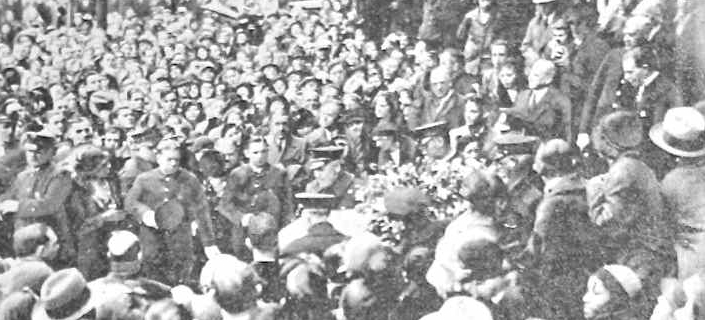
Northampton police try to keep the crowds clear of those bearing the casket outside Edwards Congregational Church, January 7, 1933
The Coolidge family was escorted out and those who had gathered gradually dispersed. After a brief pause at The Beeches, the funeral procession made the three and a half-hour journey to Plymouth Notch for the second and even simpler service at the gravesite. President Hoover wanted to also attend the gravesite service but Mrs. Coolidge persuaded him to return to Washington. By early afternoon the rain had turned to hail with ice and snow already carpeting the ground surrounding where Azro Johnson had dug the final resting place of Calvin Coolidge the day before.
Arriving around 4:30PM, as the last moments of light remained in the day, six U.S. Deputy Marshals carried the casket to the grave, placing it gently on the lowering device. Arrangements were quickly made and a canopy was erected to shield the family and the site from the elements. Another faithful friend of the family met the procession there, Willard D. Cabot, a Woodstock funeral director, who had helped bury not only the President’s father in 1926 but also his son, Calvin Jr., in 1924.

Children standing respectfully beside the grave of Calvin Coolidge, Plymouth Notch. Notice there is not yet a headstone in place.

Visitors to the gravesite, January 8, 1933 (Courtesy of Corbis)

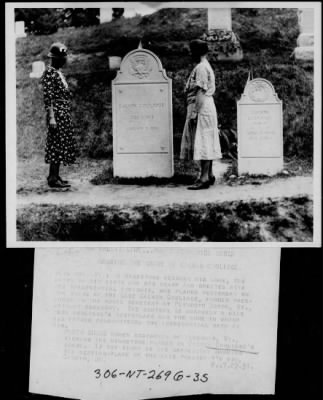
Women of Plymouth beside the newly placed headstone for Coolidge’s grave, July 29, 1933. It is simply marked with the Presidential seal, his name with birth and death dates. Adrian Malloy, who had crafted the stone for their son, Calvin Jr., offered the same service to Mrs. Coolidge in honor of her husband, placing it here for the Coolidge family on July 27, 1933.
Given the sign to begin, Reverend Penner committed Coolidge’s body to burial and then read a Robert Richardson poem selected by Mrs. Coolidge,
“Warm summer sun, Shine kindly here.
“Warm southern wind, Blow softly here.
“Green sod above, Lie Light, lie light.
“Good night dear heart, Good night, good night.”
The Benediction was read and the service concluded. Florence Coolidge stepped forward to place a single red rose on her father-in-law’s casket (Van Beck p.24). It took less than five minutes but the growing number of those in attendance stood in respectful silence for some time. The playing of taps reminded everyone that a Commander-in-Chief was being remembered that day. As everyone departed from that solemn scene, most for the one hundred miles back to Northampton, Willard Cabot, Azro Johnson and a number of Coolidge’s Plymouth neighbors lowered their dear friend’s body into the earth and filled in the place where he would rest. It was a place beside his son and among five generations of his ancestors on the hillsides he loved so deeply.

The Coolidge family headstones stand in a row at the center of the picture, Plymouth cemetery, The Notch. In order from L to R: John and Florence, Grace, Calvin and the smallest stone marks where Calvin Jr. rests. “Here my dead lie pillowed on the loving breast of our everlasting hills” — Calvin Coolidge



 The Importance of the Obvious