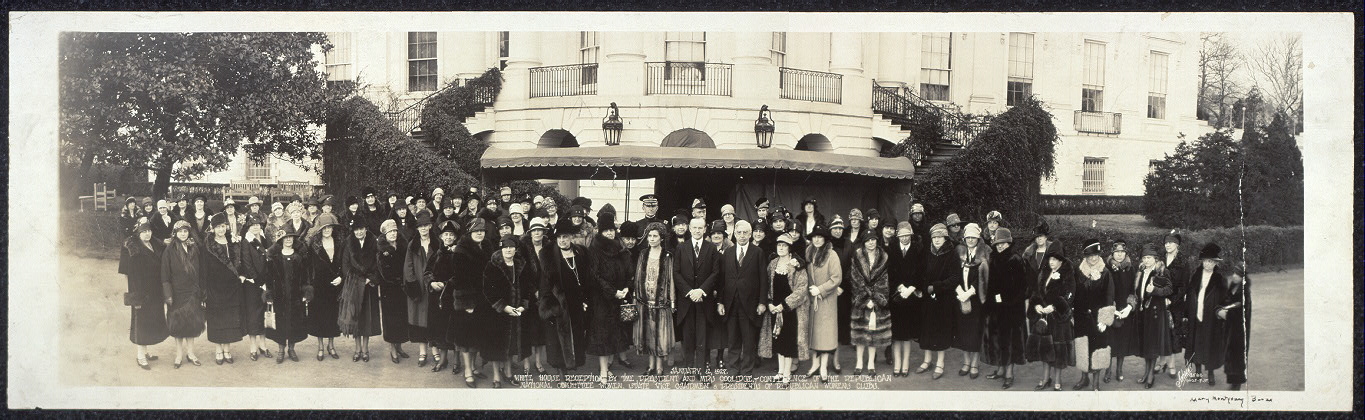
The Conference of the Republican National Committee Women meets with President and Mrs. Coolidge at the White House, a clear endorsement of Coolidge’s leadership, January 12, 1927. Just a small example of the strong Republican woman’s presence in the rough and tumble political world of the 1920s.
Last August the George W. Bush Institute, the Debate Institutes at Dartmouth and the state of Vermont partnered with the Calvin Coolidge Memorial Foundation to launch the first of what we hope are many debates to come over a range of topics. Involving some 100 high school students from 22 states, it brings the young and old together to think anew on economics, grappling with many of the same fundamentals that Calvin Coolidge faced not only in the academic halls of Amherst but in the increasingly globalized market that flourished during his administration. The next one, coming August 1 of this year, is sure to be immensely rewarding for all participants.
Writing to his father on November 13, 1892, he recounted the value of what results from classical education, which included a healthy portion of logical reasoning and debate skills, “President Gates preached to us this morning, his text ‘As a man thinketh, so is he.’ He discussed it from a psychological point of view and urged upon us the importance of keeping our thoughts centered along strong and profitable lines. It was not an exhortation to work harder on our studies but rather to keep before us some great and noble thoughts around which our whole personality might centre not as a narrow specialist but as a broad and liberal cultured man.” Occam’s razor has reduced too many educational institutions down to a restrictive specialization at the expense of inspiring students with the whole picture of existence, an entirely logical worldview grounded in the pursuit of truth.
Calvin described what happened when he took on the best debater at Amherst, in another letter to his father, dated January 14, 1894, “I had a debate yesterday as to whether a Presidential or Parliamentary form of government is the better; I had the Parliamentary side which is not particularly popular in as much as it is really to show England’s government is better than ours, and I spoke against Pratt of Brooklyn who is a very good debater and a general favorite being captain of our football team. But the Parliamentary side won by a large majority when the question was decided.” The encouragement fostered by the debates at Plymouth Notch are contributing mightily to help students and teachers, children and adults alike to apply the mind again to the art and discipline of good debating. Moreover, they are learning to think through the problems Calvin Coolidge encountered and thereby gain a greater appreciation not only for how he approached the problems of his day but also how to apply reasoned solutions for the future.
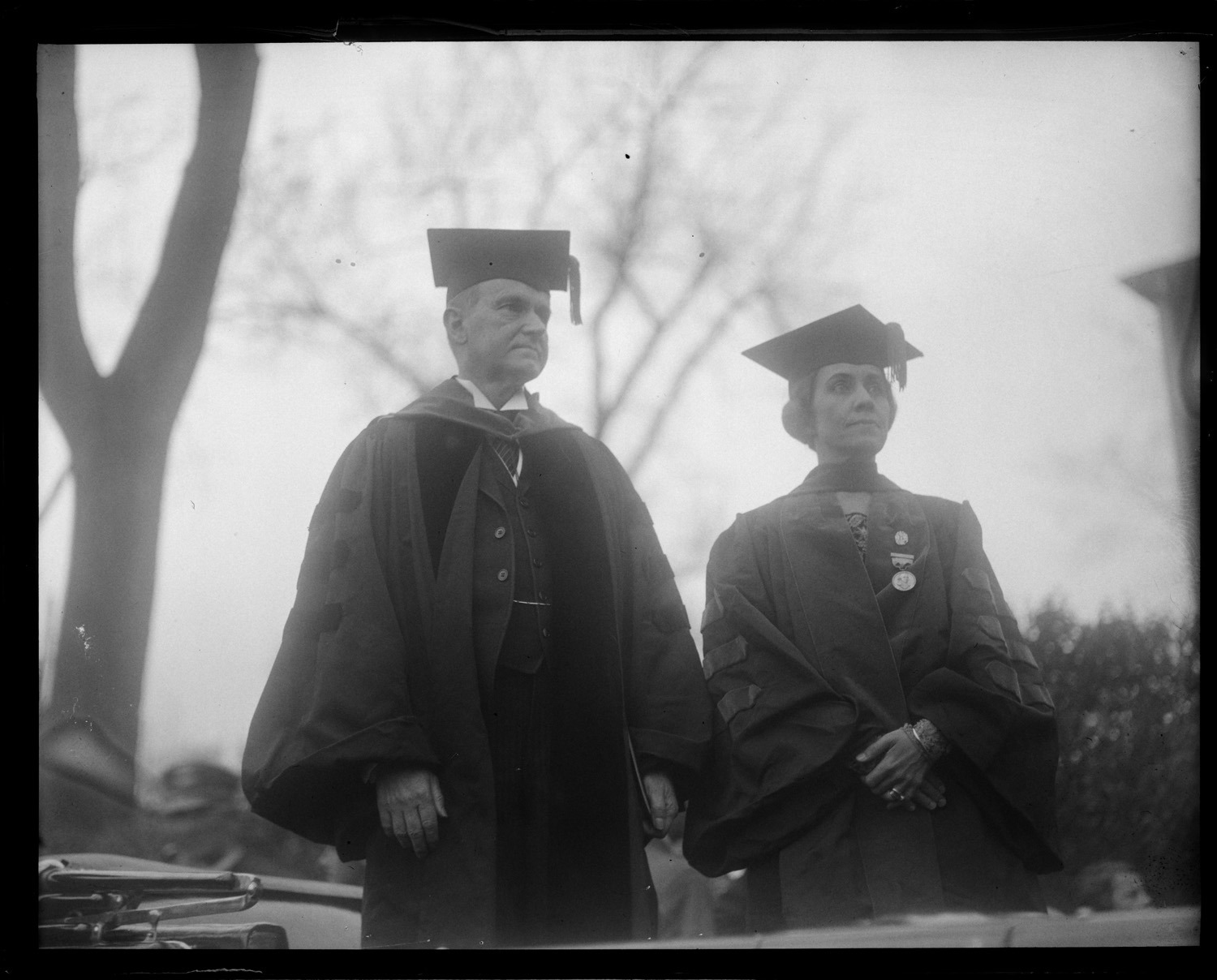
The Coolidges at Andover, May 1928, where Coolidge spoke at commencement before more than 10,000 people, including a class of 650.
Before St. Patrick’s Day comes to a close, it is useful to consider the contributions of one individual, not native to the Emerald Isle but, despite being a Congregationalist Yankee, did much toward welcoming and assimilating Ireland’s immigrants to a place of respect and honor in one of the most Irish-heavy areas of America, the city of Boston. Rather than enhancing racial or religious bigotry by demanding instant results, Coolidge diffused tensions through mutual respect and patient education. Treating the Irish no differently than anyone else who came here to work hard, live honestly and become citizens, he taught what being American is all about, free of hyphens, committed to liberty, grounded in Christian forbearance and confident enough to hold faith in our founding ideals. In this way, he did more to establish the Irish (and immigrants of all countries) as full-fledged Americans than most recognize. Coolidge would experience an unbroken series of political victories as a result, thanks in part to these “Coolidge Democrats” who understood that for immigration to benefit everyone, the responsibilities of citizenship must be taken just as soberly as its rewards. Character came first and it was that very insistence on standards, despite the career risks for Coolidge personally, that prevailed at the ballot box. Coolidge did not need a herd of consultants to validate the Golden Rule for him. As he would observe later in life: The person who is right makes his own luck. Cal points the way toward the Founder’s vision for an assimilated, prosperous and peaceful people preserved through an incremental, not immediate, process; a pathway to citizenship earned by obedience, not bestowed by political calculation for electoral advantage.
“A rarer specimen than Davis’ recent great discovery, Honesty” by “Ding” Darling, The Des Moines Register 8-31-1924


 The Importance of the Obvious