“I suppose I am booked for exhibition…”

calvin-coolidge dollar

“You’re the top…You’re a Coolidge dollar!” — Cole Porter, lyrics from You’re The Top, referring to the “Coolidge Prosperity” of the 1920’s (Anything Goes, 1934)

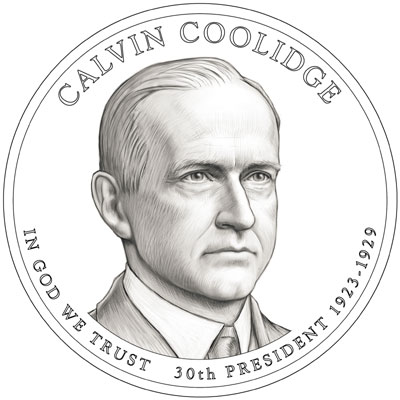
As the four new arrivals in the “Presidential $1 Coin Program” this year include Calvin Coolidge, coming in April, it is fitting to look back on a much older, even more distinguished coin from 1926. The coin is, of course, the Sesquicentennial half-dollar commissioned by Congress at the request of the National Sesquicentennial Exhibition Association and struck for special distribution at the Exposition in Philadelphia between June 1 and November 30, 1926, marking the one hundred and fiftieth anniversary of the Declaration of Independence.

It is unique as the first and only coin to be struck on which appears a President not only within his lifetime but also during his term of office. It is extraordinary that Calvin Coolidge was accorded this singular honor, a level of recognition not bestowed on any other President and only three other living individuals. It is unfortunate that the Association insisted on a technique, though popular with numismatists at the time, produced too shallow a relief in the striking that even a mint condition half-dollar looks worn and poorly produced. If only the Association had required a sharper relief of John Frederic Lewis’ striking design. While the Chief Engraver of the Mint, John R. Sinnock, whose designs were turned down, should not have taken credit for the final result, it is also unfortunate that the coin was so under-promoted and poorly struck that it did not sell better than it did — only 140,592 coins selling out of 1,000,528 (the rest going back to the Mint to be melted down for other uses). Unfortunately, Sinnock would incorporate Lewis’ style in the better known Roosevelt dime (1946) and Franklin half-dollar (1948), likewise without proper credit.

Asked about the upcoming Exposition in Philadelphia during one of his press conferences in December 1925, knowing that both he and the coin would be present at so historic an occasion, Coolidge responded with that characteristic twinkle in his eye: “There isn’t anything very definite that I can say about the Sesquicentennial Exposition at Philadelphia. I suppose I am booked for exhibition and that will probably be on the 4th of July” (The Talkative President p.13). His speech marking the anniversary of the Declaration is still one of the most quoted, most eloquent, most insightful and among the greatest speeches ever given by an American President. He would be an exhibit at the Exposition…or did he mean, he would exposit at the exhibits?
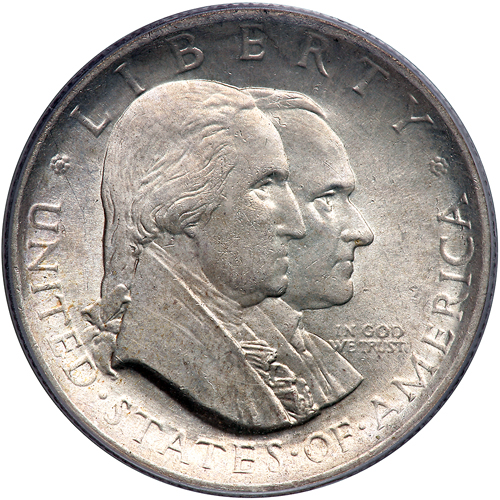
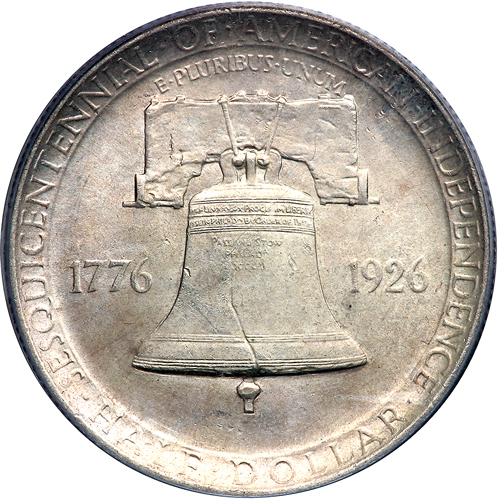
Sesquicentennial Half DollarReverse Susquicentennial Half Dollar

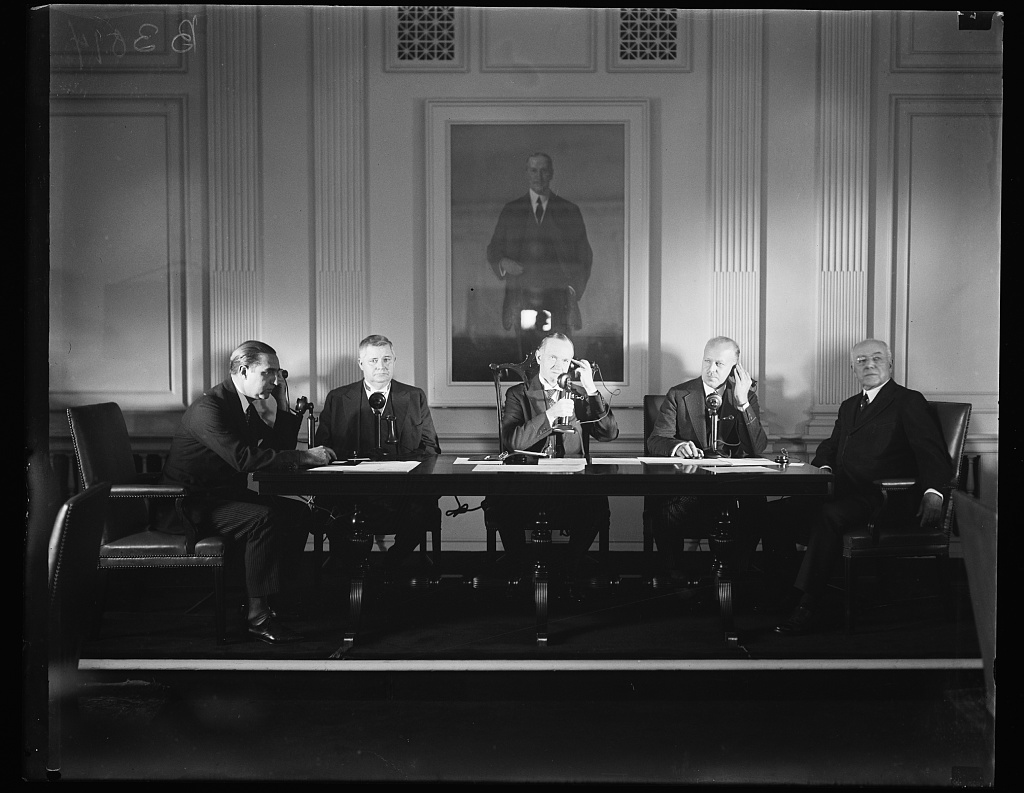
First Presidential Transatlantic Conversation, October 13, 1928

Pictured here in the Chamber of Commerce Building in Washington, D.C., from L to R: Don Mariano de Amoede y Galaremendi (Spanish Embassy, Washington); Under Secretary of State J. Reuben Clark; President Coolidge, speaking to King Alfonso; Walter S. Gifford, president of AT & T; and Joseph H. De Frees, chairman of the board, U.S. Chamber of Commerce. The man in the portrait above them is businessman Harry A. Wheeler, the first chairman of the U.S. Chamber of Commerce.

Pictured here in the Chamber of Commerce Building in Washington, D.C., from L to R: Don Mariano de Amoede y Galaremendi (Spanish Embassy, Washington); Under Secretary of State J. Reuben Clark; President Coolidge, speaking to King Alfonso; Walter S. Gifford, president of AT & T; and Joseph H. De Frees, chairman of the board, U.S. Chamber of Commerce. The man in the portrait above them is businessman Harry A. Wheeler, the first chairman of the Chamber. Thanks go out to Mr. Jerry Wallace and everyone who, through tenacious detective work, identified all the details behind this photograph.

The occasion this photograph captures marked two historic firsts: It was the first time a President personally used a transatlantic telephone and it was the first telephone conversation held between a President and one of Europe’s leaders. While the very first transatlantic service was achieved on January 7, 1927 between New York and London, the nation of Spain is here linking up with America via telephone technology, joining France, Germany, Sweden, Holland and Belgium in the ability to connect over a circuit of 6,500 miles inside of one-fifth of a second. The conversation between President Coolidge and King Alfonso XIII was flawlessly crisp, heard clearly on both sides of the Ocean and was noted as the best talk thus far experienced with such a device over so long a distance. President Coolidge had spoken to the leaders of Mexico, Canada and Cuba in past months but it was this conversation that made history.

After exchanging greetings, President Coolidge elaborated on the exceptional potential of the telephone and what it meant for future. Coolidge, speaking to the King, observed, “I welcome this added link, no less strong because it is invisible, between Spain and the United States. I believe it to be true that when two men can talk together the danger of any serious disagreement is immeasurably lessened and that what is true of individuals is true of nations. The international telephone, therefore, which carries the warmth and the friendliness of the human voice, will always correct what might be misinterpreted in the written word.

“Whatever brings our two countries closer is of value to us and to the world. This Western Hemisphere, discovered by the wonderful navigators of Spain, has always owed much to your country. The language of Spain is the language of a great part of the Americas. The fine traditions of Spain are the basis of the culture of a large part of the Americas and our friendship with the great nations in the South draws us closer to their mother country. With your country and with theirs the United States stands for the promotion of world understanding and peace…I am especially glad thus orally to greet your Majesty, because I know the position of great personal responsibility you hold in directing the policies and progress of your country. I wish for your Majesty a long and happy life and for your country all the prosperity and happiness which come from wise and benevolent leadership in all those things which make life richer and finer.”

King Alfonso XIII of Spain, painted by Philip Alexius de Laszlo in 1927. De Laszlo also painted a portrait of Coolidge (1926).

King Alfonso XIII of Spain, painted by Philip Alexius de Laszlo in 1927. De Laszlo also painted a portrait of Coolidge (1926).

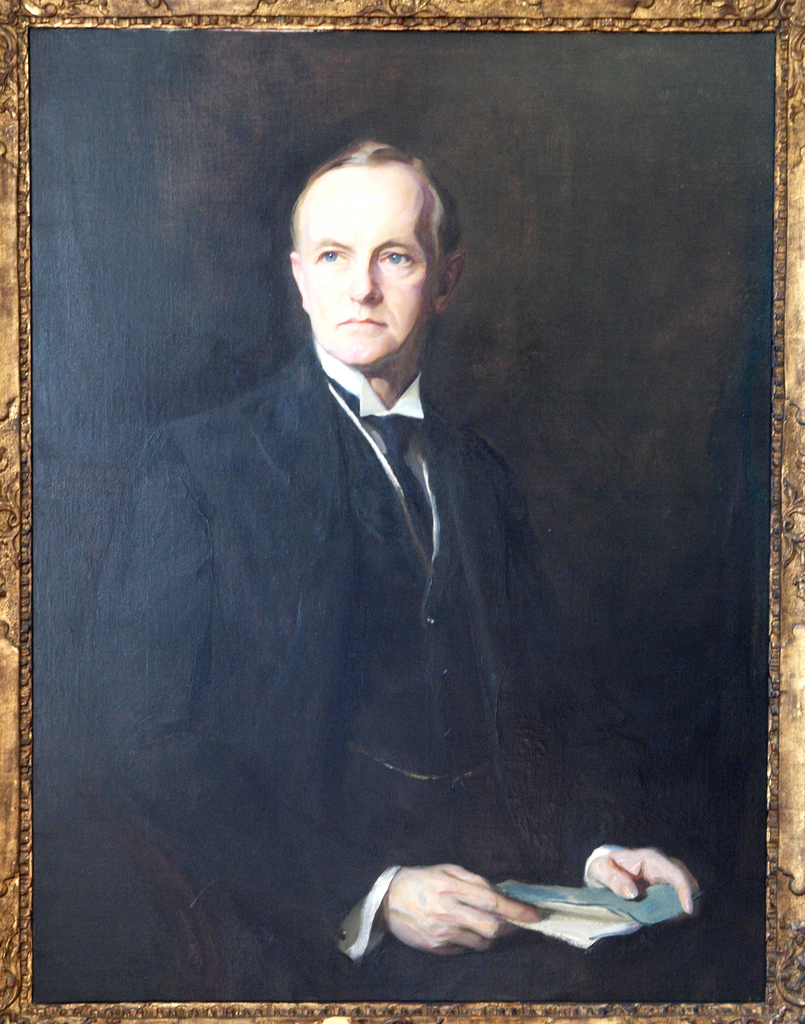
The portrait of Coolidge painted by Hungarian artist Philip de Laszlo, two years before the telephone conversation with King Alfonso.

The portrait of Coolidge painted by Hungarian artist Philip de Laszlo, two years before the telephone conversation with King Alfonso.

To that, King Alfonso replied, “Mr. President, I thank you for the cordial words in which you do Spain the honor and justice to recognize her outstanding services to the Americas and I agree that we ought to expect from this new means of communication ever closer relations because of the intimate and more perfect understanding between the two peoples.

“I reiterate to your Excellency, with my salutations, the testimony of my most sincere appreciation and extend best wishes for the peace and prosperity of the United States.”

On September 21, 1976

Ronald_Reagan_image

While today marks the 103rd anniversary of Ronald W. Reagan’s birth, he would appreciate the focus not upon him but the reappraisal that is underway of an exceptional, yet far underrated, predecessor. A thoughtful admirer of Calvin Coolidge, President Reagan proved that “Silent Cal’s” economic model is anything but outmoded or theoretical: universal tax cuts spur growth and expand opportunity for everyone. The accomplishments of the 1980s, while by no means complete or consistent with Coolidge’s full record, demonstrated that moving back toward individual liberty and away from a massive government bureaucracy still works. It accomplishes genuine results, establishes peaceful progress and preserves opportunity to move forward and upward as free individuals. “Big Government” can only promise material goods without substantive delivery, disrupt social advances and destroy individual potential. Coolidge’s example — slashing tax rates four times combined with drastic annual reductions in Federal spending while paying down the national debt, $5 billion paid during his tenure alone — will work anywhere, anyplace, anytime. It only requires the will and courage to translate those principles into policy. The current administration, hostile to these proven precepts, continues to pull America further from its roots, the fertile soil of bold and disciplined leaders like Coolidge.

Heading into the election of 1976, as the nation stood poised to elect Jimmy Carter, Ronald Reagan (four years before the Presidency) took the occasion of his radio broadcast to deliver one of the most cogent expositions of why Coolidge still matters. His words, spoken almost forty years ago, ring truer now than they did at the time,

“The names of some Presidents are invoked by spokesmen of both political parties as ‘men for all seasons,’ epitomizing the greatness of America, Washington, Lincoln, Jefferson etc. Then there are Presidents whose names are brought in party circles, hailed as great but, if acknowledged by the other party at all with NOT quite the same enthusiasm.

“There are also two lists of Presidential names – one for each party, usually held up to view for strictly partisan purposes. Each party lists past Presidents of the opposing party as examples of that party’s terrible record.

“The Democrats for example get laughs by mentioning Silent Cal Coolidge. And truth is many Republicans chuckle a little and go along with the idea that he was a do nothing President. Sometimes I wonder if he really was a ‘do nothing’ or was he a little like a Life Guard on the beach who also seems to be doing very little when there is no emergency. If you take a closer look he is quietly being watchful.

“Cal Coolidge is good for laughs but not all of them are at his expense. There was the press conference where a persistent reporter asked the President if he had anything to say about prohibition? Cal said ‘No.’ ‘Any comments on the world court?’ – ‘No.’ – “What about the farm situation?” Again the answer was ‘no.’ The reporter said, ‘You don’t seem to have any comment about anything.’ Coolidge said, ‘No comment & don’t quote me.’

“Probably no President has ever lived in the White House and maintained so unchanged his previous life style. Which in Coolidge’s case was the simple, even frugal life he had lived on a New England farm.

“Shortly after he became President he sent his teenage son into the tobacco fields to work in the summer as he always had. One of the other workers surprised at this said to the young Coolidge, ‘if my father were President I wouldn’t be out here working in the field.’ Young Coolidge said, ‘If my father were your father, you would.’

“But while ‘Silent Cal’ seemed to be doing nothing as President, the federal budget actually went down and so did the national debt. Consumer prices fell but unemployment stayed at the figure we only dream of – 3.5 % which means everyone who wanted a job had one. Federal taxes were cut four times.

“The number of automobiles on our streets and highways tripled during his years in the White House and radio sales went up 1400%.

“In just the 5 years from 1922 to 27 the purchasing power of wages rose 10%. It was a kind of ‘Golden Era,’ in other ways. Hollywood would never again be more glamorous and there were giants in the sports arenas whose names are still legend – the Manassas Mauler, Jack Dempsey, Knute Rockne, The 4 Horsemen, Red Grange, Babe Ruth and Big Bill Tilden. No I’m not saying President Coolidge was responsible for them but they were larger than life figures that went with America’s place in the world.

“So what if he was a ‘do nothing” President. Do you suppose doing nothing had something to do with reducing the budget, redu’ing the debt, and cutting taxes 4 times?

“This is Ronald Reagan. Thanks for listening.”

Taken from Reagan’s Path to Victory:The Shaping of Ronald Reagan’s Vision: Selected Writings (pp.72-74).

Portrait of Coolidge with Rob Roy by DeWitt M. Lockman, 1931. Commissioned for the New York Historical Society.

Portrait of Coolidge with Rob Roy by DeWitt M. Lockman, 1931. Commissioned for the New York Historical Society.