On Democrat Party Promises

c-coolidge

A Massachusetts newspaperman, a Republican, once recounted this boyhood memory for then-Governor Coolidge, during one of their conversations on Beacon Hill:

“When I was a boy in Springfield, another youngster met me on the street one day and asked me whether I was a Republican or a Democrat. I said I didn’t know and asked what difference it made. ‘Well,’ said the other boy, ‘if you are a Democrat you can march in our torchlight parade and come up to my father’s flag-raising and have some ice cream.’ I replied, ‘All right, I’m a Democrat.’ So you see,” the chagrined newspaper told Governor Coolidge, “I sold my first vote to the Democratic Party for a dish of ice cream.”

“Well,” Coolidge shrewdly replied, “you got more than some of the Democrats get” (Whiting, President Coolidge: A Contemporary Estimate, p.60).

Democrats making grand promises, benefiting a select few at the top, is not new; neither is buying support with those promises. Aptly did Joseph P. Kennedy, Sr., JFK’s father, warn against what he coined “Santa Claus” government where the individual is held in “slavish dependence” to the state (Stoll, JFK, Conservative, p.10). The glue of that dependence is, as Coolidge underscores, the long history of unquestioned yet unfulfillable assurances made by Democrats. The problem this time is not that another Democrat has been caught making impossible guarantees to buy or keep votes. The problem now is that a President knowingly repeated a criminally fraudulent claim on which millions relied — a promise essential to the passage of a law that has destroyed the economy, taken over the health care industry, led directly to the cancellations of millions of people’s plans, driven up costs for everyone, forced competent doctors from the field, obligated not just 5% of the population but the entire country with trillions of dollars in generational debt, and secured his re-election thereby so that the controls assumed because of his promise can be cemented permanently into American life. After all, no government program ever goes away, regardless of the depth of its failure.

It illustrates that some habits never change. Democrats appealed to the lowest desires even then. We all want ice cream but are we prepared to pay what it is already costing each of us in the freedom to choose, the say over our own government, our morality, human dignity, and the realization of each person’s fullest potential, when left unshackled by government “help”?
“No…I won’t take it as a gift”

It was during Coolidge’s first term as president of the Massachusetts Senate that he clashed with Governor David Walsh, a Democrat, over a particular bill awaiting the governor’s signature. Heading over to the governor’s office, Coolidge discovered that the bill had not yet been signed. The governor’s secretary then instructed, “Come around tomorrow, senator, and I will give you the pen which he uses in its veto.” Just as quickly, Senator Coolidge shot back, “No, Mr. Secretary, I won’t take it as a gift, but I will swap it for the pen which I use to sign the bill passed over his veto.” With that, Coolidge turned and walked out. Governor Walsh knew that, with Coolidge, an override was no empty boast. The bill was signed.

Civility, for Coolidge, did not preclude his firm resolve to confront the “other side,” forcing Democrats to explain their positions to voters. When Coolidge faced opposition, the solution was not to surrender the field to appear open-minded or magnanimous but rather to demonstrate the strength of his position with logic, confidence and a strong measure of wit. He never arrived at a position hastily considered. As such, he expected those around him to exercise the same thorough certainty. He cared nothing for electoral costs from the positions he took. He took them because, having thought them through, knew they were right. If he lost, he could return home, preserving integrity whatever the result might be.

He was not a man to see “moral victory” in Republican losses either. The belief in our system, limited government, low taxes and freedom under law deserved full support, no less by those who wear the name, “Republican.” The name stood for specific principles. The name entailed worthy ideas to be defended and explained not discarded and apologized for every election cycle. It was never a virtuous or wise thing to teach others a lesson by deliberately withholding support for these principles or the candidates who espoused them in order to protect a convoluted, purist view of Party pecking order. Coolidge knew that a courageous and truthful articulation of sound principles deserves and keeps the public trust. Anything short of empowering informed voters with a full realization of the policies and leadership they are going to get in their candidate, the campaign is a failure. To cater to, as individuals or as political parties, the disingenuous, fraudulent or pandering politician is not civility, it is a repudiation of sound government and a betrayal of faithful service to the people.

Image

“I shall, if they get excited”

ImageA mistaken impression can sometimes be left by historians regarding Coolidge’s attitude on civility. Some seem to think that civility is incompatible with any form of political confrontation, even employing Coolidge as the symbol of a civil discourse and non-controversial comportment. Coolidge possessed very unpopular convictions at times and made controversial stands throughout his life. His refusal to allow Boston strike leaders to return to the police force is one such example. Coolidge’s overhaul of his state’s administrative agencies, reforming 120 into 19 departments was another potential political powder keg he embraced. His adept use of the veto and appointment powers furnish more controversial examples. Instead, the “need for civility” plea, principally coming from the establishments of both parties, being the biggest violators of the rule, tend to use it in order to convince conservatives they need to sit down and quietly consent to whatever happens, for the good of the country and the Party.

It is as if Coolidge never tolerated heated exchanges or passionate debate between opposing sides. In reality, he did more than that, knowing such controversy did not warrant wringing hands over the Republic’s future from the “tone” of partisan bickering. The parties were supposed to be partisan. As he once wrote, someone has to be partisan or else no one can be independent. Partisanship itself was not inherently detrimental because it was through the party system that public policy is discussed and upon which the welfare of everyone is deliberated. Partisanship could be abused, as with anything else, but it was not intrinsically one of the “deadly sins.” Sound conclusions emerge when opposing political principles are free to clash in public discussion. When government becomes too bipartisan, collaborating with unchallenged conformity, the checks and balances of our system are allowed to erode, crowding out both the well-being of all Americans and their freedom to govern themselves.

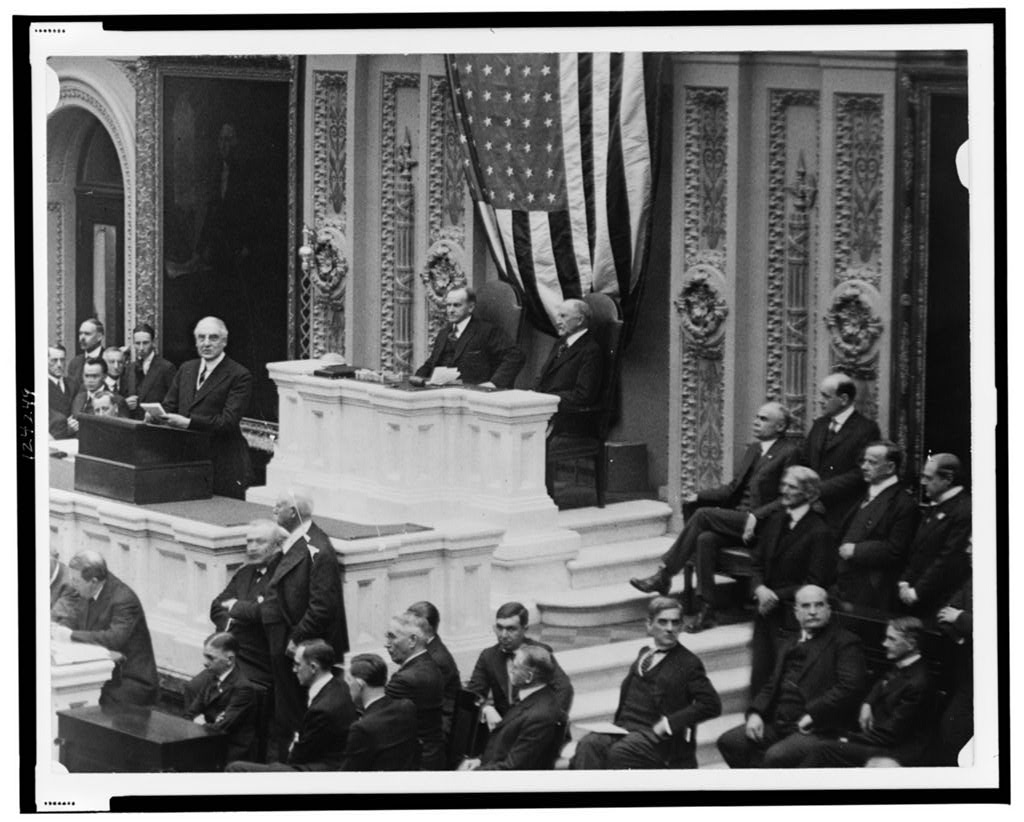
For Vice President Coolidge, during the summer of 1921, in his first few months as presiding officer of the Senate, an intense back-and-forth between Missouri Democrat James Reed and North Dakota Republican Porter McCumber unfolded before his eyes. As the political exchange turned into blunter rhetoric, accusing the other of being a “liar” and inviting his adversary to “step outside,” the visitors up in the gallery and other Senators chimed in.

Coolidge sat unfazed, calmly and collectedly, as the “coolest” tempered man in the room. Despite the growing din in the hall accompanied by the urgings of a fellow Republican to call everyone to order, Coolidge knew a use of the gavel was unnecessary. It was not detrimental to halt this “teachable moment” on the differences between party principles or to shut down the emotional banter. Both served a purpose in our system. Undiluted civility was strong enough to withstand partisan rhetoric. It could do so as long as an honest press remained free and the people were informed with the truth. It was at this moment that Coolidge gave expression to his legendary dry wit. The Vice President turned to the Republican and remarked, with the straightest of faces, “I shall, if they get excited.”

Image