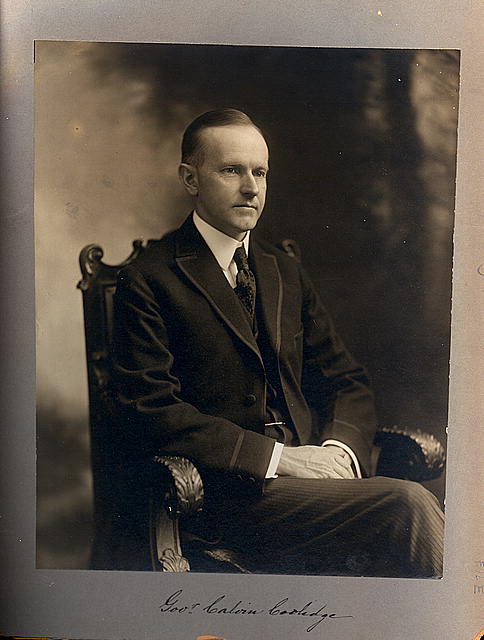
Governor Calvin Coolidge

Governor Calvin Coolidge

John Derbyshire, speaking as the character Chai, writes of Coolidge, “Closer study revealed some harmonics. Humor, certainly. Something in the turn of the mouth…something impish, irreverent, boyish. Yet a steadiness in the eyes–a certitude weightier than mere smugness. Beneath the clerkishness, great strength and wisdom. I trusted this man at once, and wanted to know him better” (‘Seeing Calvin Coolidge in a Dream,’ p.23).

The trust he earned went deeper than his office, it went to the soundness of his character, the power of his philosophy, the confidence without arrogance that he conveyed and the consistency of his actions.

This is what makes him so threatening to those who reject the finality of what the Founders discovered regarding human nature and society. In place of truths like equality before God and a government of limited power, there has come an institutionalized inequality maintained through a virtually unlimited control by a few. America’s experiment of self-government, with its moral nature cut away, is fast becoming the playground of despots and libertines.

It is up to us, serious-minded and mature citizens, to summon the courage and responsibility necessary to be worthy of freedom.

On Good Business

Mr. Coolidge recognized the essence of good business was in strengthening ties of service and collaboration with others. He never saw the validity of an adversarial system, such as Bentham and the socialist economists espoused. Profit was important, of course, but not the supreme purpose of good business relations. He understood that business was about more than “crushing the competition.” It was about building bridges, not burning them. That is why he demanded a meeting with an apprehensive editor one afternoon. The editor had not published the entire number of articles agreed upon and written by the former President. Still, Mr. Coolidge had been paid for the entire set. The editor, bracing for confrontation, was shocked to find the former president wanted to meet in order to return the balance of the money due for the articles not published. To Coolidge, if they were not “good enough” to warrant publication, it would not be right to take money for them. In this way, good business is preserved.

The former President, writing another article on June 17, 1931, observed the necessity for “good business” to continue, especially as folks struggled to keep commerce going,

“It is a very sound business principle to let the other fellow make a profit. That was the essence of the slogan we heard a few years ago about passing prosperity around. The same thought is involved in paying good wages and fair prices. Cutting prices calls for cutting wages in the end.

“This is often the basis of the complaint against large concerns. When they control a large percentage of production they control the prices of the raw and unfinished materials used in that trade. They become almost the sole market for them. Under this condition there is a strong tendency in the name of efficiency and good management to squeeze out the small concerns furnishing these materials. But it is not usually good business.

“We are all so much a part of a common system of life that the business world is not healthy unless we all have a chance. A profit made by squeezing some one else out of a livelihood will almost surely turn up later as a loss. The great asset in trade is good will. The best producer of good will is the profit which others make” (emphasis added).

On Teachers and Teaching

“It is rising above a calling, above a profession, into the realm of art. It must be dignified by technical training, ennobled by character, and sanctified by faith. It is not too much to say that the need of civilization is the need of teachers. The contribution which they make to human welfare is beyond estimation…The earnest conscientious men and women, running from the head of the great university down to the kindergarten, represent a force for good which is immeasurable. The influence which they create for better things, the inspiration which they give for higher ideals, are the chief contributing force to the stability of society and the march of progress. They point the way the dawn, they lead toward the morning, toward light, toward truth” — Calvin Coolidge, speaking before the County Teachers’ Institute and School Directors’ Convention, Reynoldsville, Pennsylvania, December 21, 1922.

When, however, teaching descends to mere self-service that rewards mediocrity, tenures incompetence and protects immoral character, it has violated the sanctity of this charge. When a system of education debases moral conduct, condones failure and punishes the individual for practicing standards that do not comport with the lowest member of the collective, it makes a mockery of education’s purpose. When the goal is not to pursue truth but to deny it exists with requirements that praise misspelling and reward wrong answers for their good intentions, education is sending its students wholesale to slaughter.

The ideals Coolidge reminds us of are necessary if society is to progress with the principles that equip it for what the future holds. Many should not be teaching at all because they do not have the moral character it deserves. Morals, relegated for far too long as the antiquated trappings of religious fanatics, are the basis that makes life whole, nourishes the soul, and prepares the mind for all the challenges of life. When classical education is abandoned, virtue is but the first of many standards to be jettisoned. When that happens, when education consists of teacher’s tenure and multimillion dollar facilities, instead of on the souls and minds of people, it is not surprising that shootings, sexual crimes and assembly-line indoctrination become the norm.